- Best for
- Renter-safe, move-friendly living-room refresh
- Cost
- Under $400
- Difficulty
- Weekend-friendly
- Time
- 2–4 hours
Why this terracotta-and-cream sofa seating corner is the move-friendly look of 2026
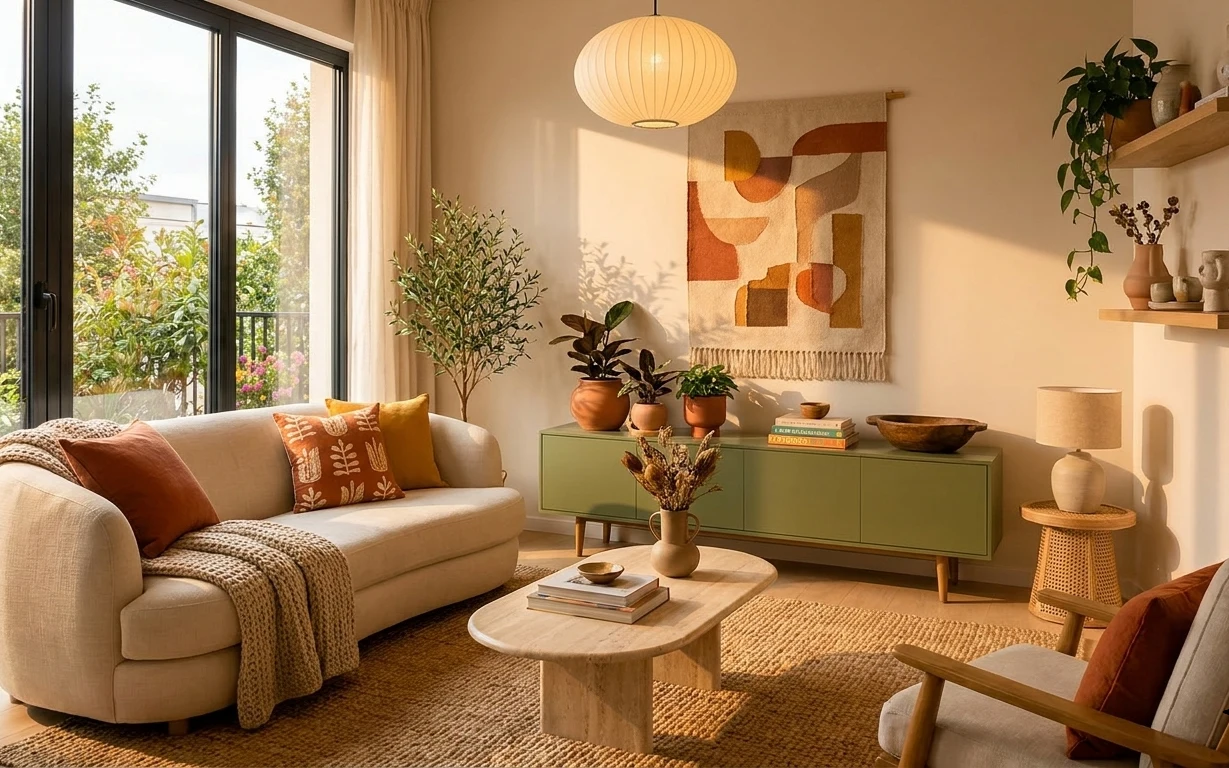
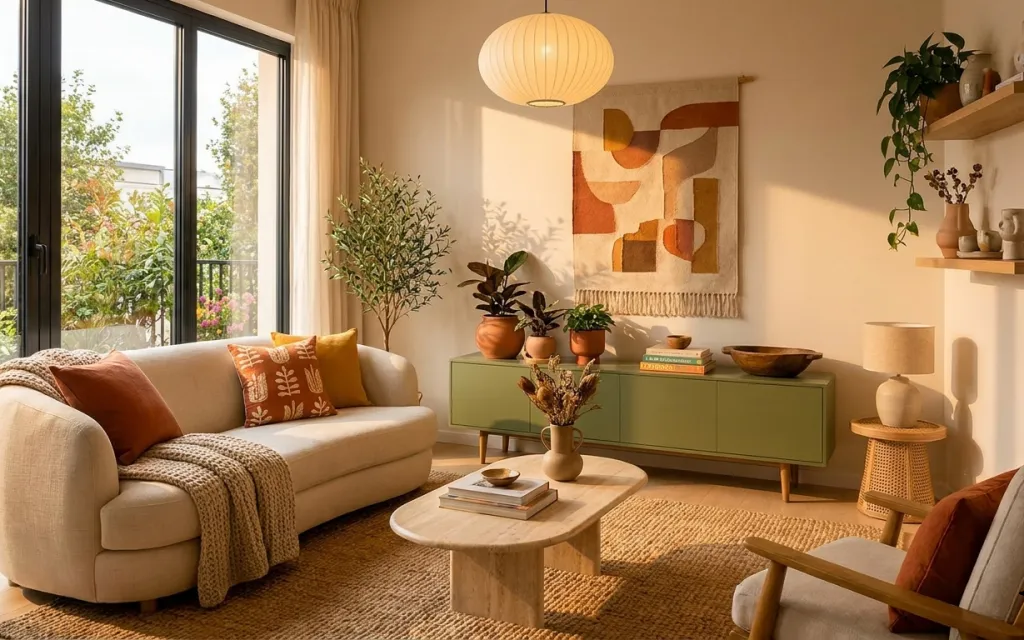
This photo reads like a boho editorial spread, but it’s built from practical textures: a large woven-style rug underfoot, a chunky knit throw folded over a sofa arm, and layered pillow fabrics in cream and rust. The framed abstract wall hanging brings the warm color story up to eye level, while the console styling uses ceramics and books to look intentional without adding bulky furniture. For shared housing folks, this kind of “soft-first” approach is achievable because nothing requires drilling or permanent changes—everything is removable and fits in boxes.
My own mistake the first time I tried this vibe was overbuying decor objects instead of committing to textiles. I grabbed random small things, and the room still looked flat. What changed my mind was starting with the big anchor (the rug), then adding one warm pillow and one grounded knit throw. That’s the order that makes it look styled instead of scattered.
Layer 1 — large area rug ($200) jute-style texture that hides everyday mess
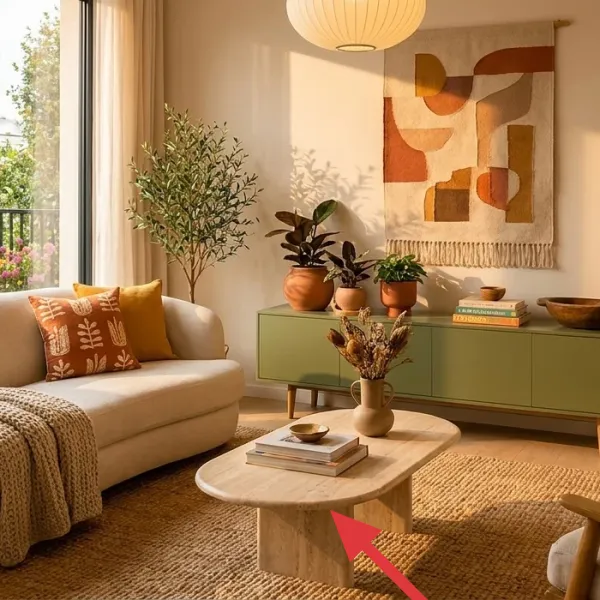
This large area rug is the foundation for the whole earthy palette. In the photo it reads warm, natural, and slightly textured, which does two jobs at once: it softens the hard lines of the wood coffee table and it makes the cream sofa look richer instead of washed out. If you’re choosing an alternative, I’d rather you go for a rug with visible weave than a perfectly smooth “barely-there” neutral. Trade-off: you’ll want a rug pad or you’ll feel shifting underfoot, but the payoff is that stains and scuffs don’t show as fast.
Layering for comfort (and less slipping)
If your rug moves on the floor, add a rug pad so the texture stays crisp-looking even after daily living.
Layer 2 — knit throw blanket on sofa ($45) chunky drape for instant depth
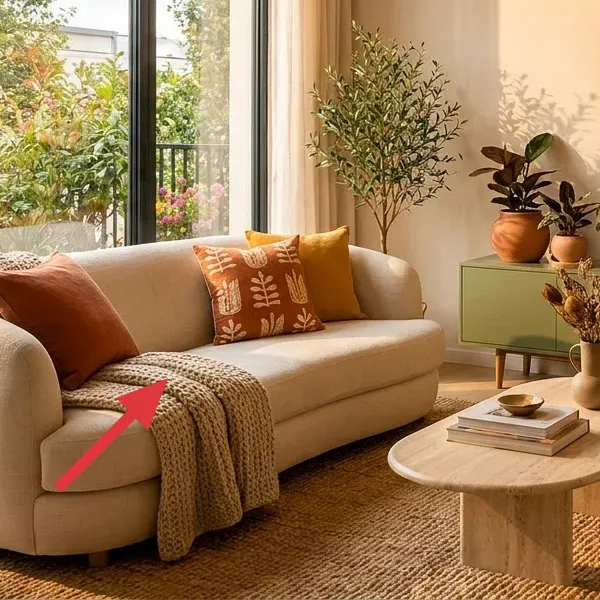
The knit throw is doing the “depth” work in this corner. It’s casual enough to feel lived-in, but its thickness gives you real contrast against the smooth upholstery and the flat coffee table top. The best part for renters and shared housing is that you can fold it into a compact rectangle and it won’t take up much space when you move. Go for a cotton or cotton-blend knit in cream or oatmeal tones so it echoes the rug and curtain, not the terracotta accents. Trade-off: chunky knits can catch pet hair, so keep a lint roller nearby.
Why knit looks warmer than a thin blanket
Thicker texture catches daylight differently, which is why cream looks richer beside terracotta.
Layer 3 — orange throw pillow ($20) dyed terracotta tone that reads warm in daylight
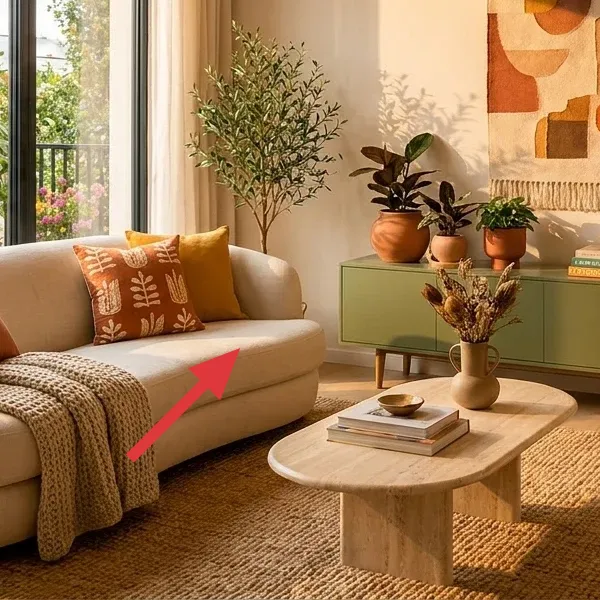
This orange pillow cover is the color hinge of the whole room. It’s saturated enough to pull the terracotta notes forward, but it still sits comfortably in an earthy-neutral palette because the undertone is warm, not neon. Since it’s just a pillow cover, it’s also the easiest layer to pack and swap later—take the cover off, toss it in a suitcase, and you’re done. If you can only buy one “color” piece, make it this one. Trade-off: brighter colors can show wear sooner than creams, so plan for at least one refresh later in the lease cycle.
Make it instead of buying it
DIY a dyed terracotta pillow cover so you can match the warm orange note without committing to a full new pillow set.
Materials
- White pillow cover (cotton/linen blend) — 1 cover — fabric-dye starter kit — $12
- Salt (for dye bath) — 1 box — grocery/market — $4
- Large bucket or plastic tub — 1 — thrift store or what you have — $0
- Gloves — 1 pair — pharmacy — $3
- Plastic wrap or grocery bags — a few — pantry — $0
- Paper towels + dish soap — as needed — pantry — $1
Steps
- Pre-wash the white cover so dye takes evenly (skip fabric softener).
- Prepare your dye bath in a bucket using the kit instructions and stir until fully dissolved.
- Wet the cover, then submerge and stir continuously for even color.
- Keep checking the shade every few minutes until you hit terracotta-orange.
- Rinse in cool water until runoff clears, then wash separately on gentle.
- Dry flat or low-heat, and insert the cover back into your pillow.
Don’t dye polyester unless your dye says it’s for it
If your cover isn’t dye-friendly, the color can come out patchy—check the fabric label first.
Layer 4 — patterned throw pillow ($18) warm neutral motif that ties the rug to the couch
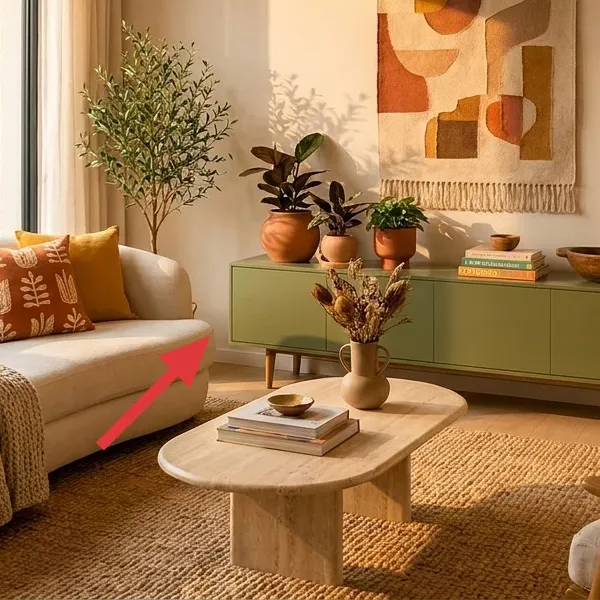
The patterned pillow adds movement without adding more color chaos. In the photo, the print stays in warm earth tones that echo the rug and the terracotta pillow, so you get contrast from texture and pattern—not from extra unrelated colors. This is a smart choice for shared housing because a pillow is basically pure portability: it comes with you, and it doesn’t require any hardware. If you’re tempted to swap both pillows for matching solids, don’t—pattern is what stops the sofa from looking like a single block of cream. Trade-off: pick a pattern with a similar value range (light vs dark) so it doesn’t fight the knit throw.
Pick patterns with the same “lightness” as your knit
If the pillow pattern is too dark, it can make the whole corner feel heavier than the room needs.
Layer 5 — framed abstract wall hanging ($70) removable art that brings warmth to eye level
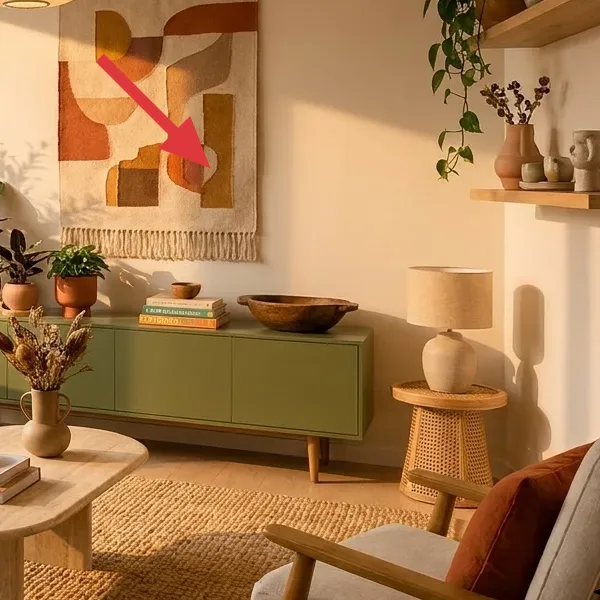
This framed abstract wall hanging is the visual anchor that makes the corner feel finished. It’s large enough to read from across the room, and the warm shapes pull your terracotta and rust notes into the space even when you’re only sitting on the sofa. For shared housing, framed art works because it can typically hang with a Command hook system (no drilling) and it packs flat if needed. Choose a frame that’s easy to remove and keep the print size consistent with the wall scale in your photo—too small looks lost. Trade-off: you have to level it carefully so it doesn’t skew the composition.
Short wall rule
Center it at roughly eye level when seated; that’s how it feels intentional rather than decorative.
Layer 6 — books stacked on the green console ($25) color breaks that make styling look lived-in
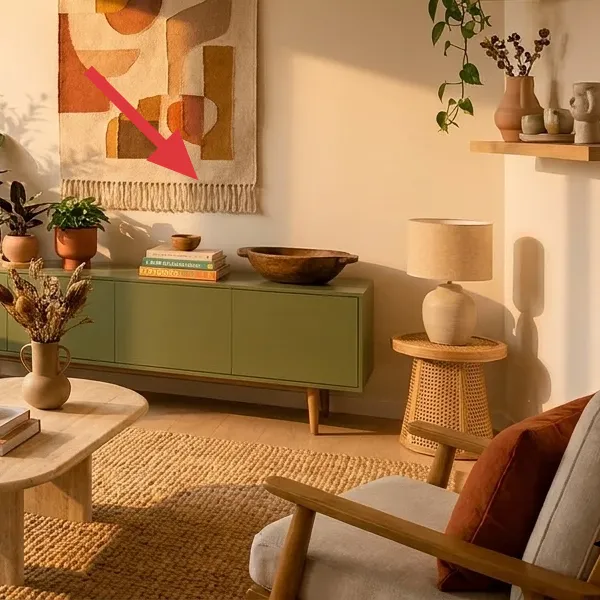
Those stacked books add structure to the console styling. Instead of scattering small objects, you’re creating a base height, which makes the ceramic pieces feel like they’re arranged “on purpose” rather than placed randomly. Books are also the most practical styling tool for move-friendly rooms: they pack into boxes without fragile packaging. If you’re shopping for a cheaper alternative, look for older paperbacks or thrifted hardcovers in warm cream, tan, and earth-leaning colors—then stack by height. Trade-off: avoid glossy covers if you don’t want glare in daylight.
Stack by height, not by theme
A few different heights read more natural than one perfect uniform column.
Layer 7 — ceramic vases on the green console ($20) small-scale shape variation for a tidy look
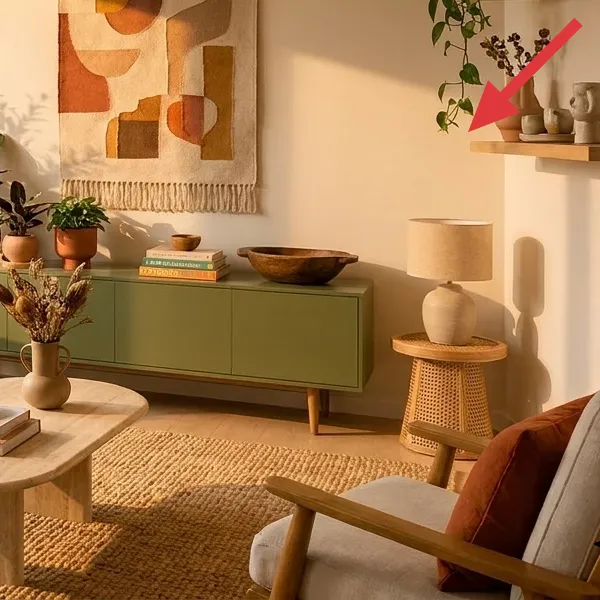
The ceramic vases give you the “shape language” on the console: curved silhouettes, matte surfaces, and warm neutral tones. In the photo, they sit among the books and smaller decor pieces, which helps the console avoid looking flat—even with only a handful of items. The reason this works better than adding more random small objects is that ceramics repeat a material (look for terracotta-adjacent colors and off-whites) while varying form (tall, squat, and rounded). Trade-off: ceramics can chip, so wrap them in paper or a towel layer during moves.
Keep weight low
Ceramics are sturdy, but lighter pieces are easier to carry when you’re moving on a deadline.
The cost, layer by layer
| Layer | Item | Cost |
|---|---|---|
| 1 | Large area rug (5×7) | $200 |
| 2 | Knit throw blanket | $45 |
| 3 | Orange throw pillow cover | $20 |
| 4 | Patterned throw pillow cover | $18 |
| 5 | Framed abstract wall hanging (16×20) | $70 |
| 6 | Book stack (thrifted hardcovers) | $25 |
| 7 | Ceramic vases (set of 2) | $20 |
| Total | $398 | |
If you want a cheaper variant, swap the framed abstract for an unframed print (still within a frame you already own) and choose a thinner woven rug around $150. Everything else can stay the same, and you’ll still get that warm, terracotta-and-cream read.
What worked, what didn't (across the whole room)
The overall win here is that the look is built from repeatable materials: woven texture on the rug, knitted texture on the throw, and warm ceramics on the console. That material repetition makes the room feel cohesive even when you’re mixing prints and colors. The one thing to watch is scale—when rugs or art are too small, the corner looks like a collection of separate pieces.
What worked
- The large area rug anchors the seating so the sofa doesn’t float against the floor.
- The knit throw adds thickness and keeps the cream sofa from looking flat in daylight.
- Two pillow covers (solid orange + warm pattern) add contrast without introducing new colors.
- The framed abstract wall hanging pulls terracotta up to eye level and makes the corner feel finished.
- Stacked books create instant height so the console decor reads intentional.
- Varying ceramic shapes keeps the console styled even with minimal objects.
What didn't
- If your rug is too low pile or too smooth, the whole corner looks cooler and less earthy.
- A pillow pattern that’s too dark can overpower the knit throw and make the sofa feel heavier.
- Skipping the framed wall piece often leaves the room “top-heavy empty,” especially by the window.
- Too many small decor objects on the console can start looking cluttered instead of styled.
- Ceramics without a repeated color note (terracotta/off-white) can feel random on move-in day.
What we'd skip if we did it again
Skip buying a second full throw blanket in a different color. In this setup, one chunky knit in cream (plus the orange pillow) is enough; adding another blanket creates visual competition and packs poorly.
Skip trying to match the exact terracotta everywhere with tiny decor pieces. Instead, repeat the same warmth in two places—one pillow and one console ceramic note—so the palette stays cohesive even after you remove items for a move.
Skip oversized framed art if your wall is narrow. When the frame scale doesn’t match the seating distance, it reads like a random print rather than an anchor, and you’ll end up redoing the placement later.
Frequently asked
How long does this kind of sofa-corner refresh take?
Plan for about 2 to 4 hours total. The rug swap (if you’re replacing) is usually the slow part because you’re clearing the coffee table zone. Pillow covers and throws take minutes, and console styling is fast once you decide on a “base height” with books. Hanging the framed abstract wall piece depends on your setup—using a removable hook can be done in under an hour.
I’m renting—can I still do the wall hanging part?
Yes, as long as you use a removable hanging method compatible with your wall type. This plan is designed around taking the framed abstract wall hanging down when your lease ends. If you’re on plaster or painted drywall, choose a command-style hook system that won’t rip paint. Avoid anything that requires drilling or permanent mounting hardware.
What if my space is smaller than the photo?
Go smaller on the rug size but keep the rug shape (a rectangular rug under the sofa area still reads grounded). Use only one patterned element—either the patterned throw pillow or the framed wall print—so the corner doesn’t feel busy. Keep the console styling minimal: books as height, then one ceramic cluster instead of multiple separate pieces.
What if my room is bigger—how do I avoid it looking empty?
Scale up the framed abstract wall hanging and keep the rug big enough that at least the front legs of the sofa sit on it. For textiles, you can add a second throw pillow cover of the same warmth family, but keep colors tied to the orange + cream notes. Console-wise, add height with books first; don’t just add more objects.
Where should I shop for these layers if I want them move-ready?
Start with soft goods at retailers that offer pillow covers, throws, and rugs with easy returns. Then check local thrift for books and ceramics—those are often easier to pack and cheaper than buying new. For framed art, look for sizes like 16×20 that are straightforward to hang with removable hardware and easy to store flat.
Biggest mistake to avoid in this room type?
The most common miss is choosing decor pieces that don’t share materials or undertones. If the rug is cool-gray but the pillows are warm terracotta, the corner will feel off even if you like each item separately. Decide on one “warm family” (cream + rust/terracotta) and match texture too: woven rug, knit throw, matte ceramics.