- Best for
- High-impact, move-ready bathroom styling
- Cost
- $355 total (under $400 budget)
- Difficulty
- Easy (mostly swaps; one simple craft)
- Renter-safe
- No drilling, all items pack up
Why warm brass-and-sage is the walk-in shower bathroom of 2026
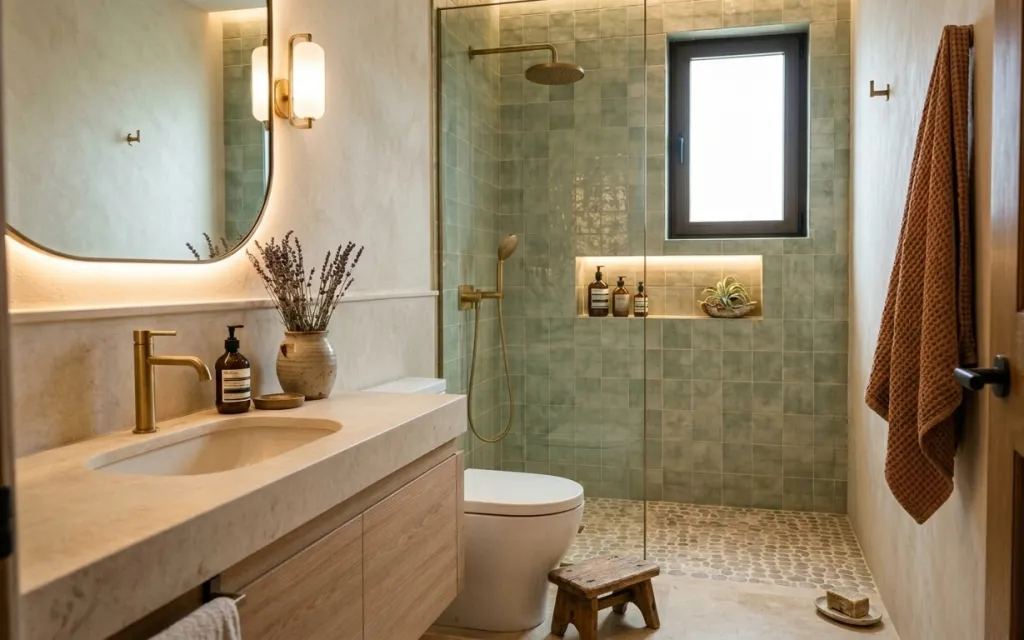
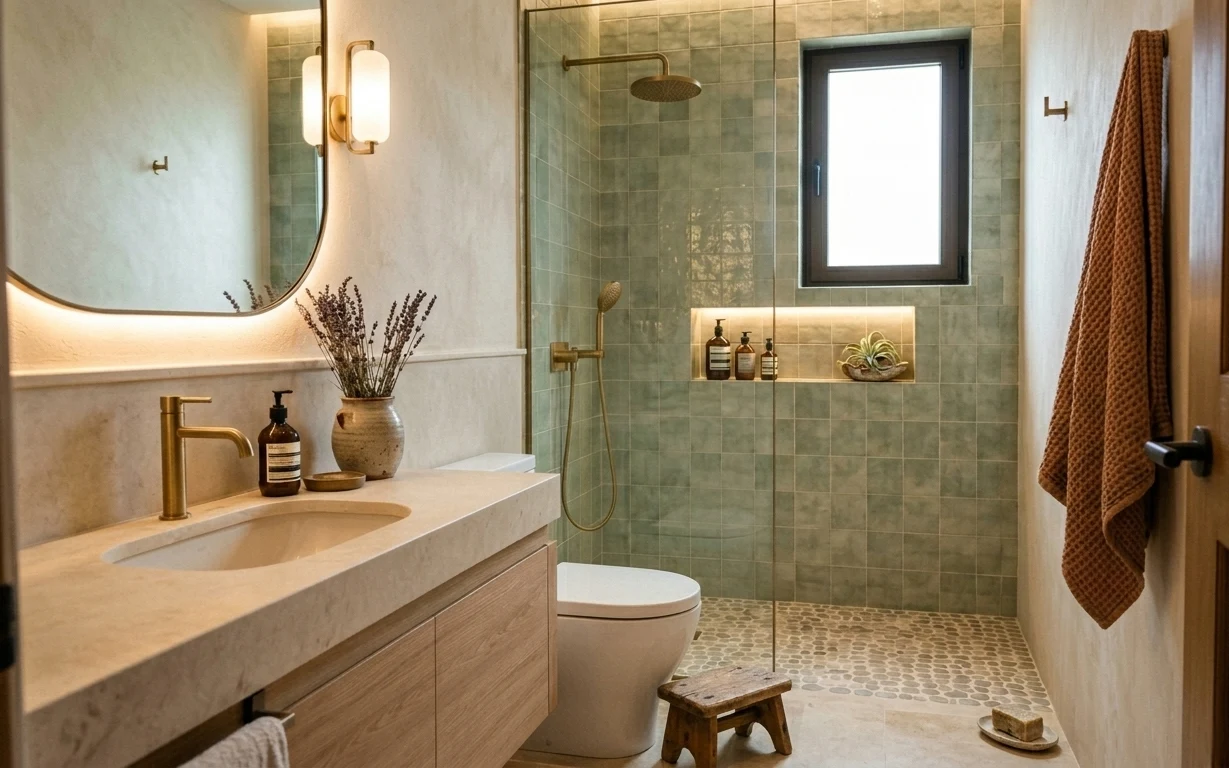
The fastest way to make a bathroom feel finished isn’t a full redo—it’s the “vignette” approach. In this space, the brass wall sconce glow, the cream stone surfaces, and the green tiled shower wall set a rich baseline. From there, small textures do the work: the brown bath towel reads soft next to tile, the ceramic vase with dried lavender-like stems adds height, and the air plant in dish brings a quiet, airy note. For shared housing, the whole point is choosing swaps that come with you.
I used to overthink bathrooms and buy too many small gadgets that never got used—then I’d pack them and still feel like the room looked unfinished. What changed for me was watching how focal points behave: mirrors, plants, and a single towel “anchor” the look so the rest can be simple. Here, the brass frame and warm objects keep the palette cohesive without needing any permanent installs.
Layer 1 — brown bath towel on door ($25) Soft texture against tile
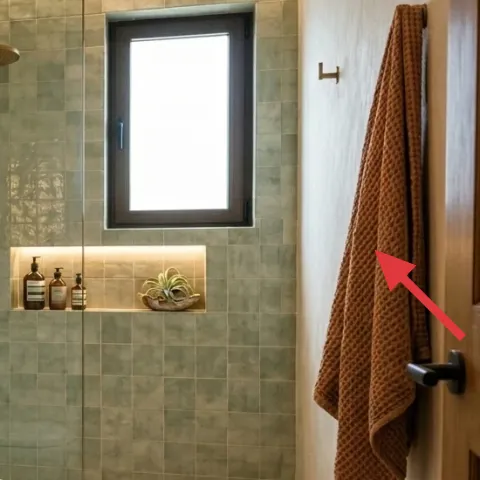
A folded brown bath towel on the door is small on paper, but it immediately softens the bathroom’s hard surfaces—especially with green tiled walls and stone flooring. It’s also an easy, truly move-friendly swap because towels pack flat and dry fast. I’d rather add one strong textile than chase a complicated color change that won’t survive the next lease. The trade-off: towel thickness matters. If the towel is too thin, it reads temporary instead of plush against tile.
Keep the towel’s fold tight
A crisp roll looks intentional and holds up in photos, even when it’s clearly just a fabric swap.
Layer 2 — ceramic vase with dried lavender-like stems ($40) Height without watering
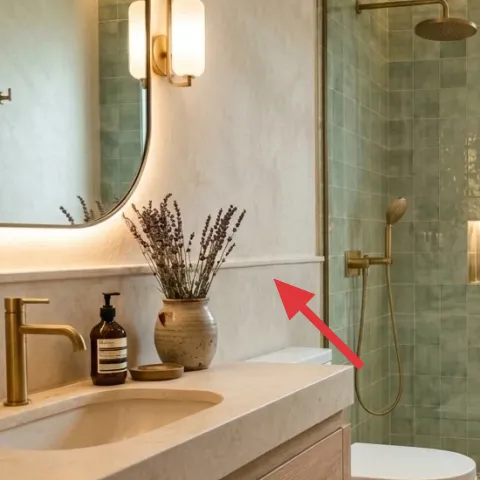
The ceramic vase with dried lavender-like stems adds vertical shape at countertop height, which is exactly where bathrooms otherwise feel flat. The vase’s matte warmth also plays nicely with the brass wall sconce tone and keeps the palette from getting too cool next to sage-green tile. Buying dried stems is a cheat code for shared housing: no schedule, no drainage mess, and it packs without liquid. The trade-off is that dried stems shed a little at first—so it’s worth handling gently and topping with a quick fluff if needed.
Match the “dry” palette, not the exact plant
Muted browns, creams, and dusty purples keep the look spa-like without turning into a craft project.
Layer 3 — bathroom air plant in dish ($15) A tiny living accent
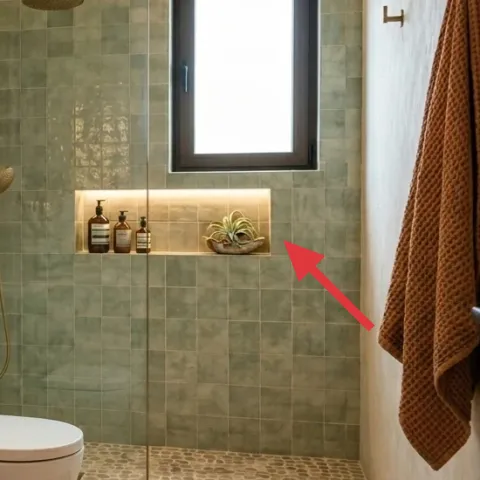
A bathroom air plant in dish gives you that “real-life” organic texture without taking up floor space or needing a planter stand. It sits on the niche shelf level, where eyes naturally scan when you enter—so it reads as part of the room’s design, not clutter. Air plants also tolerate dry-ish bathroom conditions better than many traditional houseplants. The trade-off: you’ll want a simple routine—usually a quick misting schedule—so it stays healthy rather than slowly drying out.
Use the niche shelf as your plant height
Keeping it at eye level avoids the crowded look that happens when plants drop to the floor.
Layer 4 — soap pump bottles on niche shelf ($45) Coordinated “apothecary” basics
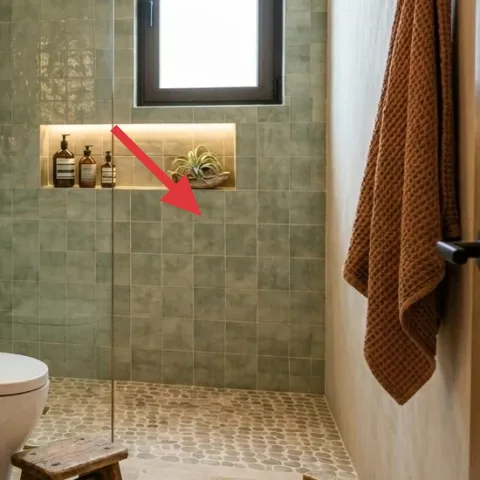
Soap pump bottles on the niche shelf turn everyday items into a visual set, which is the whole bathroom “spa” trick. Because this shelf is built into the shower wall, the styling needs to feel intentional rather than random—matching bottle shapes and labels gives that polished effect. You’re also not paying for anything permanent: you’re just swapping consumables and transferring products into coordinated bottles. The trade-off is that the bottle set works best when you commit to one color family so the bottles don’t fight the warm brass and sage tile.
Avoid mixing bottle sizes
When one bottle is dramatically taller or bulkier, it stops reading as “curated” and starts reading as “overflow.”
Layer 5 — wooden step stool ($80) A practical perch with warm grain
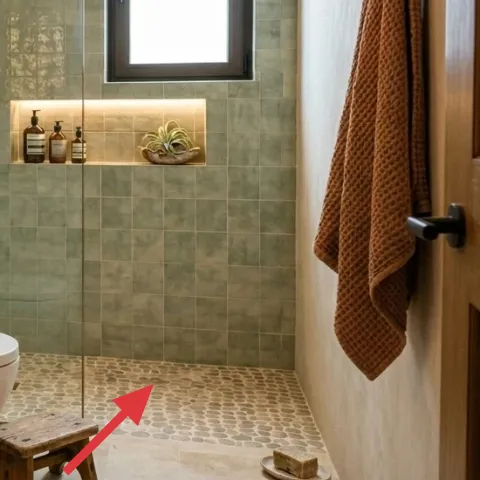
A wooden step stool adds a human, tactile element right where the bathroom can feel overly architectural. In this layout it also makes sense functionally—reachable height for a towel or bath essentials—while the warm wood grain ties into the brass wall sconce finish. It’s move-friendly because it’s single-piece furniture you can wrap and carry, not a bulky install. The trade-off: wood needs a little care around moisture. If it gets constantly splashed, wipe it down and let it dry so it doesn’t dull.
Pick a stool with a flat top
It supports small items cleanly and looks tidy in the photo zone near the shower.
Layer 6 — arched wall mirror with brass frame ($120) Portable focal point
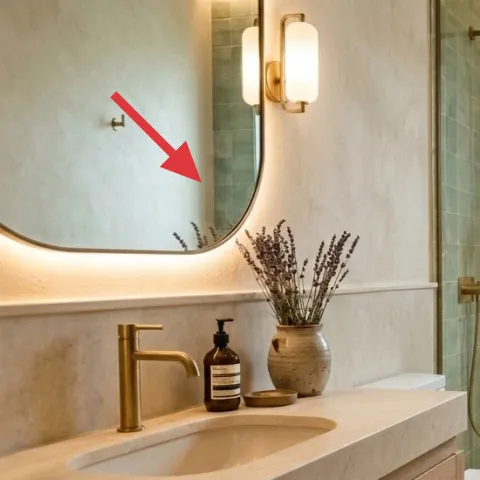
An arched wall mirror with a brass frame works like a visual “ceiling light” for the whole bathroom: it reflects the warm sconce glow and echoes the same metal tone used around the faucet. This is the layer that makes the rest feel designed, because it frames your palette—cream stone, sage tile, and brass accents—in one spot. In shared housing, mirrors are often the easiest high-impact item to keep with you, even when layouts change. The trade-off is weight and packaging, but it’s still far simpler than any fixed remodel.
Make it instead of buying it
DIY a pressed flower frame that leans against the wall or sits on a shelf, giving you that same “focal point” job without needing a permanent mirror install.
Materials
- Cardstock or light mat board — 2 sheets — craft store — $10
- Pressed flowers (assortment) — small pack — craft store — $7
- Clear gel medium or craft glue — small bottle — craft store — $6
- Arch-shaped or oval frame backing (unassembled, lightweight) — 1 — craft store — $8
- Command hook (foam-friendly if needed) — 1–2 — hardware store — $12
Steps
- Arrange pressed flowers on the cardstock to match the mirror-like arch shape.
- Press each stem in place, then lift a section at a time to apply glue/medium.
- Set the pieces back down and smooth gently so petals lie flat.
- Let the adhesive set until fully dry to the touch.
- Assemble the lightweight frame backing around the finished cardstock.
- Hang with a Command hook or lean it behind a towel stack spot so it’s visible.
Total DIY cost: $43 — saves about $77 over buying.
Layer 7 — small soap dish on shower ledge ($30) One tidy detail, not a clutter shelf
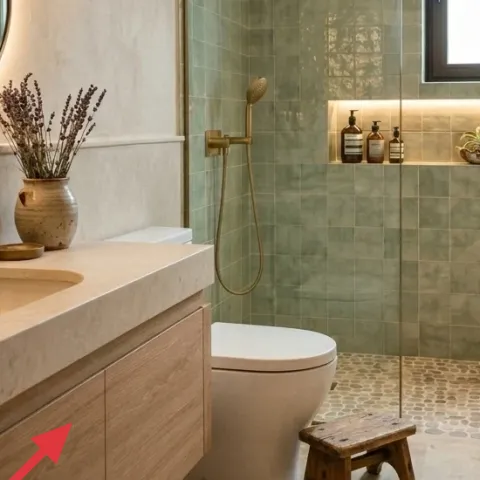
A small soap dish on the shower ledge keeps your sink area from turning into a scattered “where did it go?” moment. In a bathroom that already has a niche shelf and a glass shower, the visual goal is separation: soap stays in one place, not sliding across stone surfaces. A dish also adds material contrast—especially against cream stone and green tile—so the counter and ledges look styled, not busy. The trade-off: you have to clear the dish when switching soaps, because residue builds faster in humid bathrooms. Still, it’s a quick reset that makes daily use look better.
Choose a dish that drains
Look for a design with a slight lip or texture so soap doesn’t turn mushy on the ledge.
The cost, layer by layer
| Layer | Item | Cost |
|---|---|---|
| 1 | Brown bath towel | $25 |
| 2 | Ceramic vase with dried stems | $40 |
| 3 | Air plant in dish | $15 |
| 4 | Soap pump bottles on niche shelf | $45 |
| 5 | Wooden step stool | $80 |
| 6 | Arched mirror alternative (pressed flower frame) | $120 |
| 7 | Small soap dish | $30 |
| Total | $355 | |
If the budget has to dip, start with Layer 1 (a single towel you already like) and Layer 3 (an air plant in dish). Everything else can be sourced secondhand—especially the wooden step stool and vase—and still fit this warm brass-and-sage direction.
What worked, what didn't (across the whole room)
The overall win here is how warm metals and earthy textures can make tile look intentional without changing anything fixed. The smaller objects—towel, vase, air plant, and bottle set—read like a coordinated mini-collection instead of separate purchases. The biggest downside was going too matchy with labels: it can look staged if every bottle is identical.
What worked
- The brown bath towel softens the green tiled surfaces and photographs well without extra staging.
- The ceramic vase with dried stems adds height without any watering or drainage issues.
- The air plant in dish brings organic texture at niche-shelf height, where eyes actually land.
- Coordinated soap pump bottles turn daily essentials into an apothecary-style moment.
- The wooden step stool adds warm grain and stays useful, not just decorative.
- A mirror-shaped focal point (even via a pressed flower frame) prevents the bathroom from feeling unfinished.
What didn't
- Mixing too many bottle heights made the niche shelf look busy instead of curated.
- Choosing a soap dish that doesn’t drain quickly can leave the ledge looking darker over time.
- If the pressed-flower focal point is placed too low, it competes with the countertop instead of framing the room.
- Skipping the towel texture makes the whole palette feel colder, even with brass present.
What we'd skip if we did it again
Skip buying multiple matching “bathroom sets” at once. In a tile-forward space, two or three coordinated items (towel, bottles, one focal detail) look calmer and easier to pack than five separate themed pieces.
Skip “statement” decor that needs permanent mounting. Bathrooms are usually where renters get tempted by wall installs—foam-core, leaning formats, and Command-hook options keep the look while avoiding leftover residue.
Skip overloading the niche shelf and ledges. If the soap bottles, soap dish, and plant are all competing, the room reads cluttered. Keep one anchor object per surface and repeat materials (brass tone, cream stone, earthy browns) for cohesion.
Frequently asked
How long does this bathroom refresh take?
Most swaps take about 1–2 hours: towel placement, arranging the vase and air plant, and styling bottles and soap dish. The pressed flower frame is the only real time sink, and it’s still a single afternoon. If you’re new to crafting with pressed flowers, give yourself extra drying time for the adhesive.
If this is shared housing, is the pressed flower frame still practical?
Yes, because it’s portable and doesn’t require changing anything fixed. You can lean it or hang it with a Command hook instead of installing hardware. When the next lease starts, you can pack it in a flat box with paper protection and recreate a focal spot wherever your bathroom layout lands.
What if my bathroom is smaller or the niche shelf is narrower?
Keep the same strategy—one anchor object per surface—but scale down by choosing fewer items on the niche shelf. For example, use one soap bottle pump plus the plant, then leave space around them. The towel can also be the same color, just folded smaller so it doesn’t crowd the door area.
Where should I shop if I want the warm brass + earthy look?
Start with household essentials first—towels, soap bottles, and a soap dish—because the visual set matters more than brand. For the plant and dried stems, craft stores and florists usually have good inexpensive options. For the step stool, look at home stores for wood tones, or check thrift and resale for solid wood pieces.
What’s the biggest mistake people make in bathrooms like this?
Over-styling every surface at the same time. Bathrooms already have tile texture and reflective surfaces, so too many small items make the niche shelf and countertop look cluttered instead of curated. Aim for repetition—brass tone on one item, earthy browns on another—and leave breathing room.
Do I need real plants, or can I go fully low-maintenance?
You can go fully low-maintenance. Dried stems in the ceramic vase are the easiest swap to keep. If you don’t want an air plant routine, replace it with a small decorative object you can wipe clean, but keep the placement at niche-shelf height so it still reads as an intentional layer rather than random decor.
More in Bathroom
How to refresh a walk-in shower bathroom for under $400
A walk-in shower bathroom refresh that stays move-ready and no-drill-friendly on a $400 budget. Swap in warm textiles, a few countertop/sho…
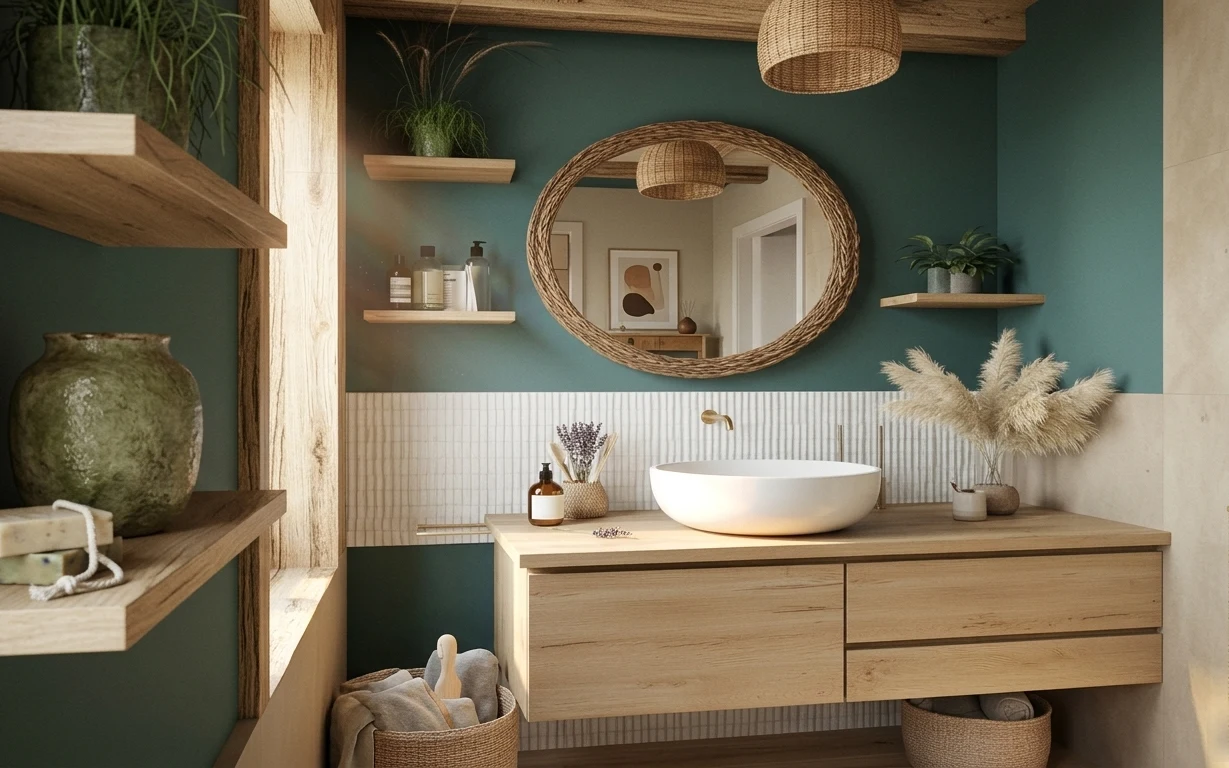
How to style a bathroom vanity wall for $500
A teal-and-wood bathroom vanity wall gets a calm, japandi feel on a $500 refresh plan. Swap in a round rattan mirror, update the faucet, an…
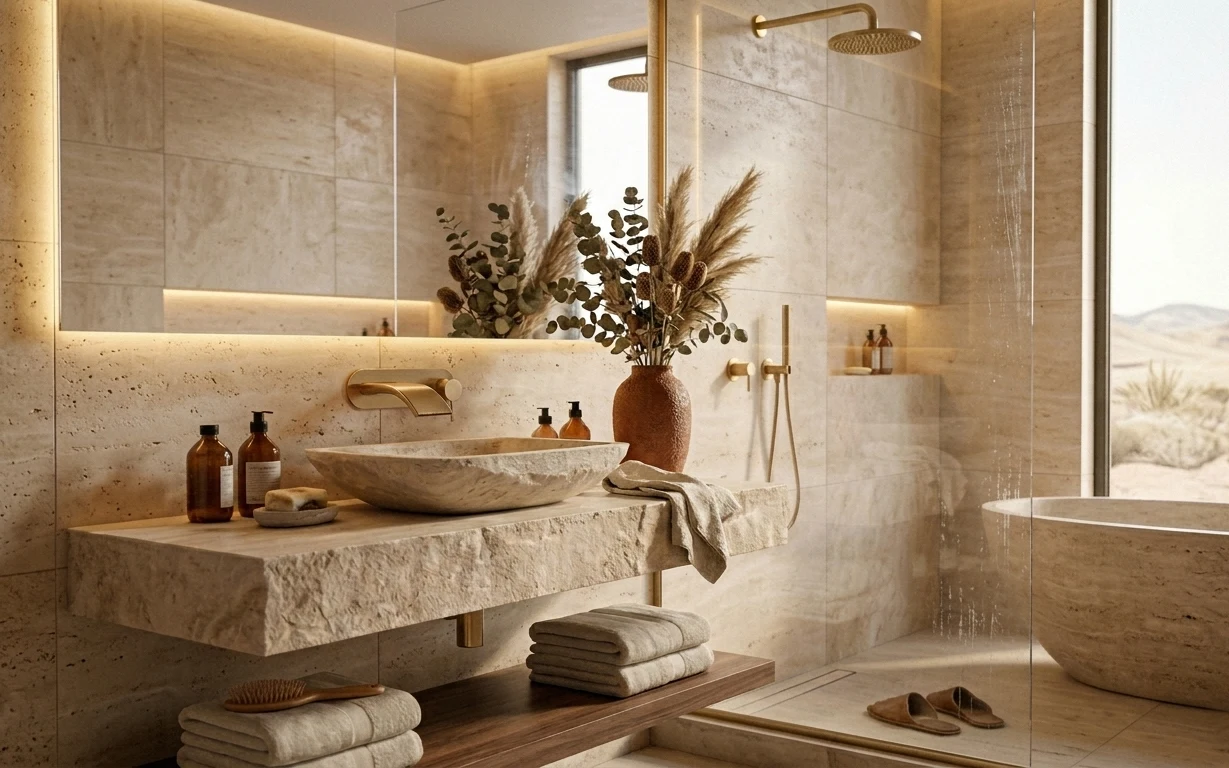
7 swaps for a spa-like bathroom for under $400
A spa-like bathroom look built from 7 renter-friendly swaps for under $400. Focus: folded towels, a warm terracotta vase with dried stems, …