- Best for
- bathroom vanity wall focus
- Cost
- $435 total DIY refresh
- Difficulty
- Weekend-friendly installs
- Time
- 4–7 hours depending on mounting
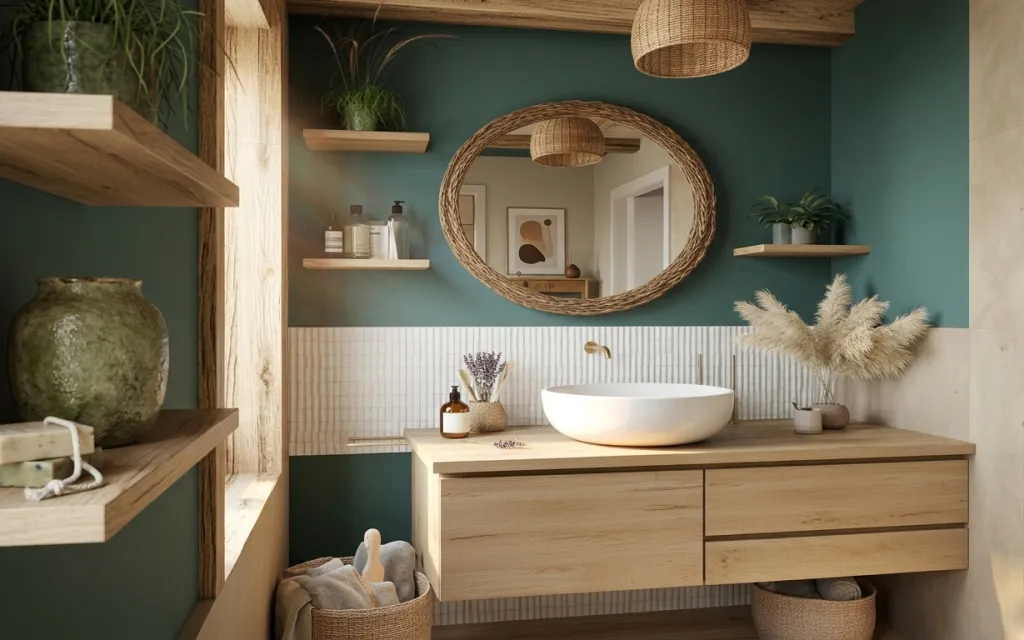
Why this teal-and-rattan bathroom vanity wall is the bathroom vanity wall of 2026
That round rattan mirror plus the warm woven ceiling light shade is doing the heavy lifting here—everything else can stay simple. The vanity top reads light and clean against white subway tile, and the textures (rattan, pampas, woven light shade) keep the teal wall from feeling flat. For a homeowner refresh, this is achievable because most of the changes are swaps and installs: a new mirror, a refreshed shelf, and a few smaller styling items. It’s the kind of update that makes the space feel “finished” without chasing perfection.
I used to think the mirror was just functional, but I’ve learned the hard way: the shape becomes the room’s anchor. On my own bathroom refresh, I hung the wrong scale mirror and suddenly the faucet looked awkward. Here, the round frame works with the soft curves of the vanity top and the airy pampas stems. The result is calm instead of busy—even with multiple shelves and containers in the same sightline.
Layer 1 — decorative tray on vanity top ($25) organizes small things at countertop level
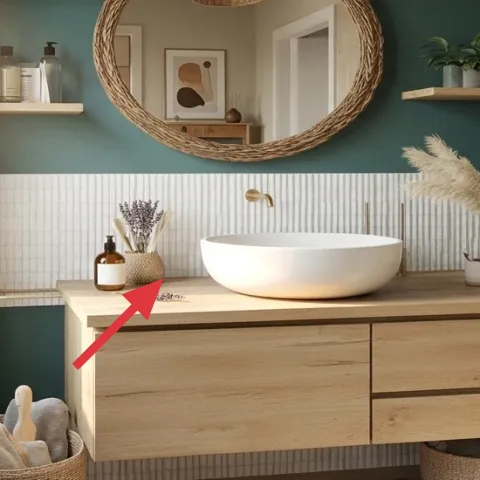
This decorative tray sits on the wood vanity top and gives all the tiny items—soap, bits of decor, and whatever you reach for first—a single “home base.” The biggest benefit is visual: your eye doesn’t bounce across scattered labels and containers. It’s an easy win compared with repainting the vanity or swapping the whole countertop. The trade-off is that you have to choose a tray size that fits your daily routine; too small makes everything spill out, and too large crowds the sink zone.
Keep the tray centered on the countertop
Centering at least one tray item (or aligning it with the faucet) makes the whole vanity read intentional instead of styled-from-the-moment-you-took-the-photo.
Layer 2 — pampas grass arrangement ($35) adds height without taking up floor space
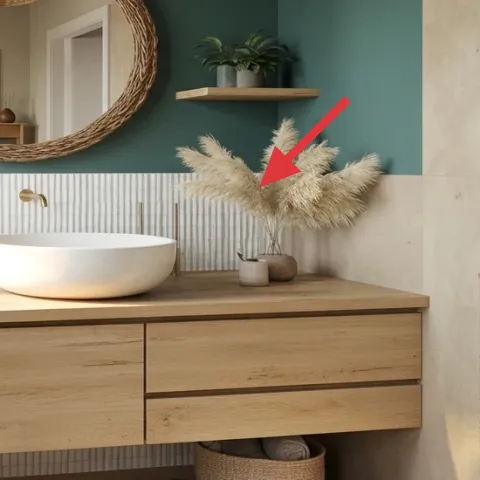
The pampas grass arrangement brings movement and vertical texture above the vanity line, and that’s exactly what the eye needs in a bath corner like this. When you’re working with a teal wall and white tile, adding one soft, neutral plume keeps the palette from feeling icy. Compared with adding more small decor pieces, this is a clearer choice because it gives height in one move. The trade-off is that pampas needs a light touch—if it sheds or gets too crowded with other items, it starts looking messy instead of airy.
Choose stems that feel airy, not dense
If the top looks too “puffy,” the arrangement can read heavy next to the bright tile. Fluff and pull stems apart before styling.
Layer 3 — round rattan mirror frame ($120) brings warmth and a soft focal shape
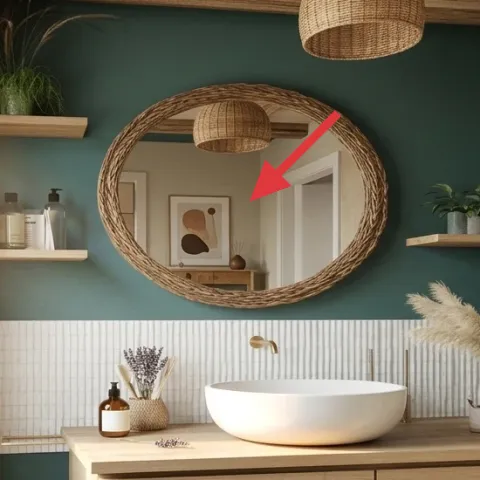
The round rattan mirror frame is the focal point here, and it’s doing more than reflecting light. The woven texture echoes the nearby woven ceiling light shade, which helps the whole bathroom feel coordinated instead of random. A round mirror also breaks up the strong rectangles—white tile, cabinet drawers, and shelf lines—so the space feels calmer. The swap is better than adding more wall art, because you get both function and texture in one piece.
Don’t mount it too high
If the mirror sits above your natural sightline, the faucet zone can look disconnected from the reflection. Aim for a comfortable center height before you drill or anchor.
Layer 4 — floating wood shelf ($45) DIY-painted to match the vanity and feel built-in
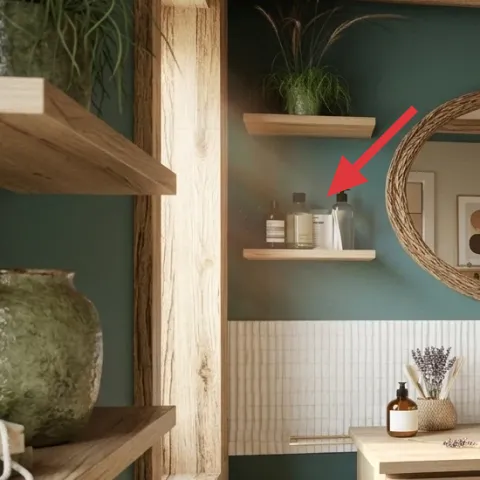
Floating wood shelves make this wall feel layered and styled, but they only work when the finish looks intentional next to the vanity top. For a budget refresh, updating one shelf with a simple paint/stain approach is far more impactful than adding another small object. The best part is you can tune the tone—slightly warmer or slightly lighter—so it sits naturally beside the wood cabinetry. The trade-off is prep: skipping sanding or skipping clean-up shows up fast on a high-visibility shelf.
Make it instead of buying it
Refresh a floating wood shelf by sanding and painting/staining it so it visually matches the vanity tone.
Materials
- Sandpaper (120 + 220 grit) — assorted sheets — $10
- Tack cloth or lint-free rag pack — 1 pack — $8
- Paint or wood stain (small can) — 1 small can — $7
- Mini foam roller + small angled brush — set — $4
Steps
- Sand the shelf surface to knock down sheen and rough up for adhesion.
- Wipe with a tack cloth until no dust remains.
- Apply a thin first coat of stain or paint, focusing on edges and grain lines.
- Let the first coat dry fully, then lightly sand any raised grain.
- Apply a second thin coat for even color.
- Dry overnight, then install with sturdy wall anchors/screws.
Total DIY cost: $29 — saves about $16 over buying.
Match undertones, not just color
Wood can lean yellow or orange. Pull the shelf tone toward the vanity top so the room reads cohesive from across the bathroom.
Layer 5 — woven hanging ceiling light shade ($120) makes the whole corner feel warmer after dark
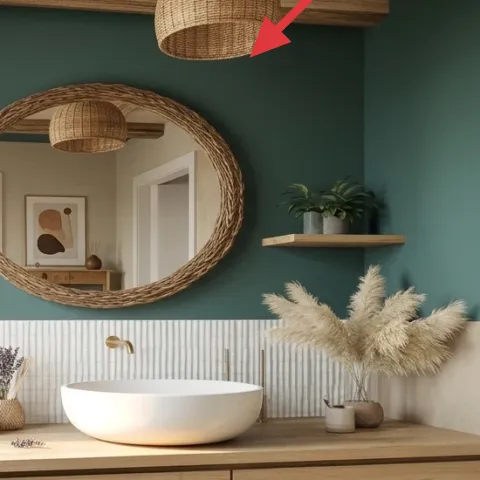
That woven hanging ceiling light shade adds a soft, diffuse glow that flatters both teal walls and the white tile backsplash. When the light source has texture, you get more gentle shadowing along the shelf and vanity, which makes the space feel styled even when it’s not “decorated.” Swapping the shade is a stronger move than adding another small lamp, because it changes the way the entire wall reads. The trade-off is choosing scale—too small looks lost above the vanity, too large overwhelms the mirror.
Use a warm bulb to keep the rattan golden
A warmer color temperature helps the woven texture look rich instead of gray.
Layer 6 — gold faucet ($70) ties the sink zone to the mirror hardware vibe
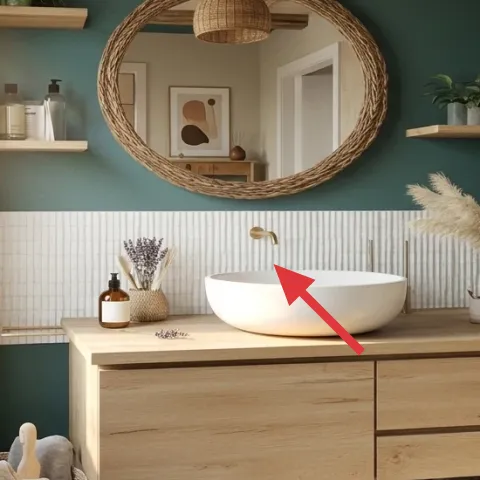
The gold faucet anchors the sink zone and makes the countertop feel intentional, especially next to the round mirror and the warm wood tones. If you’re refreshing a bathroom vanity wall, hardware updates are efficient: they change the look right where you spend time. Compared with trying to style your way out of a dated faucet, this is a cleaner visual upgrade. The trade-off is that faucet installs can be finicky, so double-check compatibility with your current plumbing and consider professional help if anything looks uncertain.
Avoid mismatched metal finishes
If you add gold elsewhere (shelf brackets, hardware, accessories), keep the tones consistent so the bathroom doesn’t look accidental.
Layer 7 — light-colored hand towel ($20) adds texture and a “lived-in” cue
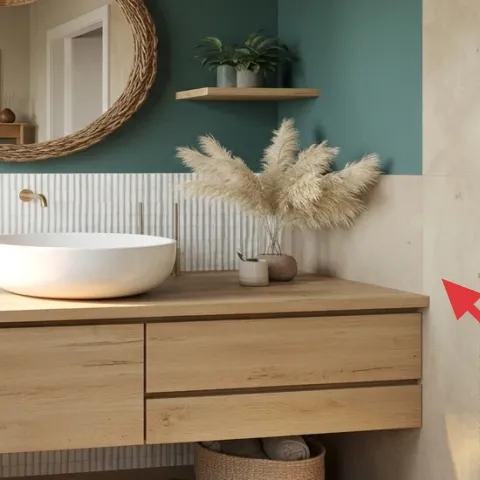
A light-colored hand towel adds softness and a practical element that reads on sight every time you use the vanity. In a bathroom with a teal wall and white tile, the towel’s neutral tone prevents the space from feeling too cool or too hard-edged. Styling-wise, it’s a better alternative than adding more decorative jars, because it feels functional rather than themed. The trade-off is that you’ll want it to look crisp enough; a towel that’s rumpled or too thick can visually compete with the mirror.
Fold it to create a clean edge
A simple triangle fold or tight roll makes the towel look intentional next to the mirror and shelves.
The cost, layer by layer
| Layer | Item | Cost |
|---|---|---|
| 1 | Decorative tray | $25 |
| 2 | Pampas grass arrangement | $35 |
| 3 | Round rattan mirror | $120 |
| 4 | Floating wood shelf (DIY equivalent) | $45 |
| 5 | Woven ceiling light shade | $120 |
| 6 | Gold faucet | $70 |
| 7 | Light-colored hand towel | $20 |
| Total | $435 | |
If you want a cheaper variant, start with the mirror and tray and keep the faucet finish. Swap in a simpler shelf finish, choose a basic hand towel set, and use one tall dried arrangement instead of multiple small containers.
What worked, what didn't (across the whole room)
The biggest wins were the round mirror and the woven textures, because they soften the teal-and-tile grid and make the vanity wall feel styled even when it’s minimal. The shelf styling also helped—everything looks intentional when the countertop and shelf items share a similar warm material language.
What worked
- The round rattan mirror breaks up rectangular tile and makes the wall feel balanced.
- Woven light texture warms the teal wall and flatters the white backsplash after dark.
- A single decorative tray prevents clutter from turning into visual noise.
- Pampas adds height at the vanity line, so the corner feels taller without extra furniture.
- The floating wood shelf finish ties into the vanity tone instead of fighting it visually.
- Gold faucet hardware gives the sink zone a clear focal point.
What didn't
- Overloading the shelf with too many small items makes the wall look busy next to the mirror.
- If the towel looks too rumpled, it competes with the clean lines of the tile and drawers.
- A shelf finish that’s even slightly cooler than the vanity top makes the whole wall feel mismatched.
- If the mirror is mounted too high, the faucet zone looks disconnected from the reflection.
- Inconsistent metal tones (gold vs. brass vs. chrome) can make the hardware feel accidental.
What we'd skip if we did it again
Skip adding more small bottles or decorative jars on the shelf. With a mirror and shelves already in the same sightline, small items multiply quickly and turn into clutter instead of texture.
Skip changing the tile or repainting the wall if the teal and white foundation already feels right. This refresh shows that a mirror shape, warm light, and a couple of texture swaps can do the heavy lifting.
Skip a shelf that doesn’t match the vanity’s undertone. Even if the color looks close in daylight, warm wood nearby makes undertone differences obvious—so it’s better to match tone than match the label.
Frequently asked
How long does this bathroom vanity wall refresh take?
Plan on about 4–7 hours total. The decorative tray and towel styling take 30–60 minutes. Swapping in a new mirror and installing a shelf is usually the time bump—expect a couple hours depending on your wall type. If the faucet needs extra fitment time, add another hour or two. Most of the work is visible-and-done, so the room starts looking better even mid-day.
What if I rent—can I still get this look?
If you can’t do permanent installs, keep the mirror and faucet as priorities only if your landlord permits. For the rest, focus on non-damaging upgrades: a decorative tray, towel styling, and a temporary shelf solution using removable supports if your setup allows. The woven ceiling light shade may require wiring access, so that part is the one to avoid unless you have permission or an electrician agrees.
My bathroom is smaller—how do I scale the mirror and shelf?
Use the mirror as your scale reference. In a smaller bathroom, choose a slightly smaller round mirror and keep one main shelf instead of multiple shelves. The key is to preserve negative space around the mirror so the teal wall still reads calm. With the pampas arrangement, use fewer stems and keep the height closer to the top edge of the vanity to avoid overwhelming the room.
Where should I shop for the rattan mirror and woven ceiling light shade?
Look for rattan mirrors and woven shades at home decor retailers that carry natural materials year-round, plus marketplaces with lots of variations in size. Match your measurements first: mirror outer diameter and the clearance above the sink matter more than style photos. For the light shade, search by shade diameter and check whether it fits your existing socket or requires an approved fixture setup.
What’s the biggest mistake with this kind of bathroom refresh?
Overstyling is the most common issue. With a bold teal wall, white tile backsplash, a round mirror, and shelves, every extra small container competes for attention. Another frequent mistake is mismatched metal tones—gold faucet hardware plus a different finish in hooks or brackets makes the sink zone look inconsistent.
More in Bathroom
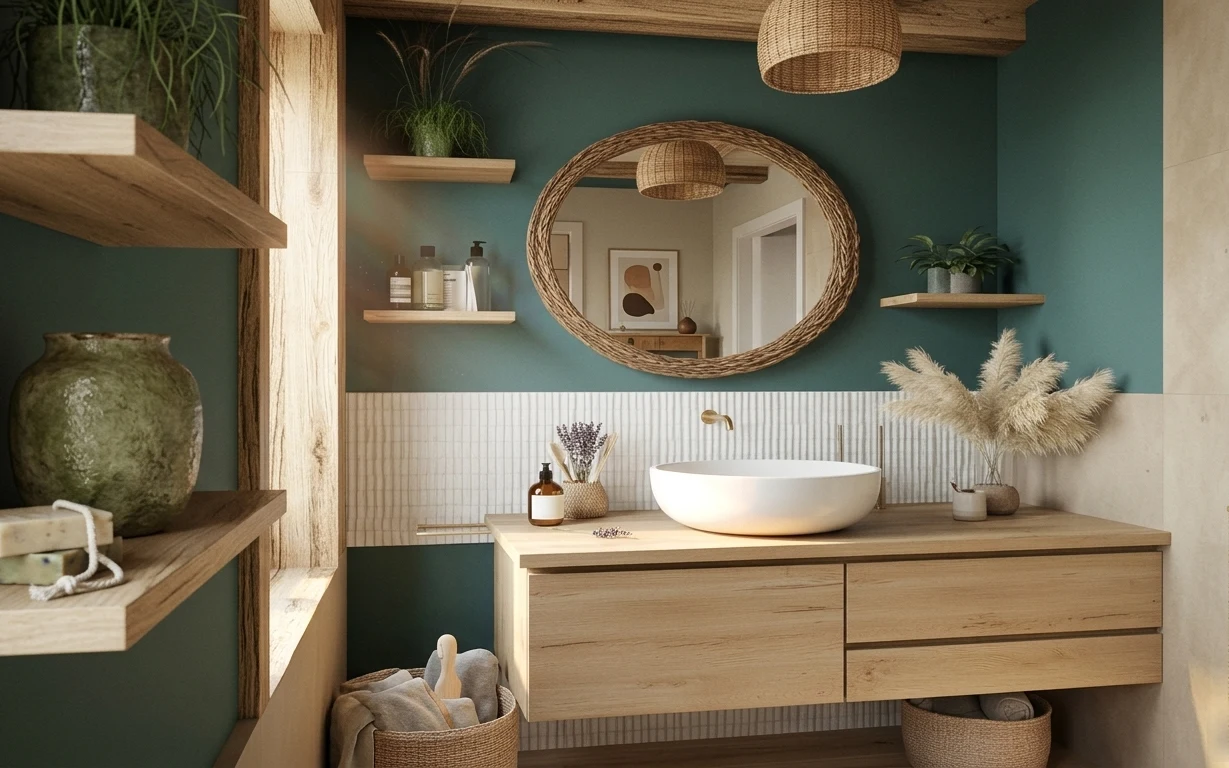
How to style a bathroom vanity wall for $500
A teal-and-wood bathroom vanity wall gets a calm, japandi feel on a $500 refresh plan. Swap in a round rattan mirror, update the faucet, an…
7 swaps for a spa-like bathroom for under $400
A spa-like bathroom look built from 7 renter-friendly swaps for under $400. Focus: folded towels, a warm terracotta vase with dried stems, …
7 renter-safe upgrades for a bathroom vanity counter refresh, $300
A bathroom vanity counter refresh that leans into teal tile, warm wood, and soft styling—built for shared housing and moves. This $300 plan…