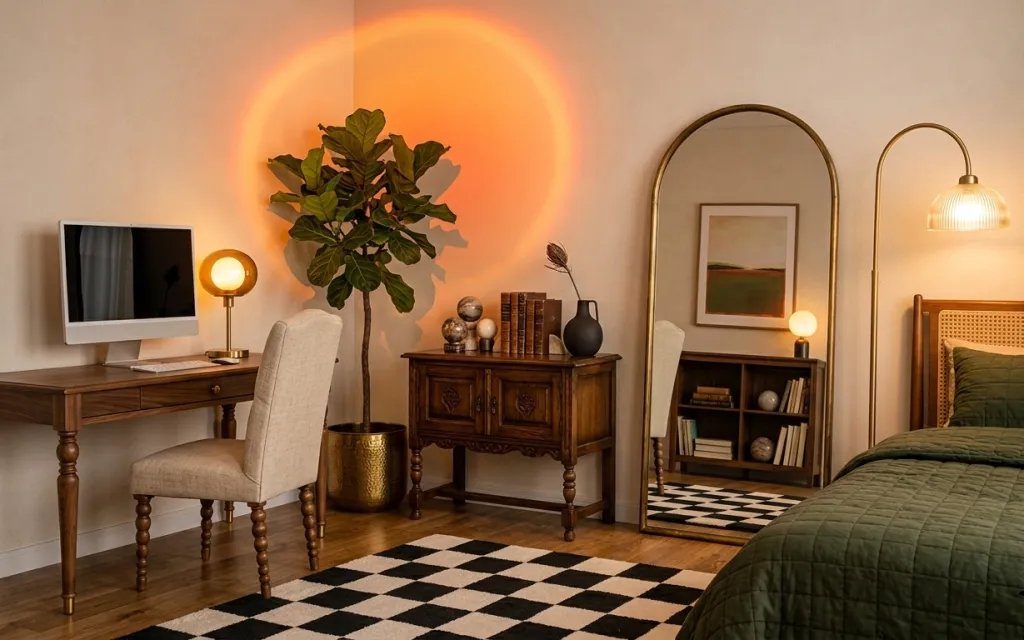
- Best for
- Bedroom nook styling with storage + light
- Time
- One weekend
- Total cost
- $915 (7 layers)
- Renter-safe
- Most swaps work; art/lighting depends on your setup
Why brass mirror-and-forest-green textiles are the bedroom nook of 2026
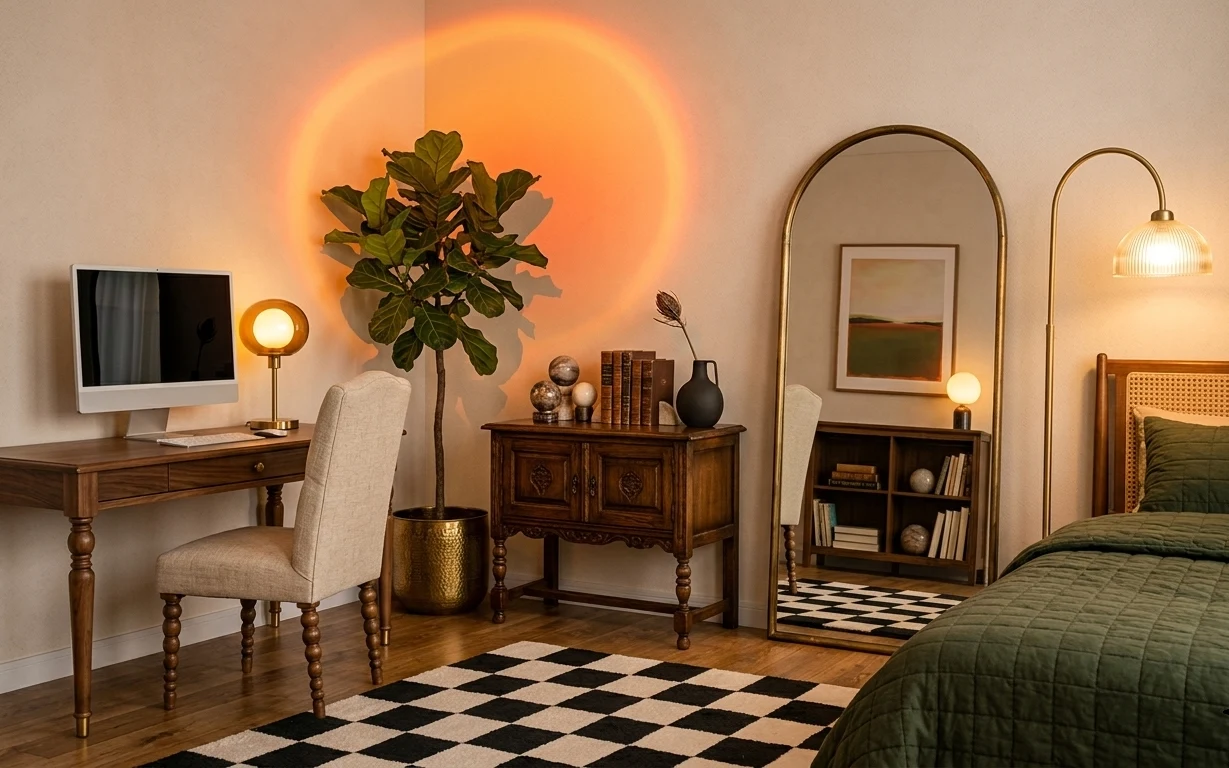
Start with the parts that read from across the room: the black-and-white checkered rug anchors the whole nook, and the warm brass lighting makes the desk-and-console zone feel intentional instead of “random furniture.” In this photo, the textures do a lot of the work—plastered walls, stained wood, and the quilt’s dense weave all play nicely together. The best part for homeowners: you can pick a single, high-impact anchor (like the rug) and build outward, instead of replacing everything.
I used to overthink “matching.” In my first round of decorating, I tried to make every finish—wood, brass, and paint—hit the exact same tone. This setup changed my mind: brass only needs to show up in a couple of places, then you can let the darker wood and forest textiles carry the rest.
Layer 1 — Checkered black-and-white area rug ($150) Grounding pattern underfoot
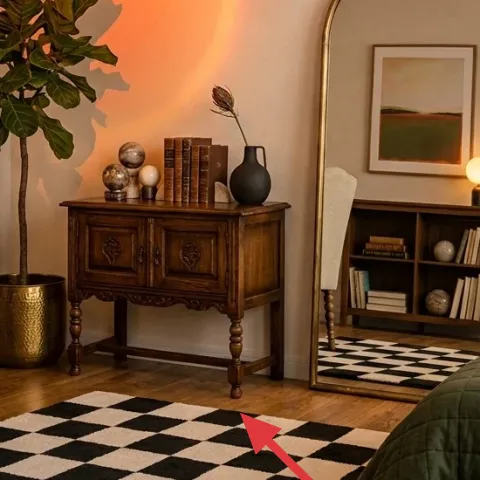
The checkered rug is what turns a bedroom nook into a defined zone. Black-and-white patterns are easiest because they “agree” with both warm woods and green textiles, and they hide day-to-day dust and scuffs better than a light solid. In this photo it sits under the console legs and into the bed area, so it visually ties the whole vignette together. The trade-off is size planning: a pattern like this needs enough area to breathe, or it can feel busy. If the room is smaller, go for the same pattern style, but slightly less coverage—keep the console readable.
Keep the check centered
When you can, align one row of the pattern with your mirror or console so the eye lands on a clean grid.
Layer 2 — Writing desk with drawers ($180) A warm place to pause
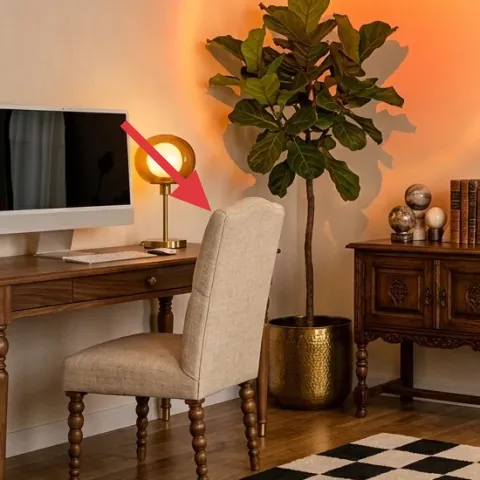
This desk is the nook’s “workstation,” but the real win is its proportion: it’s long enough to hold a lamp and small decor without swallowing the room. The medium-to-dark wood keeps the look grounded, while the drawers add function (and a little visual rhythm) that plain tables don’t. Choosing a desk like this over a thinner console gives you a practical surface for a lamp and books, which matters in a bedroom where you want fewer floating clutter moments. The trade-off is footprint—make sure there’s a clear path from chair to bed so the nook doesn’t feel blocked.
Let brass repeat once more
Because this desk has a brass-based lamp, the mirror’s brass finish feels like an intentional “echo,” not a coincidence.
Layer 3 — Wood console table with doors ($200) Storage with a vintage-shaped silhouette
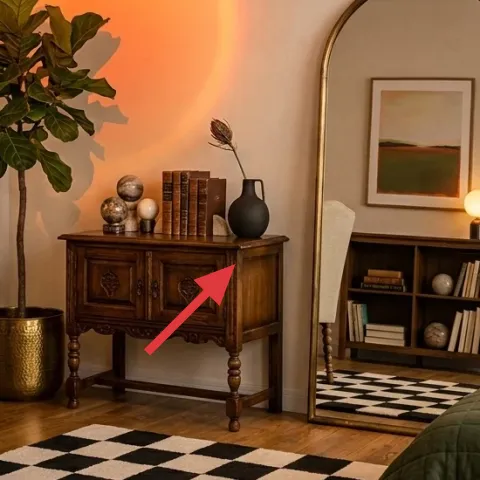
The console table gives you that classic bedroom feel—clean front, room for styling, and concealed storage behind the doors. In the photo, its dark wood tone bridges the lighter wall and the forest-green quilt, which keeps everything from reading too “matchy.” If you tried to replace it with a super-modern floating shelf, you’d lose both visual weight and the ability to stash extra blankets or chargers out of sight. The trade-off here is styling discipline: a console invites too-many objects. Aim for three categories—something tall (vase), something rounded (brass vessel), and a small stack (books)—then stop.
Style in heights, not in piles
One tall piece, one medium piece, and one low item usually reads fuller than five small things laid flat.
Layer 4 — Arched brass mirror ($120) Light that looks placed
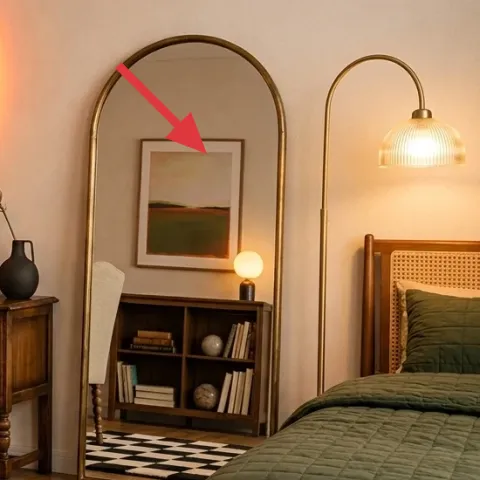
The arched mirror is doing quiet work: it softens the geometry of the room and adds a reflective highlight right where you want the eye to land. Brass also plays well with both the lamp base and the wall sconce, so the lighting feels curated instead of random. You could choose a simple rectangle mirror, but the arch is what makes this nook feel “finished” without additional furniture. The trade-off is placement height—if it’s too low, it won’t frame the landscape print correctly and the reflection will feel off. Keep the bottom edge high enough that it reads in line with the console’s display area.
Avoid too much glare
If a lamp reflects straight into your line of sight, tilt the mirror slightly or move the lamp a few inches to reduce hot spots.
Layer 5 — Bookcase with shelves ($140) Vertical storage that doesn’t look bulky
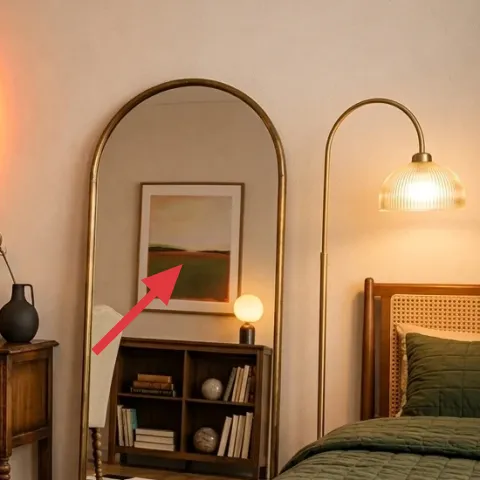
The bookcase brings structure to the right side of the nook and gives the styling background a believable “collection” vibe. It’s also practical: shelves let you store books, extra glassware, or small baskets while still showing off a few decorative objects. Compared with a single standing shelf, a full bookcase reads more intentional and supports layering art and lighting on the wall beside it. The trade-off is spacing—open shelving gathers clutter faster than closed storage, so stick to a handful of repeated shapes (a few book stacks, a vase, a small object) and leave some empty space. That negative space helps the rug pattern stay the star.
Match object scale to shelf depth
Use medium objects and a couple of taller pieces so they read clearly at a distance.
Layer 6 — Globe table lamp with brass base ($45) Warm light, no hard wiring panic
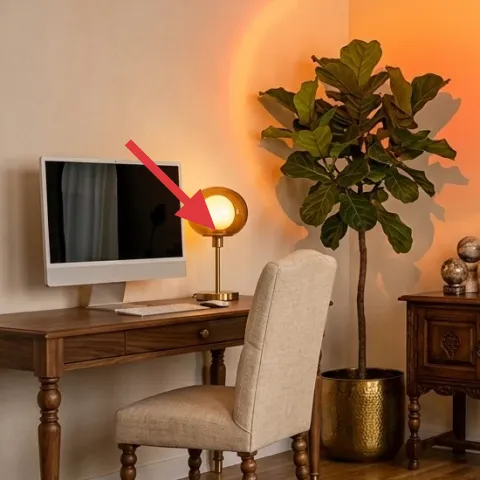
The globe table lamp adds that warm, rounded glow that makes a bedroom nook feel restful even in daytime. It also gives you a different light shape than the wall sconce—spheres vs. a bell shade—so the lighting doesn’t turn into a one-note look. Going with a plug-in lamp is a comfort move for a weekend project: minimal risk, fast placement, and you can adjust the lamp position until it hits the mirror and console at the right angle. The trade-off is bulb choice—use a warm temperature bulb so the brass doesn’t read yellow-green against the wall.
Pick the right bulb temperature
A warm bulb (not daylight) keeps the room’s beige walls from looking flat.
Layer 7 — Framed landscape print ($80) DIY the frame, keep the art
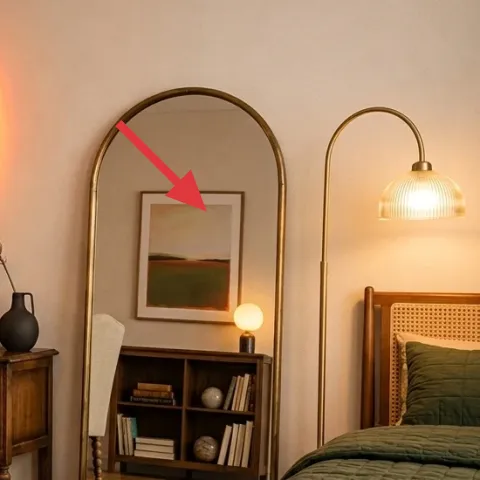
A framed landscape print is the easiest way to make a bedroom nook feel collected instead of temporary. Since the print itself is already working visually, the DIY move is to focus on the frame finish so it harmonizes with the brass mirror and lamp base. A newly painted frame can look custom in an afternoon, especially if the original frame is already solid and straight. The trade-off: you’ll spend a little extra time prepping corners and edges so the paint doesn’t look thick. The good news is you can DIY the frame without committing to swapping the art.
Make it instead of buying it
Paint a thrifted or leftover frame in a warm brass-like tone so the framed landscape print matches the mirror and lamp without replacing the artwork.
Materials
- Painter’s tape — 1 roll — hardware/lumber store — $8
- Degreasing cleaner (or dish soap + sanding) — 1 — hardware store — $5
- Sandpaper (fine grit) — 1 pack — hardware store — $7
- Warm metallic spray paint — 1 can (enough for one frame) — home store — $20
- Clear protective topcoat (optional but helpful) — 1 — home store — $15
Steps
- Clean the frame so paint grips—scrub, rinse, and let it dry fully.
- Lightly sand to scuff the surface, focusing on corners and edges.
- Tape off the glass and any areas you want to keep paint-free.
- Dust off thoroughly, then set up ventilation and a drop cloth.
- Spray a thin first coat, letting it flash between passes.
- Apply 2–3 light coats until the finish looks even and opaque.
- If using a topcoat, spray it after the color cures per the can instructions.
- Reassemble the frame and hang it so it visually centers beside the mirror.
Total DIY cost: $55 — saves about $25 over buying.
The cost, layer by layer
| Layer | Item | Cost |
|---|---|---|
| 1 | Checkered black-and-white area rug | $150 |
| 2 | Writing desk with drawers | $180 |
| 3 | Wood console table with doors | $200 |
| 4 | Arched brass mirror | $120 |
| 5 | Bookcase with shelves | $140 |
| 6 | Globe table lamp with brass base | $45 |
| 7 | Framed landscape print (DIY frame) | $80 |
| Total | $915 | |
If you want a cheaper variant, shrink the spend on the desk and bookcase: look for solid wood secondhand, and put the money into the rug + mirror combo, since those are the parts you’ll notice first.
What worked, what didn't (across the whole room)
This nook works because it mixes one bold pattern (the rug) with warm, reflective metal (brass) and grounded wood tones. The lighting choices also keep the bed-and-desk area feeling soft instead of harsh. The only place to watch is styling density—if every surface is filled, the room stops looking collected.
What worked
- The checkered rug turns separate furniture pieces into one walkable “zone.”
- The arched brass mirror adds softness against straight chair and console lines.
- Two lamp sources—globe + wall sconce—make evenings feel warmer without extra fixtures.
- The console doors hide clutter, so books and decor look intentional instead of random.
- The bookcase keeps vertical storage visible, which prevents the corner from feeling flat.
- Forest-green textiles anchor the palette so beige walls don’t feel empty.
What didn't
- Overstacking the console with small items makes the rug pattern feel louder.
- Using a cooler light bulb temperature can make brass look slightly green.
- If the mirror sits too low, it doesn’t frame the landscape print correctly.
- Too-small rugs under the bed can make the nook feel like it’s floating.
- Replacing the console with a very lightweight shelf can remove the needed visual weight.
What we'd skip if we did it again
Skip the all-in-one “matching set” approach. When every piece comes from the same collection, it reads like furniture you didn’t live with yet. In this nook, the finishes vary on purpose—brass repeats, but wood tones stay richer and imperfect, which feels more lived-in.
Skip a plain, low-contrast rug. If the pattern disappears, the desk and console look like they’re sitting in separate rooms instead of forming one bedroom nook. Put your budget into a rug with clear contrast first, then tune the rest of the palette with textiles.
Skip overfilling the console and bookcase. Leave some breathing room on shelves and let the framed landscape print do its job. The second the surfaces become equal density, the nook loses that quiet, collected balance that makes it feel calm.
Frequently asked
How long does this bedroom nook refresh take?
Plan for one full weekend. Most of the time goes to choosing and placing the rug, getting the mirror height right, and styling the console and bookcase so it doesn’t look cluttered. Painting a DIY frame can usually be done the same weekend; just factor in drying/curing time for spray paint and topcoat.
What if I’m renting and can’t make changes to the wall?
You can still get most of the look. Use the globe table lamp and keep the wall sconce as your existing lighting if you already have it. For wall decor, stick to a renter-safe hanging method for the framed landscape print, or lean it on a console when you’re testing placement first.
My room is smaller—should I still use a checkered rug?
Yes, but scale matters. In a smaller room, prioritize keeping the rug large enough to sit under at least the front legs of the desk chair or into the bed area. If the rug can’t extend, consider a less intense version of the pattern so it doesn’t feel busy next to the mirror and bookcase.
What if I already have a desk or console I like?
Lean into what you have and shift the budget to what photographs best: the rug, the mirror, and one lighting source. Those three are the biggest “first glance” elements. If you keep your existing desk, you can still DIY the framed landscape print frame for an instant finish.
Where should I shop to keep it under budget?
For mid-century shapes on a budget, start with local thrift stores and Facebook Marketplace for the desk, console, and bookcase. Buy the rug new only if you can’t find the right size. Lamps and mirrors are often worth shopping secondhand, but choose clean glass and sturdy wiring to avoid extra hassles.
Biggest mistake people make in this kind of nook?
Over-styling. It’s tempting to fill every surface, especially when there’s a rug pattern and a mirror reflection. If the console and shelves are equally dense, the whole nook reads chaotic. Aim for a few deliberate objects in different heights, then stop.
More in Bedroom
Under $1000: brass-arched bedroom nook refresh
A brass-arched bedroom nook can look finished without a full remodel. With 7 budget-friendly swaps that total $915, you can add a high-impa…
Under $400: botanical bedroom refresh with move-ready swaps
A bedroom refresh that copies the hero’s botanical feel with move-ready swaps and no drilling. This plan keeps the total under $400 and foc…
Under $500: earthy-neutrals bedroom refresh with 7 move-ready swaps
A bedroom refresh built for shared housing: add a patterned area rug, layer a rust knit throw, and swap in renter-safe wall decor—plus ligh…