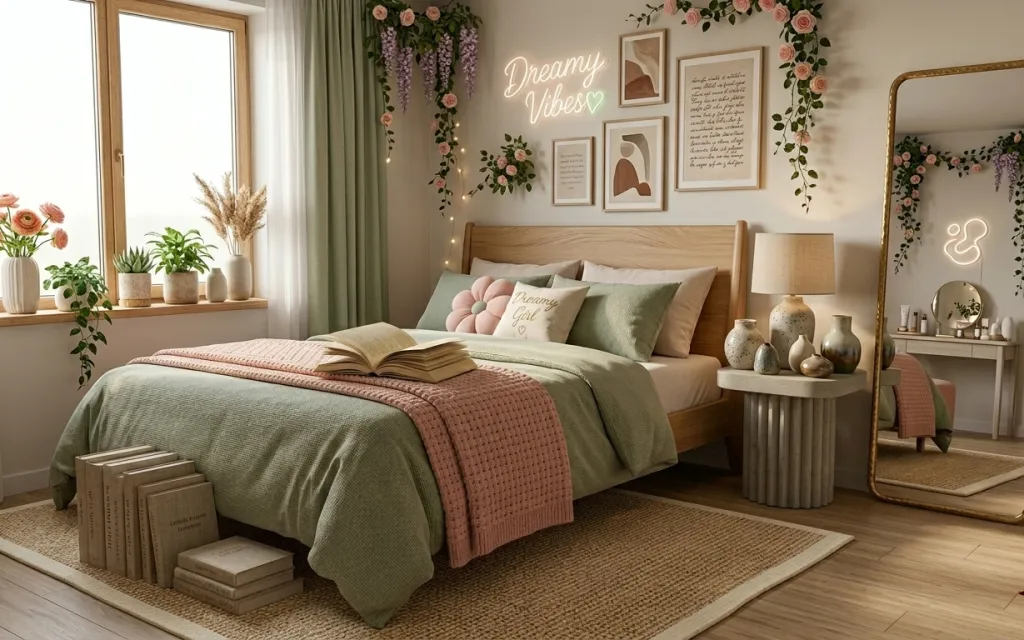
- Best for
- move-ready styling in shared bedrooms
- Time
- 2–4 hours for setup, longer if curtains need adjusting
- Total cost
- about $360 (under $400)
- Renter-safe
- yes—textiles, freestanding mirror, and removable lighting
Why the sage-and-terracotta bedroom look is the move-friendly bedroom of 2026
The hero’s palette is doing most of the work: sage green textiles, warm terracotta tones, and beige surfaces keep the whole bedroom calm even with a lot going on. The jute rug adds texture underfoot, while olive curtains soften the window wall without pretending the room is bigger than it is. A small framed wall print keeps the wall styled but not precious. Warm string lights and a cream table lamp handle the “after sunset” mood, and the brown knit throw brings the tactile, lived-in finish.
I almost over-decorated this kind of vibe the first time I tried it—more frames, more greenery, more everything—until I realized my eye didn’t know where to rest. The difference was choosing one focal zone (the bed + wall art) and repeating the same two materials (jute and warm beige) in small doses. That’s the trick for shared spaces: look intentional without turning your room into a moving box museum.
Layer 1 — jute rug (5×7 look) ($80) texture that makes the floor feel softer
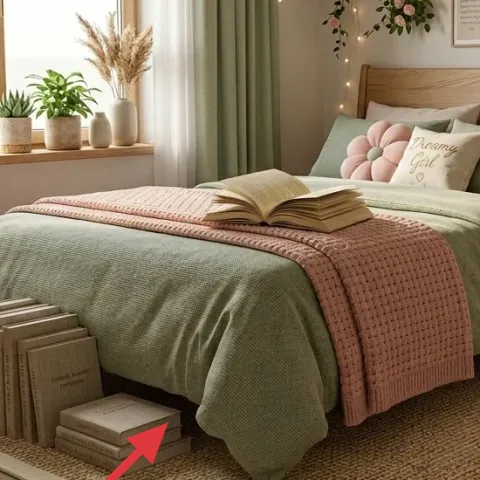
A jute rug is the quickest way to get that “warm under your feet” foundation you see in the hero, especially with a light wood floor. In the image it sits under the bed zone and anchors everything from the comforter to the side table, so you can add color elsewhere without fighting the base. The trade-off is shedding: jute can leave a little fiber at first, so a quick vacuum routine matters. The obvious alternative is an all-synthetic flat weave, but it usually reads smoother and less botanical—jute is the texture that keeps this bedroom from looking sterile.
Choose jute in a tight, natural weave
Natural texture shows best when the pattern is subtle; it keeps the wall art and plants from competing with the rug.
Layer 2 — olive curtain panel pair ($40) window softness without a permanent wall change
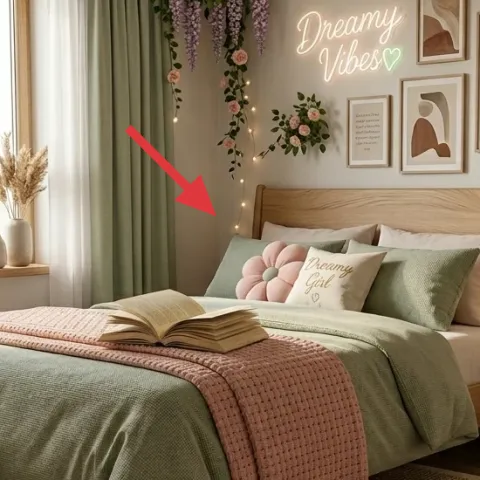
The olive curtain panels are doing a huge job in the hero: they tint daylight toward sage instead of letting the window wall look stark. Because they’re just fabric, they’re also one of the most practical moves for shared housing—fold, bag, and rehang the next lease. The trade-off is letting the window still do the heavy lifting: if the panels are too sheer or too thin, the color impact disappears. Instead of trying to “decorate the wall,” use curtains to reframe the room—especially when you already have framed prints and hanging floral garland on the wall.
Pair olive with white sheer for depth
That layered look keeps the daylight bright while still giving you a tinted, cohesive backdrop.
Layer 3 — small framed wall print ($40) one calm focal point among the botanicals
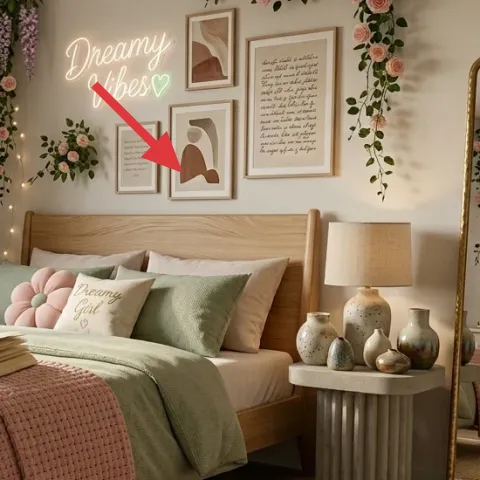
In the hero, the framed prints cluster keeps the wall from feeling blank without turning the bedroom into a full gallery wall. Picking one small framed print for this layer creates the same “collected” effect because it draws the eye where it already wants to go: toward the bed zone. The trade-off is restraint—one print won’t replicate a whole wall of frames, so it’s best when the rest of the wall already has decorative cues (like hanging floral garland). The obvious alternative is a larger, statement frame, but smaller pieces read more forgiving in rooms you’ll move out of quickly.
Keep frames varied but sizes close
Different imagery looks curated when the frames share a similar scale and material color.
Layer 4 — warm string-light arrangement ($30) the gentle glow around the bed
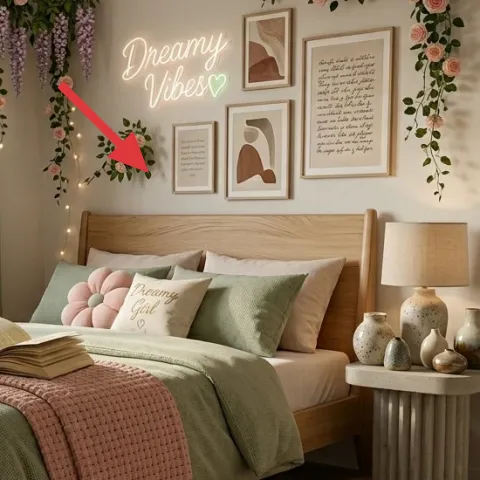
Warm string lights are the bedroom’s night shift in the hero: they make the bed wall feel finished and they soften the contrast between the window daylight and the darker wall tones. This is also a renter-friendly approach, because it avoids any drilling or permanent installs—just temporary placement for a cozy read after dark. The trade-off is careful routing: lights look messy if the line is too visible or tangled, so placement should follow the wall’s existing shapes. Instead of buying a pre-made “decor set,” build a simple arrangement that frames the bed zone and works with the hanging garland already in the room.
Make it instead of buying it
This string-light arrangement uses warm fairy lights plus removable hooks to outline the bed wall area—no drills, no patching.
Materials
- Warm fairy string lights — 1 set — store home goods/online — $15
- Command Strips multi-pack — 1 pack — hardware aisle — $8
- Twine ties (for bundling the line) — 1 roll — craft aisle — $2
Steps
- Plan the path by holding the lights against the wall behind the bed.
- Wipe the wall with a dry cloth, then place Command Strips where you’ll anchor the wire.
- Clip or tie small loops with twine so the wire lies flat without kinks.
- Hang the lights in a loose vertical-to-horizontal rhythm that echoes the wall’s garland.
- Plug in, then adjust spacing for a even glow—before you press down fully.
- Remove at move-out by pulling the strip tab slowly so residue stays minimal.
Total DIY cost: $25 — saves about $5 over buying.
Layer 5 — brown knit throw blanket ($25) color and texture that reads “finished”
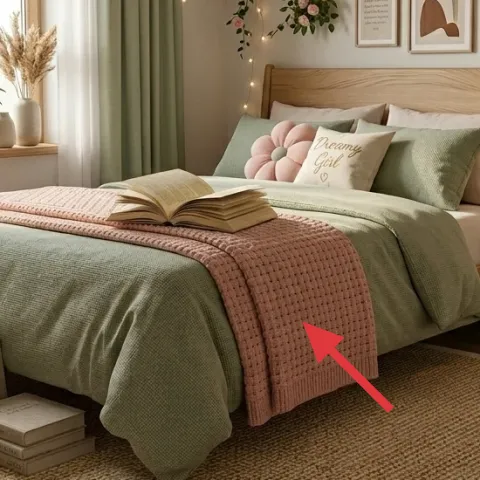
The brown knit throw is the hero’s easiest way to introduce texture on the bed without buying new furniture. It drapes over the comforter in a way that makes the bed look styled even when no one has made it perfectly. The trade-off is thickness: a knit that’s too chunky can overwhelm a small bedroom, while one that’s too thin won’t show the texture you see in the image. The obvious alternative is a smooth faux-fabric throw, but that won’t catch the warm lamp glow the way knit does. For a move-ready refresh, this is also one of the best textiles to fold and pack.
Don’t choose a knit that pills quickly
Look for tighter yarns and check reviews—pilling shows fast on throws that get constant use.
Layer 6 — cream table lamp ($25) a soft light source that makes wall decor feel intentional
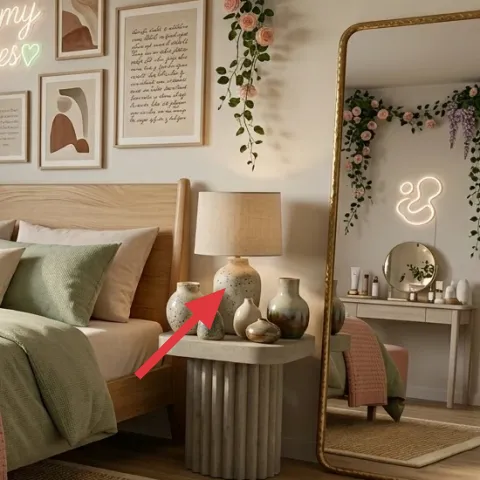
A cream table lamp gives you the same warm, readable glow you see in the hero without needing any hardwired changes. It sits beside the bed, so it supports the layered look: rug texture down low, window softness in the middle, and warm light near eye level. The trade-off is that you’re responsible for bulb choice—cool bulbs can fight the sage-and-terra palette. Instead of relying on overhead lighting, use the lamp to “paint” the wall with warmth, especially when string lights are already on. In shared housing, lamps are also great because they pack well and can move with you room to room.
Choose a shade that stays neutral
A cream shade keeps the wall art and plants from looking yellow-green under harsh bulbs.
Layer 7 — gold standing mirror ($120) reflection that doubles the bedroom’s botanical vibe
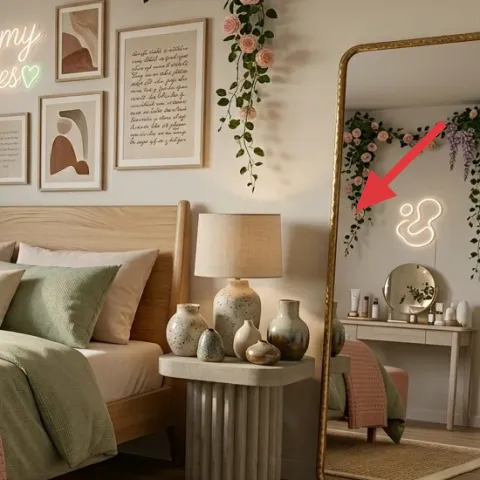
The gold standing mirror does two jobs at once in the hero: it adds a warm metallic frame and it visually expands the bedroom by reflecting the wall decor and lamp area. Because it’s freestanding, it also fits shared housing reality—you can move it room to room without negotiating with the landlord about hard installs. The trade-off is size and stability: you’ll want to place it where it can stand safely on the floor and won’t tip over easily. Compared with a small wall mirror, a standing mirror keeps the look cohesive even when you’re only styling one side of the room.
Lean into vertical shape
A taller mirror exaggerates the room’s height and balances the bed’s horizontal lines.
The cost, layer by layer
| Layer | Item | Cost |
|---|---|---|
| 1 | Jute area rug (5×7 look) | $80 |
| 2 | Olive curtain panel pair | $40 |
| 3 | Small framed wall print | $40 |
| 4 | Warm string-light arrangement (DIY-equivalent) | $30 |
| 5 | Brown knit throw blanket | $25 |
| 6 | Cream table lamp | $25 |
| 7 | Gold standing mirror | $120 |
| Total | $360 | |
If you want the same vibe for less, swap the mirror for a smaller gold-leaning framed mirror and choose an off-white lamp shade instead of cream. You’ll still get the warm reflection and soft glow, but the “metal moment” becomes smaller and cheaper.
What worked, what didn't (across the whole room)
The best results came from layering texture where your hands naturally land: rug underfoot, knit on the bed, and a neutral lamp shade nearby. The warm string-light arrangement also made the wall feel styled at night, not just during daylight. The gold standing mirror helped the botanical wall feel less busy by reflecting the scene instead of adding another flat rectangle.
What worked
- The jute rug grounded the sage and terracotta palette without making the room feel heavy.
- Olive curtain panels tinted daylight, so the wall art and botanicals read softer together.
- Warm string lights filled the “bed wall gap” after dark and reduced harsh contrast.
- The brown knit throw added texture that held up even when the bed wasn’t perfectly tucked.
- The cream lamp shade kept reflections neutral instead of turning the room yellow-green.
- The gold standing mirror made the botanical wall feel intentional from multiple angles.
What didn't
- Choosing too many framed prints at once made the bed wall feel visually crowded.
- Cool-toned bulbs would have fought the warm beige decor and made everything look flatter.
- If the string lights sit too taut, you lose the organic, garland-like rhythm.
- A throw that’s too thick can visually shorten a smaller bedroom bed zone.
- Placing the standing mirror too close to the bed can crowd the walkway instead of opening it.
What we'd skip if we did it again
Skip a “matchy” bed setup that relies on patterned bedding that isn’t flexible. In a shared space, the easiest wins come from changing texture and color with textiles you can fold—rug, knit throw, and simple pillows—rather than committing to a full coordinated set that won’t travel well.
Skip hardwired-looking lighting tricks. If the look depends on anything installed into the ceiling or wall, it’s harder to remove at move-out, and it usually costs more than a plug-in lamp that can move with you.
Skip building a full gallery wall immediately. Start with one small framed wall print and let the string-light glow and curtains do the “volume” work—then add more frames only if the room still feels blank after you live with it for a week.
Frequently asked
How long does this bedroom refresh take?
Plan on about 2–4 hours if the rug, curtains, lamp, and mirror are already in-hand. The slow part is tuning the visual rhythm: centering the rug under the bed zone, lining up curtain height, and adjusting the string-light path so the warm glow looks intentional. The framed print placement is quick, but spacing checks usually take extra time.
Will this work in a rented bedroom with limited control?
Yes, because the big changes here are textiles, freestanding pieces, and removable decor. Curtains can be re-used across leases, the standing mirror doesn’t require wall mounting, and string lights can be anchored with removable Command Strips. Even if wall art placement is constrained, you can keep the bed-zone focal point by choosing one framed print.
What if my bedroom is smaller or wider than the hero?
For a smaller room, keep the rug closer to the bed footprint and avoid over-extending the mirror so it doesn’t block a walkway. For a wider room, center the mirror opposite the bed wall so the reflection fills more space. The key is repeating the same materials—jute and warm neutrals—so proportions feel cohesive even when the room’s dimensions change.
Where should I shop differently for the best results?
For textiles and lighting, focus on places with good return policies for color and texture—curtains and knit throws are easier to swap when fabric tone matters. For decor items like the gold standing mirror, thrift and home resale sites can be a win, but check stability and condition. For framed prints, look for smaller sizes so the bed wall stays calm.
Biggest mistake to avoid in this bedroom style?
The biggest miss is adding too many competing “focal” elements at once—multiple large frames plus dense garland plus several bold textiles. If the wall is already decorative, the bed zone should use fewer, stronger materials: one rug, one knit throw, and warm light. When in doubt, reduce the number of frames and let string lights create the depth.
More in Bedroom
Under $400: botanical bedroom refresh with move-ready swaps
A bedroom refresh that copies the hero’s botanical feel with move-ready swaps and no drilling. This plan keeps the total under $400 and foc…
Under $500: earthy-neutrals bedroom refresh with 7 move-ready swaps
A bedroom refresh built for shared housing: add a patterned area rug, layer a rust knit throw, and swap in renter-safe wall decor—plus ligh…
Under $600: a shared-house Mediterranean bedroom refresh with seven movable layers
A complete seven-layer shared-house refresh for a Mediterranean bedroom — cream block-print pillow shams, olive linen throw, two matching C…