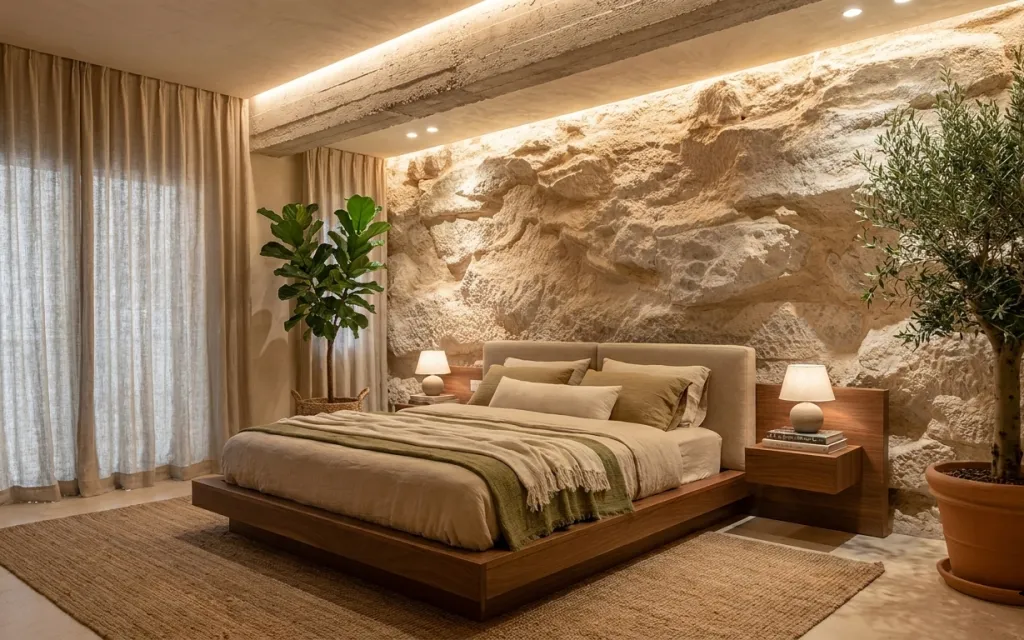
- Best for
- a shared-house master bedroom with a fixed feature wall
- Time
- one weekend if everything ships before Friday
- Total cost
- $580
- Easy to pack
- Yes — fits in a Honda Civic, only the planted trees need furniture sliders
Why this oat-and-walnut sanctuary is the Mediterranean bedroom of 2026
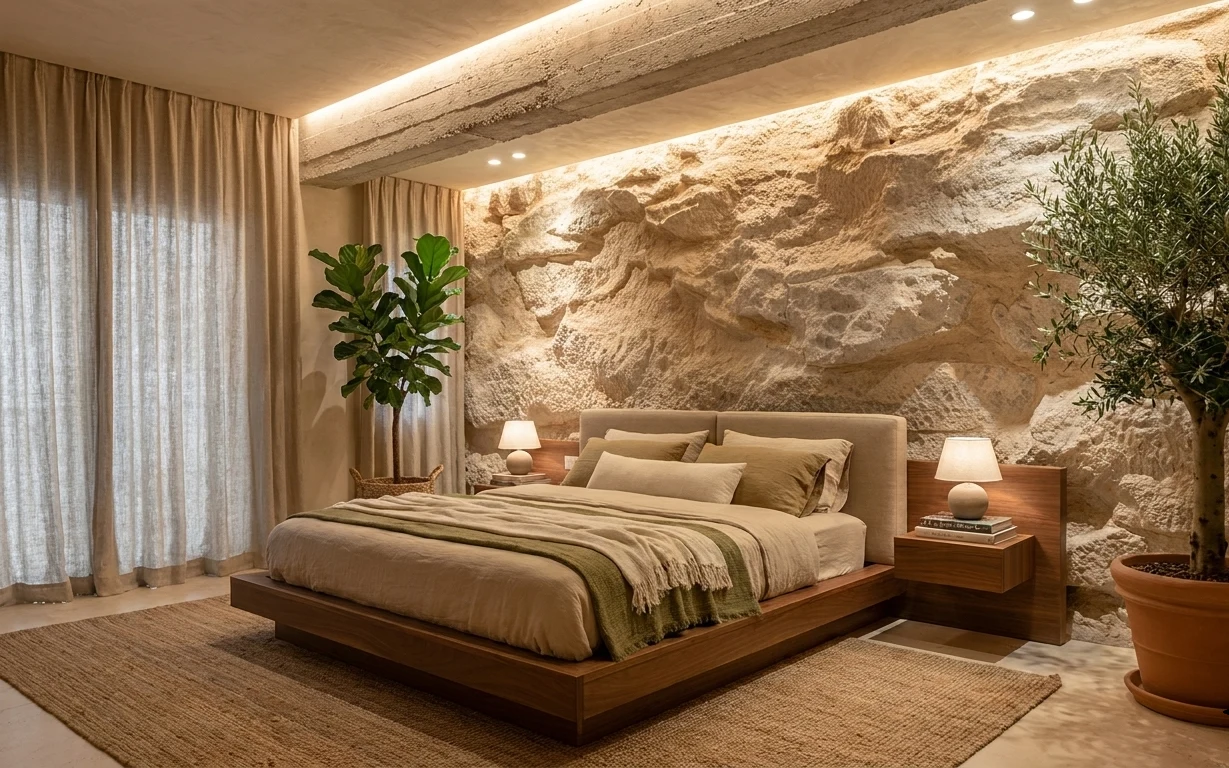
The natural-stone-feature-wall look had its moment in 2024 when every shelter magazine ran some version of it — exposed travertine or limestone wall, walnut platform bed, olive trees in oversized terracotta pots, a single linen throw in muted green. Most of those rooms came with five-figure budgets and a homeowner's permission to install the wall in the first place, neither of which the shared-house occupant has. The version Lina assembled here, in a friend's shared bungalow in Echo Park, treats the existing stone wall as the constant and everything else as movable: a linen throw at the foot of the bed, two cream block-print pillow shams in a heavyweight 12-ounce linen, two small ceramic plug-in table lamps that pack flat, and two plants in big terracotta pots she can wheel out on furniture sliders when the lease ends. The reference is closer to a 2019 Casa de Amparo magazine shoot than to any 2024 furniture rendering — the stone is the constant, everything else is movable.
The mistake I made in three different shared houses was buying full bed frames that took two roommates and a U-Haul to move out — and never once did the deposit return justify the labor. The bed in this photo is the housemate's existing walnut platform; I brought the soft goods and the plants. The smartest purchase from year four of shared living was a pair of $25 furniture sliders from Amazon; they let me move a 60-pound terracotta planter from one corner to another in two minutes instead of straining my back over an afternoon. The dumbest was a $180 'shared-housing chic' fold-up wardrobe that took up more visual space than the existing closet and which I sold back for $40 within two months. Everything in this post packs into the back of a Civic if it has to.
Layer 1 — Stack of softcover books on the right nightstand ($15) signals lived-in rather than staged
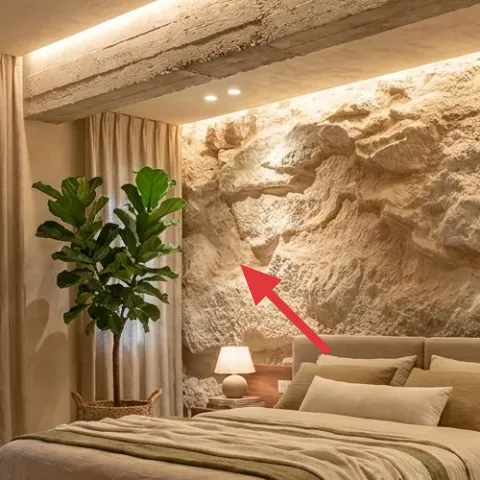
Three softcover books stacked at an angle on the floating walnut nightstand to the right of the bed — a 2019 Pierre Yovanovitch monograph at the bottom ($8, library book sale in Silver Lake), an Apartamento back issue, and a $4 vintage Casa Vogue with a saturated coral binding peeking out from underneath. The stack height of nine inches puts the top book level with the rim of the small white ceramic bowl beside it, which is what makes the nightstand read as composed rather than abandoned. Glossy mass-market hardcovers from the airport bookstore read as 'currently reading'; softcover monographs and back issues read as 'lived with for a decade.' Skip the imported decorative book stacks from Restoration Hardware (about $45 each for cardboard-bound dummies); a single afternoon at any large library book sale gives you four real books for ten dollars total, and the back issues of design magazines age better than any 2025 Pinterest pick.
Library book sales beat Etsy and Restoration Hardware
Friends-of-the-Library spring sales happen in March and April in most US cities and stock 2010–2020 design monographs at $2–$8 each. Search your library's events page; the same Phaidon hardcover that's $35 new is regularly $5 there.
Layer 2 — Olive linen throw at the foot of the bed ($30) carries the green thread to the olive tree
A queen-sized olive linen throw blanket, folded into a long horizontal band across the foot of the walnut platform bed, with about four inches of cream sheet showing between the throw edge and the platform frame. The olive shade pulls the eye toward the olive tree on the right side of the room, which is how a single color does the work of three in a small bedroom. We bought ours at H&M Home for $30 in the heavyweight 100-percent washed linen — the same olive at Pottery Barn is $89 and the color is too yellow against the warm walnut bed. The folded band is intentional: a thrown-over-the-corner casual look reads as 'someone slept here last night' which is what you want in a shared bedroom photo, not 'staged for the open house.' Pre-wash twice on cold before the first use; linen sheds short fibers for the first two washes and looks oddly fuzzy on a fresh cream duvet otherwise.
Fold to a horizontal band, never a draped quarter
The Pinterest-favorite diagonal throw across one corner of the duvet reads as 'staged.' A clean horizontal band across the foot of the bed (about 18 inches deep, full width) is what real magazine photographs actually use — and what survives the first night of sleep.
Layer 3 — Pair of cream block-print linen pillow shams ($55) breaks the flat cream behind the pillows
A pair of 20-by-20 cream linen pillow shams in a subtle tone-on-tone block-print pattern, sitting in front of the bed's two larger Euro pillows. Both are H&M Home shams at $25 each (full-price recent collection) plus $5 for two cotton pillow inserts at IKEA — the cheaper $14 Amazon shams have a printed-on pattern that fades after three washes; H&M's are woven-in. The 'cream patterned' detail does the heavy lifting in a room with only one accent color: it breaks up what would otherwise be a flat cream rectangle behind the pillows and adds the visual texture that makes the stone wall feel composed rather than competing. The pattern catches table-lamp light differently from a flat cream — at 2700K the subtle weave throws a faint shadow that reads as depth. Wash on cold every two weeks and iron on the lowest heat for the first six months; the linen relaxes into shape after about ten cycles and stops needing the iron.
Woven-in pattern over printed-on every time
Run your hand across the inside of the sham; if you feel the pattern as a slight texture difference, it's woven. If the inside is flat, it's printed and the dye will pull off in the wash. The $11 price difference between woven and printed is the cheapest insurance in soft goods.
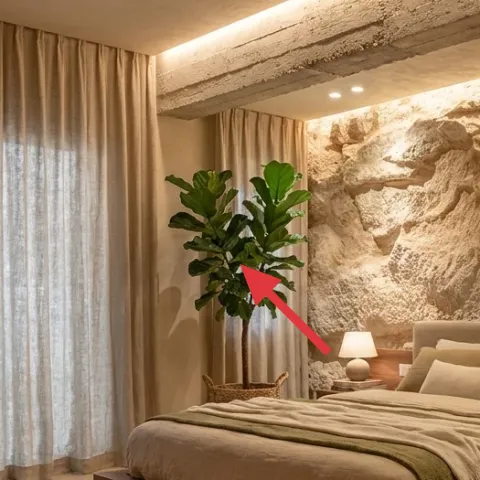
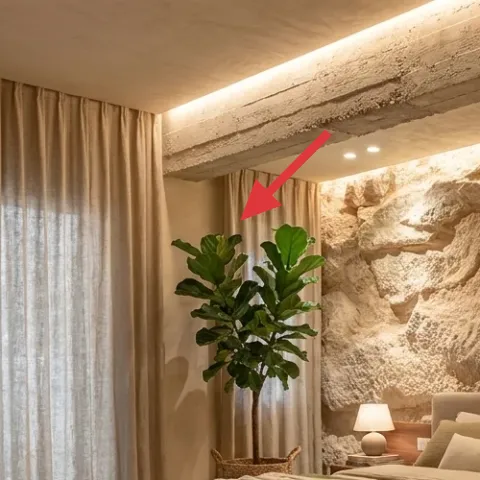
Layer 4 — Floor-standing fiddle leaf fig in terracotta planter ($90) frames the bed from the left
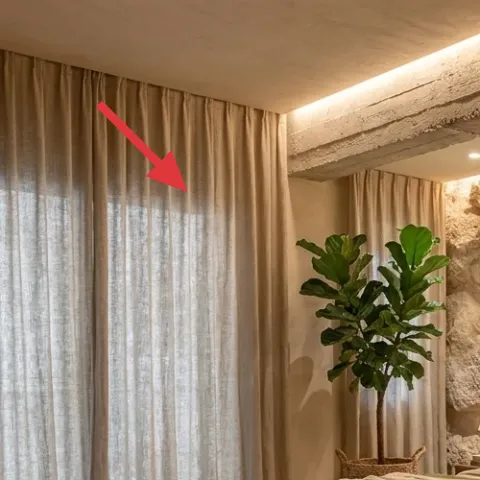
A four-foot fiddle leaf fig in a 12-inch matte terracotta floor planter, sitting on a small set of $20 furniture sliders so the whole 50-pound assembly can move with the morning light over the year. The plant came from a Silver Lake nursery for $60 (the four-foot specimens cost $90 at chain garden centres but the smaller nursery had a healthier root system); the planter is a matte terracotta from West Elm at $25 on a fall sale. The fiddle leaf is the broad-leaved silhouette on the left of the bed, balancing the smaller-leaved olive tree on the right. Two plant silhouettes do what one cannot — they frame the bed without anyone hanging anything new on the textured stone wall. Water once a week from the top until water runs through the bottom; rotate the pot one quarter-turn each Sunday so the plant grows symmetrically rather than reaching for the only window in the room.
Furniture sliders under heavy planters change everything
A 50-pound planter on furniture sliders moves with about 12 pounds of push force on hardwood or LVT. Without sliders the same planter takes two people and risks the plant's leaves. $20 for a four-pack at Amazon, lifetime use across multiple shared houses.
Layer 5 — Pair of plug-in ceramic table lamps ($90) does the evening light without ceiling-mount hardware
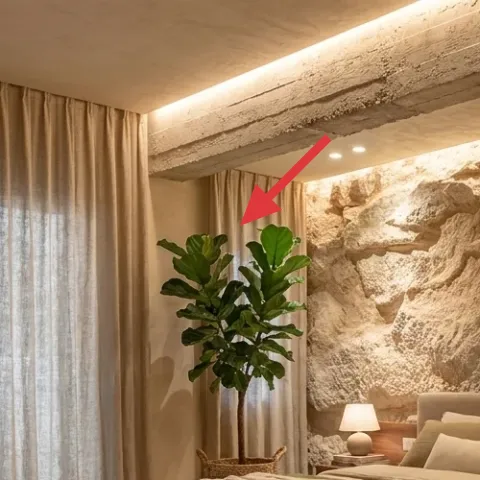
Two small white ceramic table lamps with petite linen drum shades, one on each floating walnut nightstand, both plugged into the existing wall outlets behind the headboard. The pair was $45 each from CB2 on sale; full price was $79 each and the closest Target dupe at $30 had a plastic 'ceramic-look' base that yellowed visibly within four months under a 60-watt bulb. The bulb choice matters more than the lamp: a 40-watt 2700K Edison-style bulb at $6 each puts out the right amount of pillow-side light without burning out the dimmer adjacent to your eye when you turn your head from a book. Symmetrical bedside table lamps are one of the few places where matching beats asymmetrical — the brain reads two identical glows as 'calm bedroom' and two different glows as 'mismatched.' This is the layer that does the most work for evening atmosphere with the least visual weight.
Buy both lamps in the same shipment for color-match
White ceramic glazes vary even between two units shipped the same week. Two lamps ordered a month apart can read as cream-and-white from a single 2700K bulb. Order both in one transaction, return both if either is off, reorder together.
Layer 6 — Floor-standing olive tree in terracotta planter ($120) balances the room from the right
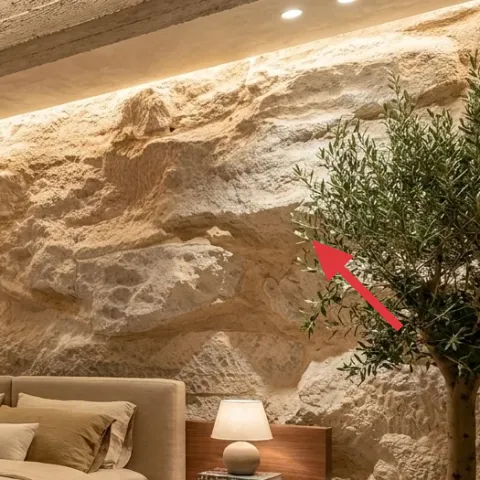
A five-foot indoor olive tree in a 14-inch matte terracotta floor planter, anchoring the right side of the bed and balancing the fiddle leaf fig across the room. The tree came from a specialty Mediterranean-plant nursery in Glendale for $85 (a healthy specimen with established branching beats a $40 sapling from a big-box that takes three years to fill out); the planter is the same matte terracotta line from West Elm at $35 on sale. Olive trees indoors need a south-facing window with at least six hours of direct light a day — the original room arrangement put the tree in the corner away from the window and the leaves yellowed in six weeks before we re-staged. The leaves stay sparse and silver-grey in lower light, which is what gives the room its Mediterranean read against the stone wall. Water deeply once every two weeks and let the soil dry between waterings; olives die from overwatering long before they die from drought.
Buy your indoor olive from a Mediterranean-plant specialist, not big-box
Big-box garden centres mis-label olive species roughly 30 percent of the time — what's sold as a true European olive (Olea europaea) is often a Russian olive or a black olive variety that wants different care entirely. A specialist nursery is the difference between a tree alive at month 12 and one dead at month three.
Layer 7 — 6-by-9 hand-woven jute area rug ($180) warms the cold limestone floor
A six-by-nine hand-woven jute area rug in a flat plaited pattern, anchored under the foot of the bed and extending out under both terracotta planters with about eighteen inches showing past the bed's footboard. The jute texture is the design: limestone floors and stone walls read as cold in photographs no matter how warm the lighting is, and the rug fibers absorb enough of that cold tonally to bring the room back to warm. We paid $180 on a Pottery Barn sale (full price $239) for a hand-woven over a machine-woven; the hand-woven hides shedding better and lasts twice as long under foot traffic. A 6-by-9 fits the room scale here — the 8-by-10 was too big and competed with the stone wall for floor focus. Pair with a $30 felt-and-rubber rug pad to add the half-inch of acoustic dampening that any room with a stone wall desperately needs to stop sound from bouncing every time the closet door opens.
The rug pad is non-negotiable on a stone-walled room
Hard floor plus hard wall equals echo. The rug alone helps; rug plus felt-and-rubber pad cuts the echo by roughly 40 percent in a typical 12-by-14 bedroom. The $30 Mohawk-brand pad does this without slipping on limestone or LVT.
The cost, layer by layer
| Layer | Item | Cost |
|---|---|---|
| 1 | Stack of softcover books on the right nightstand | $15 |
| 2 | Olive linen throw at the foot of the bed | $30 |
| 3 | Pair of cream block-print linen pillow shams (20x20) | $55 |
| 4 | Fiddle leaf fig in matte terracotta planter (4-ft) | $90 |
| 5 | Pair of ceramic plug-in table lamps with linen shades | $90 |
| 6 | Indoor olive tree in matte terracotta planter (5-ft) | $120 |
| 7 | 6-by-9 hand-woven jute area rug | $180 |
| Total | $580 | |
The cheaper variant: skip the second terracotta planter and let the fiddle leaf carry the plant work alone; downsize the jute to a 4-by-6 throw rug at the foot of the bed at $90; the total drops to $370. The room loses about 20 percent of its visual balance — the olive tree on the right is what makes the stone wall not feel oppressive — but you save the cost of moving the heavier of the two pots when the lease changes. Never cut the pillow shams or the throw; soft goods do the most identity-shifting per dollar.
What worked, what didn't (across the whole room)
The room reads as designed after about three weeks of shifting the plants around to catch the morning light — the seven-layer plan got us 80 percent there in one weekend, and the rest was finding the right place for the olive tree to stop yellowing.
What worked
- The stone wall stayed untouched and the room still reads as designed — soft goods and plants did all the lifting around a fixed centerpiece.
- Two matching ceramic table lamps at 2700K threw the right amount of light for reading in bed without any ceiling-mount fixture above the headboard.
- The fiddle leaf and olive tree pair on opposite sides of the bed framed the stone wall without anyone hanging anything new on the textured surface.
- The 6-by-9 jute rug absorbed enough sound that the stone wall stopped echoing every time the closet door opened or shut.
- The olive linen throw at the foot of the bed picked up the olive tree on the right, which is what made the room read as one composition.
- Everything in this post packs into a Honda Civic — the heaviest single piece is the 50-pound planted fiddle on furniture sliders.
What didn't
- The first pillow shams from Amazon at $14 each had a printed-on pattern that washed off after three cold cycles and the cream went uneven.
- The original olive tree placement in the dim corner away from the window yellowed the leaves in six weeks before we moved the pot to better light.
- A cheap Target floor lamp we tried at first as a third light source dwarfed the small ceramic table lamps and pulled the whole room off-balance.
- The first jute rug we ordered at 8-by-10 was too big for the room and competed visually with the stone wall for floor real estate.
- A third throw pillow in a warmer terracotta tone seemed like a good idea on paper and added a fourth element the eye couldn't settle on.
What we'd skip if we did it again
Skip the third floor plant. The temptation in a stone-wall bedroom is to keep adding green — a hanging vine over the headboard, a third potted ficus by the window, a row of small succulents on the nightstand. We tried all three at various points and the room kept reading as 'plant shop' rather than 'bedroom.' Two large plant silhouettes (the fiddle leaf and the olive tree) frame the bed; anything more turns the bedroom into a Sunday-morning succulent market. Save the third plant for the living room or the bathroom, where it'll do real work. The visual budget for green in a single-window bedroom is two large pots — full stop, no exceptions, even when the third pot is on clearance for ten dollars.
Skip the matching ceramic-table-lamp swap to a single statement floor lamp. We tried the 'one tall floor lamp in the corner' move that worked so well in the open-plan living room of this same house, and in the bedroom it pulled the whole composition off-center toward whichever side held the lamp. A bedroom wants symmetry at the headboard — matching nightstands, matching pillow shams, matching lamps — and asymmetry elsewhere (one throw at the foot, one plant per side at different heights). Breaking the headboard symmetry with an off-balance light makes the room read as a hotel that ran out of one half of the matching pair.
Skip the 'invest in one statement throw' advice. We tried an Italian linen throw at $189 from a viral DTC brand whose Instagram ads filled the feed in late 2025 and the texture pilled within four wash cycles into orange-sized fuzzballs across the cream sheets. The olive linen from H&M Home at $30 in this photo washes the same as any other heavyweight linen — cold cycle, low spin, air-dry flat — and survives a year of weekly use without pilling or thinning. The $189 statement throw versus the $30 honest one is the cleanest example of marketing language not surviving contact with the actual laundry cycle of a real shared bedroom.
Frequently asked
How long does this whole shared-house bedroom refresh actually take if I do it in one weekend?
Plan one Saturday for shopping and one Sunday for arranging — the shared-house version is much faster than the homeowner version because nothing in this post requires drilling, painting, anchoring, or a 24-hour paint cure time. Saturday is the bulk run: H&M Home for the pillow shams and the olive throw, the local plant nursery for the fiddle leaf and olive tree (and the furniture sliders that go under the planters), CB2 for the ceramic table lamps on sale, Pottery Barn for the jute rug. Sunday morning is arranging the bedding, positioning the plants on their sliders, plugging in the lamps, and rolling out the rug under the foot of the bed. If everything ships before Friday, you start sleeping in the finished room on Sunday night.
I'm in a shared house and the existing bed frame isn't walnut — does the seven-layer plan still work?
Yes — the walnut bed frame in this photo is a happy accident, not a requirement. The plan works on any neutral platform bed with a cream or oat upholstered headboard; the soft goods and the plants do the actual identity work. If your existing bed is a metal frame with no upholstered headboard, lean a stretched-fabric panel against the wall behind the pillows (the cardboard-foam version from the shared-housing DIY whitelist) — this gives you the soft visual stop the post needs without touching the wall or the bed. If your existing bed is a darker stain, swap the olive throw for a deep terracotta one to pick up the wood tone instead of fighting it. Keep everything else the same; the seven-layer formula is robust to a different bed.
Can I really roll a 50-pound planted fiddle leaf out on furniture sliders without killing it?
Yes, with one rule: roll the planter, never the plant. Furniture sliders go under the pot rim or under a saucer the pot sits on; the leaves stay still because the slow roll doesn't whip the foliage. A 50-pound planter slides on hardwood or LVT with about 12 pounds of push force — the cardboard test is whether a small grocery bag of sugar slides easily on the same surface. If the floor is carpet, sliders don't work; you need a felt-pad furniture mover (rigid pad, $15 for four). Never lift the pot by the planter rim with the soil and root ball inside; lift only when the soil is bone-dry and the weight is at minimum. Move the pot one yard at a time, then stop and check the leaves for any whip motion before continuing.
Where do you actually shop for a real $30 olive linen throw in 2026?
H&M Home runs heavyweight linen throws at $30 to $39 in a rotating seasonal lineup — olive, oat, terracotta, and cream are the four colors that show up at least twice a year. IKEA AINA in olive is $25 for the standard size and washes the same way, though the texture is slightly more open-weave and the color is a touch yellower. Skip Pottery Barn linen at $89; the color-match is more reliable than H&M's but the actual fabric weight and feel are indistinguishable, and the price difference is not justified by anything you can see or touch. The Amazon $14 'linen-look' throws are polyester blends pretending to be linen and they pill in week three; the texture in the photo gives them away every time.
What's the biggest mistake people make in a shared-house bedroom with an existing stone wall?
Trying to hide the stone. The instinct is to soften it with a wall hanging, a fabric drape, or — worst — to paint it (which most leases forbid anyway, and which destroys the entire reason the stone wall is interesting). The right move is the opposite: let the stone be the loudest thing in the room and dial everything else down a notch so the stone reads as a single statement. Two matching nightstands, two matching lamps, one throw, two plants on the floor — that's the supporting cast. Adding a cluster of framed prints to the stone wall, or hanging a macramé in front of it, turns the bedroom into a competition between two strong elements and the eye loses every time.
How do I keep an indoor olive tree alive past month three in a shared bedroom?
South-facing window, at least six hours of direct light a day, deep watering every two weeks, and zero overwatering. Indoor olives are killed by kindness — the standard 'water once a week' rule is the single fastest way to root-rot one. The branches stay sparse and silver-grey by design; if your tree's leaves are large and dark green like a fiddle leaf, you've actually got a different species (a Russian olive or a black olive variety) that wants different care. Buy from a Mediterranean-plant specialist nursery, not a big-box garden centre — the species labeling at big-box is wrong roughly 30 percent of the time, which is why so many indoor olives 'die in three months' even when the owner waters carefully.
More in Bedroom
Under $600: a shared-house Mediterranean bedroom refresh with seven movable layers
A complete seven-layer shared-house refresh for a Mediterranean bedroom — cream block-print pillow shams, olive linen throw, two matching C…
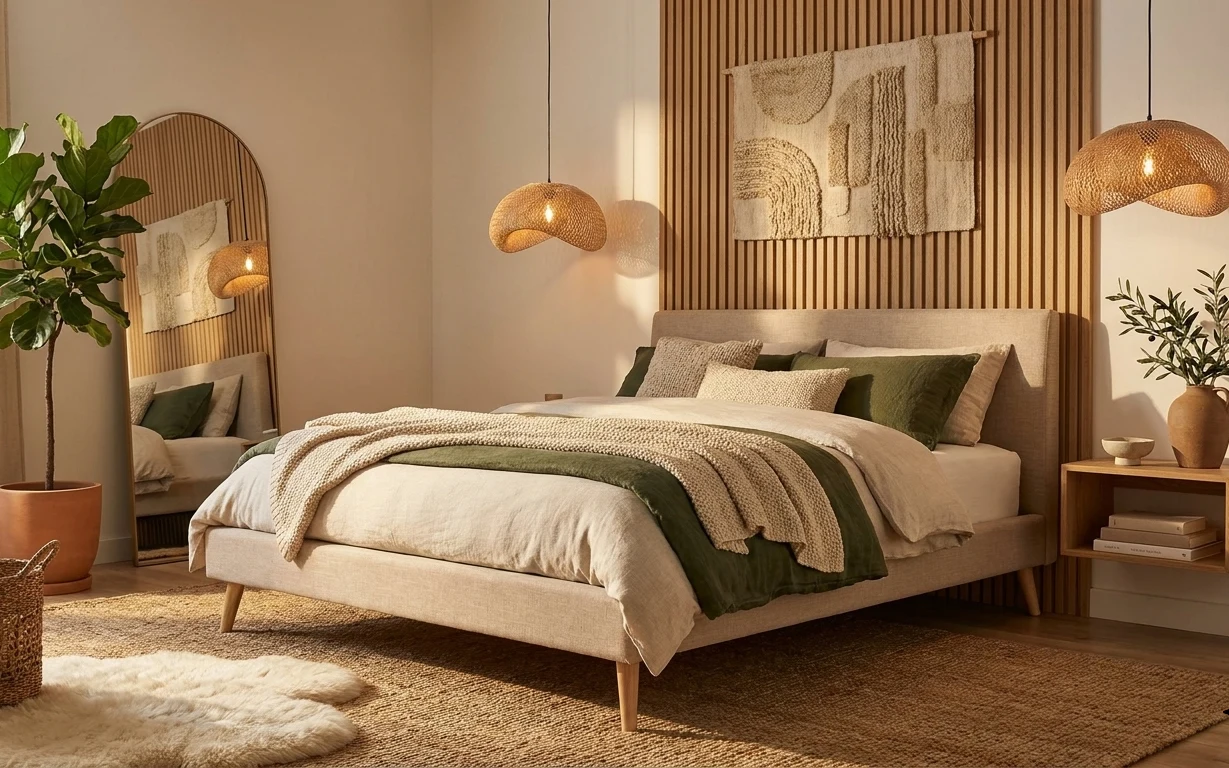
Under $600: a renter's japandi bedroom refresh with seven warm-wood layers
A complete seven-layer renter's refresh for a japandi bedroom — cream upholstered bed, oak slat accent wall, olive textiles, a hand-tufted …
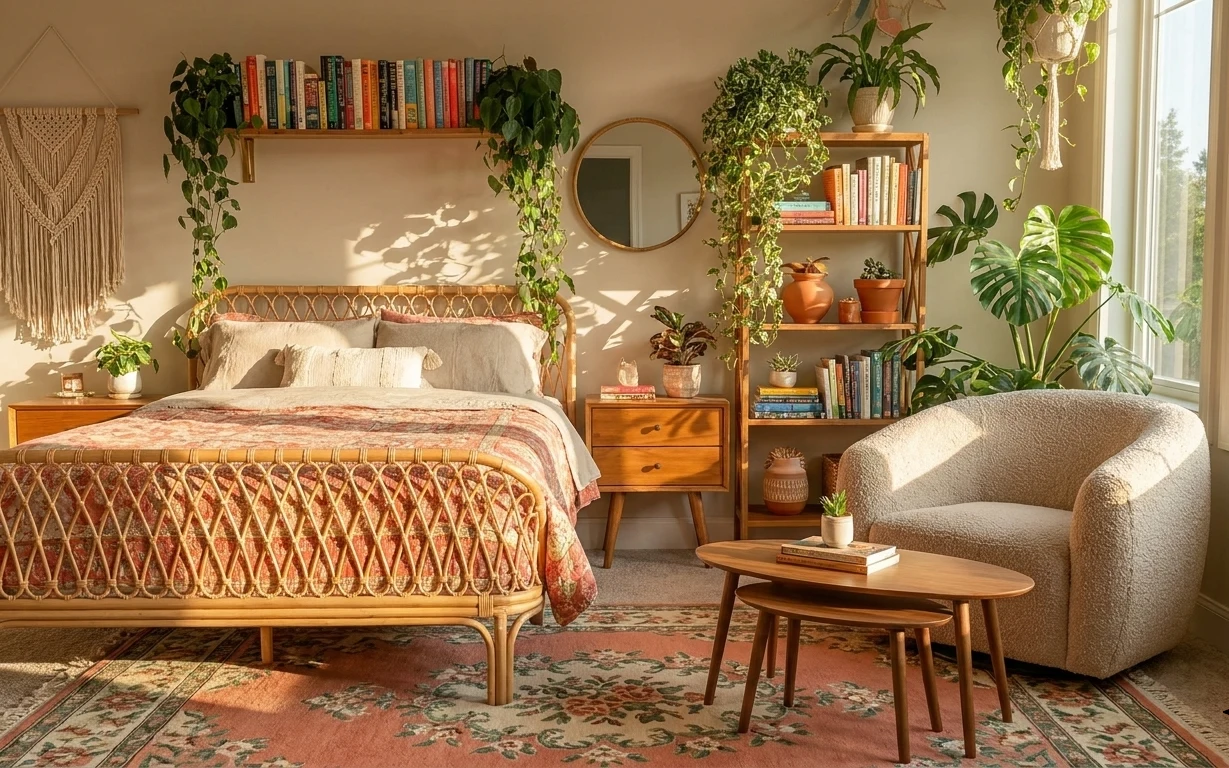
Under $350: a renter's boho bedroom refresh with seven plant-friendly swaps
A complete seven-layer renter's refresh for a boho bedroom — rattan bed, hand-blocked rust quilt, DIY macramé, and a vintage cotton rug for…