- Best for
- small to mid-size renter bedrooms
- Time
- one weekend (two afternoons)
- Total cost
- $325
- Renter-safe
- Yes — Command strips, no drilling, plug-in lighting only
Why this rattan-and-terracotta retreat is the boho bedroom of 2026
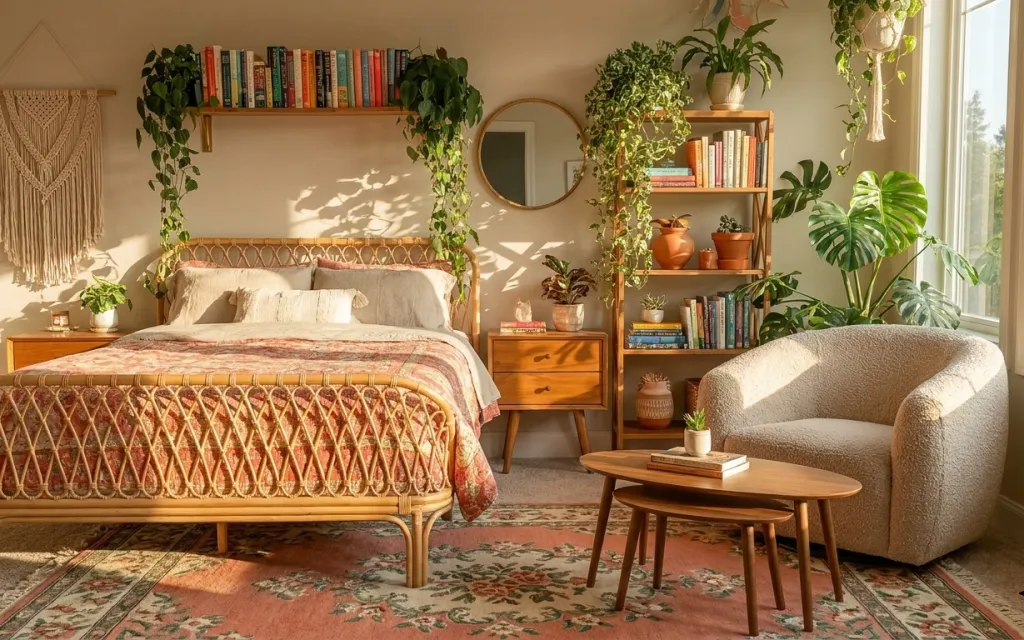
The instinct with a plant-heavy bedroom is to chase the Instagram version — a wall of monstera, four matching macramé hangings, the exact rust quilt from that one Apartment Therapy spread. Lina kept getting calls from renters who'd done that and ended up with a room that felt staged rather than lived-in. The fix here is older than the trend: a rattan headboard, a hand-blocked coverlet in faded reds, and only three real plants doing eighty percent of the green work. The reference is closer to a 1976 Mary Emmerling brownstone than a 2024 reel.
I tried to copy a friend's similar setup last spring and spent two weeks moving a pothos around the room before admitting it just looked wrong in every spot. The thing I'd missed: she had her trailing plant sitting six feet up on a shelf, not on the floor. The minute I raised mine onto the floating shelf above the bed it stopped reading as a misplaced houseplant and started reading as part of the architecture.
Layer 1 — Tabletop pothos on the nightstand ($25) sets the green baseline
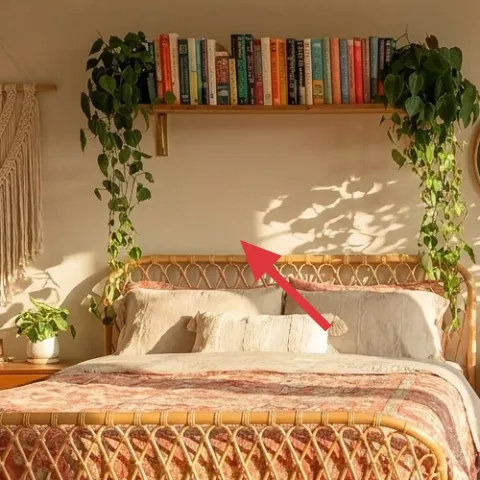
A 4-inch baby pothos in a small terracotta pot, sitting on the corner of the wood nightstand where it catches the side-light from the window without scorching. The pot is the same warm clay as the larger planters on the bookcase, which is what makes the whole left-to-right palette feel intentional rather than collected. A solid-green leaf would have been cheaper at the nursery; we paid five dollars more for a marble queen variety because the cream variegation pulls light off the wood drawer front. The cute mini ceramic pots from a discount store crack on the first temperature swing and the plant suffers.
Pick the pot before the plant
The terracotta pot sets the palette; bring it home first and walk the nursery aisle holding it. A red-clay pot wants a cream-edged leaf, never a deep glossy green.
Layer 2 — Ceramic-potted pothos on top of the bookcase ($35) bookends the green at the high point
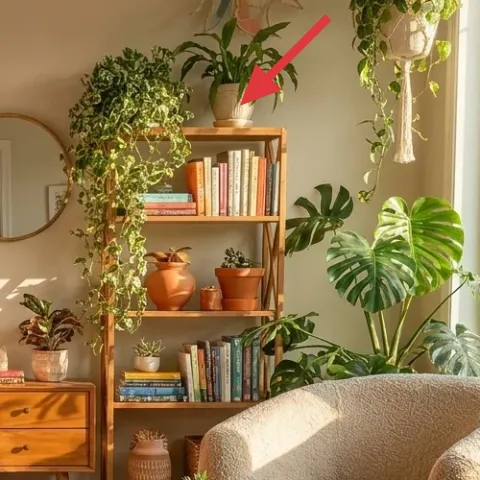
A bushy pothos in a cream stoneware pot, set on the top of the wood bookcase where it can spill toward the wall and toward the window without crowding the lower shelves. The pot is the move here — a cream ceramic against warm wood and against green leaves is the third color that keeps the corner from feeling earth-toned to the point of dullness. We trained the longest vines toward the window over four months, which is what gets them lit by the morning light at exactly this angle. The same plant in a terracotta pot would have collapsed into the bookcase visually.
Why a cream ceramic, not another terracotta
Terracotta on terracotta on cotton-rust-bed reads as monochrome and the eye stops scanning the room. A cream pot up high gives the gaze a place to rest before it travels back down the bookcase.
Layer 3 — Macramé wall hanging ($35) softens the bare wall above the nightstand
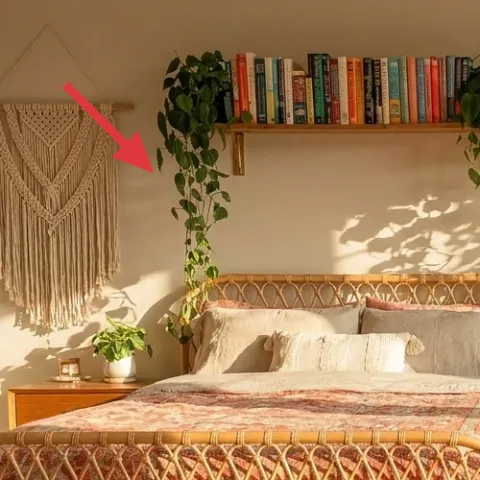
A diamond-knot macramé panel on a 24-inch wooden dowel, hung from a single 3M Command hook on the cream wall. Etsy sells the equivalent at $35 to $55 — we made ours for $24 in materials, which is the savings calculation in the block below. The cord we used is 5mm natural cotton, untwisted at the bottom for the fringe; thinner cord reads as a doily, thicker cord starts to look like a hammock. The width matches the nightstand top almost exactly, which is what makes the whole left side of the bed feel composed rather than busy.
Make it instead of buying it
A square diamond-knot macramé panel takes a Saturday afternoon and zero special tools — just your hands, a hook to mount the dowel on, and patience for the first ten knots.
Materials
- 5mm natural cotton macramé cord — 50 yards — craft store or Amazon — $14
- Pine wood dowel — 1 inch × 24 inches — hardware store — $5
- 3M Command large hook — single — drugstore — $5
Steps
- Cut sixteen 8-foot lengths of cord, fold each in half, and lark's-head them onto the dowel so the cord covers the wood completely.
- Row 1: tie square knots in pairs of four strands across the width, skipping the outer two strands on each side.
- Row 2: shift the pairing by two strands and tie another row of square knots — that offset is what creates the diamond mesh.
- Repeat the alternating pattern until the panel is about 18 inches tall, then trim the bottom fringe into a soft V-shape.
- Press a Command hook to the wall, wait an hour for the adhesive to set, and hang the dowel by its hidden string loops.
Total DIY cost: $24 — saves about $11 over buying.
Layer 4 — Floating wood shelf with thrifted books ($40) gives the headboard a horizon line
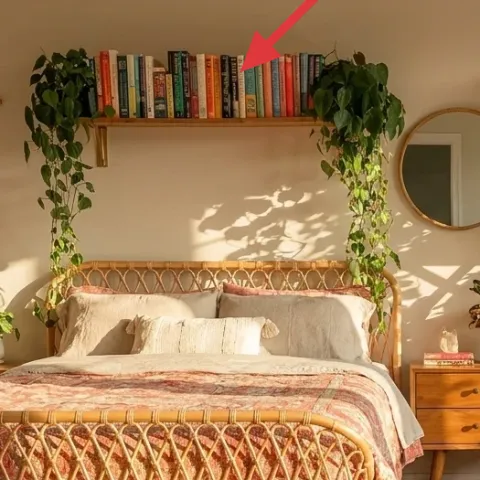
A 36-inch shallow wood shelf — Command-strip mounted, no drill, total wall load under five pounds with the books on it. The hardcovers here are not styling props: they're our actual bedside stack rotated up by eight inches. Cloth spines in red, mustard, and faded teal read as warmer than a glossy mass-market paperback row. The trailing pothos that drapes off the right end is the same plant family as Layer 1's cousin — a second one we let grow long over six months. A shelf above the bed feels architectural in a way a single piece of art above the headboard never quite does.
Test the Command strips with a third of the load first
Mount the empty shelf and hang it for 48 hours before adding any weight. Then add books in thirds, waiting 24 hours between additions. Strips fail under sudden load more often than under slow load.
Layer 5 — Hand-blocked cotton quilt ($50) queen-size kantha in faded rust and cream
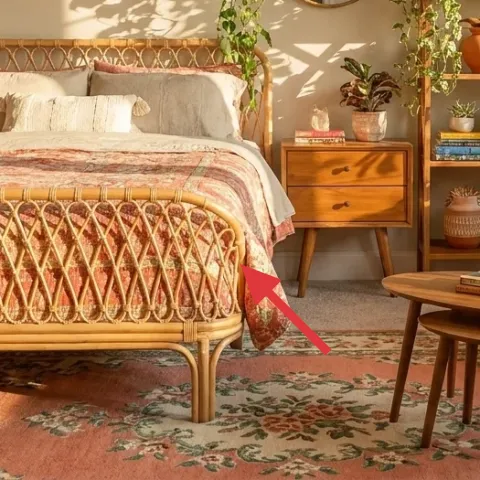
A queen-size kantha-style cotton coverlet in faded rust, cream, and apricot, layered over plain white sheets. Etsy and Jungalow both have similar in the $45 to $75 range; ours was a $50 find on a second-cousin's wedding registry overflow. The block-print quality matters here — printed-on cotton fades unevenly within six washes and starts to look like a kids' bedspread. Reversible reverse-side prints let you flip the look in three minutes, which is the main reason a quilt earns its place in a rental that moves every two years. The rust tones tie back to the terracotta pots and the red book spines on the shelf.
Pre-wash before the first night
Block-printed cotton bleeds heavily on the first cold wash. Soak in cold salt water for thirty minutes before machine-washing alone, or you'll dye your white sheets a permanent dusty pink.
Layer 6 — Round walnut-framed mirror ($50) bounces the window light back into the wall niche
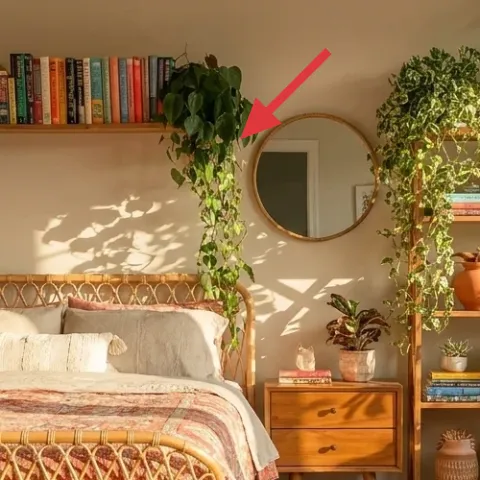
A 24-inch round mirror with a thin walnut-stained frame, Command-hung in the wall niche to the right of the bed, almost opposite the window. The reflection pulls the morning light from the window back across the bed and onto the patterned quilt — which is the whole reason it earns wall space over a piece of art. A round mirror also softens the rectangle of the headboard and the rectangle of the floating shelf above; three boxes in a row would have felt institutional. Skip the gold-framed version that's everywhere right now — it competes with the warm wood of the bed and the bookcase.
Angle the mirror down by 2 degrees
Slip a small felt pad behind the top of the mirror so it tilts forward. The reflection then shows the rug rather than the ceiling, which gives the room visual depth from across the bed.
Layer 7 — Vintage geometric area rug ($90) finishes the floor and quiets the room
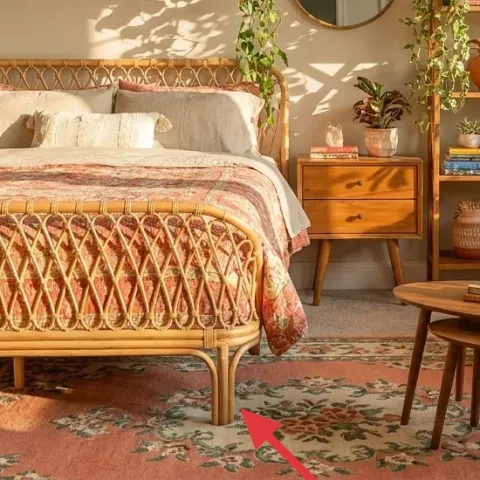
A 5×7 vintage-style cotton rug in faded pink, cream, and sage, anchored under the foot of the bed with about 18 inches showing on the sides and three feet extending past the footboard. Found at a Brooklyn estate sale for $90; equivalents on Facebook Marketplace tend to run $60 to $140 in this size and pattern era. The faded palette is the part that matters — a saturated new rug in the same pattern reads as a 2018 attempt at boho. Cotton over wool here because cotton washes (we have two cats); a small rug pad underneath kept it from sliding on the parquet for nine months and counting.
Hunt local before Etsy
Estate sales and Facebook Marketplace beat Etsy by 30 to 50 percent on faded vintage cottons. Search "boho rug" and sort by oldest listing — that's where the price drops live.
The cost, layer by layer
| Layer | Item | Cost |
|---|---|---|
| 1 | Tabletop pothos in terracotta pot | $25 |
| 2 | Ceramic-potted pothos on top of bookcase | $35 |
| 3 | Macramé wall hanging (DIY ~$24 in materials) | $35 |
| 4 | Floating wood shelf with thrifted books | $40 |
| 5 | Hand-blocked cotton quilt (queen) | $50 |
| 6 | Round walnut-framed mirror (24-inch) | $50 |
| 7 | Vintage geometric area rug (5×7) | $90 |
| Total | $325 | |
The cheaper variant: skip the vintage rug entirely and use the existing floor — every other layer still works, and the total drops to $235 if you also thrift the books for the shelf at a dollar apiece.
What worked, what didn't (across the whole room)
The room reads as actually lived in after about three weeks of small adjustments — the seven-layer plan got us 85 percent there in one Saturday, and the rest was just moving the pothos to the right spot.
What worked
- The mirror across from the window doubled the morning light without adding a single bulb to the room.
- Layering three sources of green at three heights kept the bookcase, the shelf, and the nightstand all reading as one composition.
- The hand-blocked quilt tied the rust palette to the terracotta pots without anything feeling matchy.
- Command-strip mounting the shelf, the macramé, and the mirror meant zero damage to the wall — the security deposit will thank us.
- The vintage rug muffled the parquet creaks that woke me up every time my partner got out of bed.
What didn't
- The first pothos we bought was a solid-green variety and disappeared completely against the wood bookcase.
- The Etsy macramé we considered before deciding to DIY was $55 and felt cheaply finished in the hand.
- The first floating shelf was 24 inches and looked stubby above a queen headboard; we returned it for the 36-inch version.
- A second smaller mirror we tried clustering with the round one made the niche feel cluttered and went back into the closet after a week.
What we'd skip if we did it again
Skip the matching nightstand on the second side of the bed. We started with a pair and discovered the asymmetric look — one wood nightstand on the left, just the floating shelf and the chair on the right — read as more thoughtful and less catalog. The unused nightstand sat in the hallway for two months before we sold it back to the same vintage shop for $40. If your room can hold the visual weight, one nightstand is the move.
Skip the cheaper $25 macramé from a fast-fashion home brand. Lina's seen four renters bring those home and they all looked stretched within two months — the cord is a polyester blend that doesn't drape, doesn't hold knots, and reads as plastic up close. The $24 in cotton cord plus an afternoon will give you a piece that gets better with age instead of worse, and the diamond mesh isn't difficult once the first row is set.
Skip the trend of clustering ten plants in one corner. We tried it with the bookcase and the monstera plus three more and the room read as a nursery rather than a bedroom. Three real plants — the bookcase pothos, the shelf pothos, and the corner monstera — do more work than ten because the eye can actually rest on each one. Adding a fourth almost always means subtracting attention from one of the three you already love.
Frequently asked
How long does this whole refresh actually take if I do it in one weekend?
Plan two full afternoons rather than one. Saturday is the shopping run, the macramé DIY, and the Command-strip mounting for the shelf and mirror. Sunday morning is when you live with everything for twelve hours, notice what's wrong, and shift the mirror two inches to the right. The hanging order matters: shelf first, then mirror, then macramé — top-down lets you eyeball the spacing as you go rather than fixing it after.
I rent — will the Command strips really hold the floating shelf with books on it?
Yes, but underload it. Large Command picture-hanging strips are rated for 16 pounds per pair; we use two pairs on a 36-inch shelf for a 5-pound book load, which leaves a 27-pound safety margin. The failure mode isn't the strip itself — it's the wall paint pulling off when you remove the strip. Press for 30 seconds, wait an hour before loading anything, and remove by pulling straight down on the tab rather than out from the wall.
My bedroom is smaller than this — does the seven-layer plan still work?
Drop the bookcase entirely and the floating shelf becomes the only horizontal surface for plants and books. The mirror and the macramé can stay exactly the same size — both work better in a tighter room because the reflective surface and the soft cord texture have more visual weight per square foot. Scale the rug down to a 3×5 runner along the bed side rather than a 5×7 under it. The total drops to roughly $250.
Where do you actually shop for a vintage rug under $100 in 2026?
Local Facebook Marketplace within ten miles, sorted by oldest listing first — that's where motivated sellers drop prices weekly. Estate sales on the second weekend of any month often have a $40 to $80 cotton dhurrie that's been rolled up in someone's basement for twenty years. Etsy is the most expensive option and usually overpromises on the photos. Skip the big-box vintage-style reproductions; they don't soften the way real faded cotton does over a year.
What's the biggest mistake people make when copying a plant-heavy bedroom?
Buying solid-green plants because they're cheaper and easier at the nursery. A solid-green pothos against a wood bookcase or a beige wall just disappears in photos and in person. Variegated leaves — marble queen pothos, satin pothos, neon pothos — pull light off the wall behind them and read as the design element they're meant to be. The price difference is usually five dollars per plant; the visual difference is the whole reason for buying them.
More in Bedroom
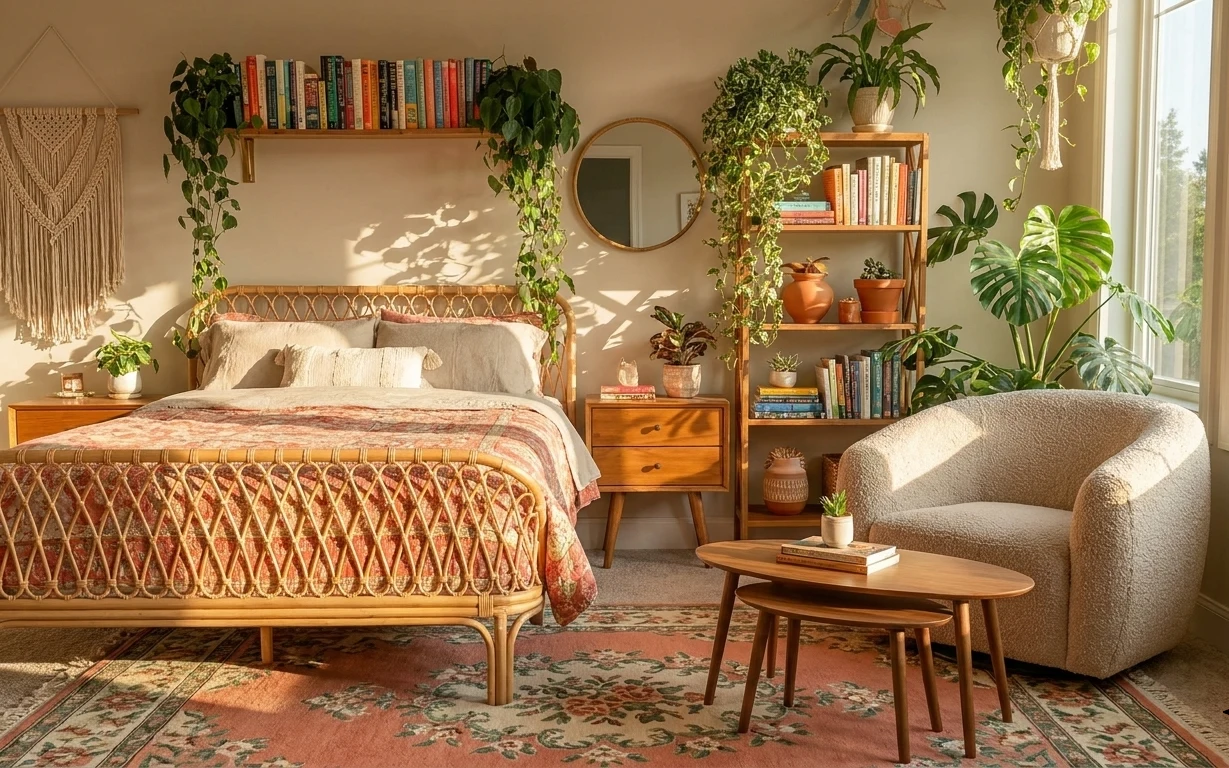
Under $350: a renter's boho bedroom refresh with seven plant-friendly swaps
A complete seven-layer renter's refresh for a boho bedroom — rattan bed, hand-blocked rust quilt, DIY macramé, and a vintage cotton rug for…
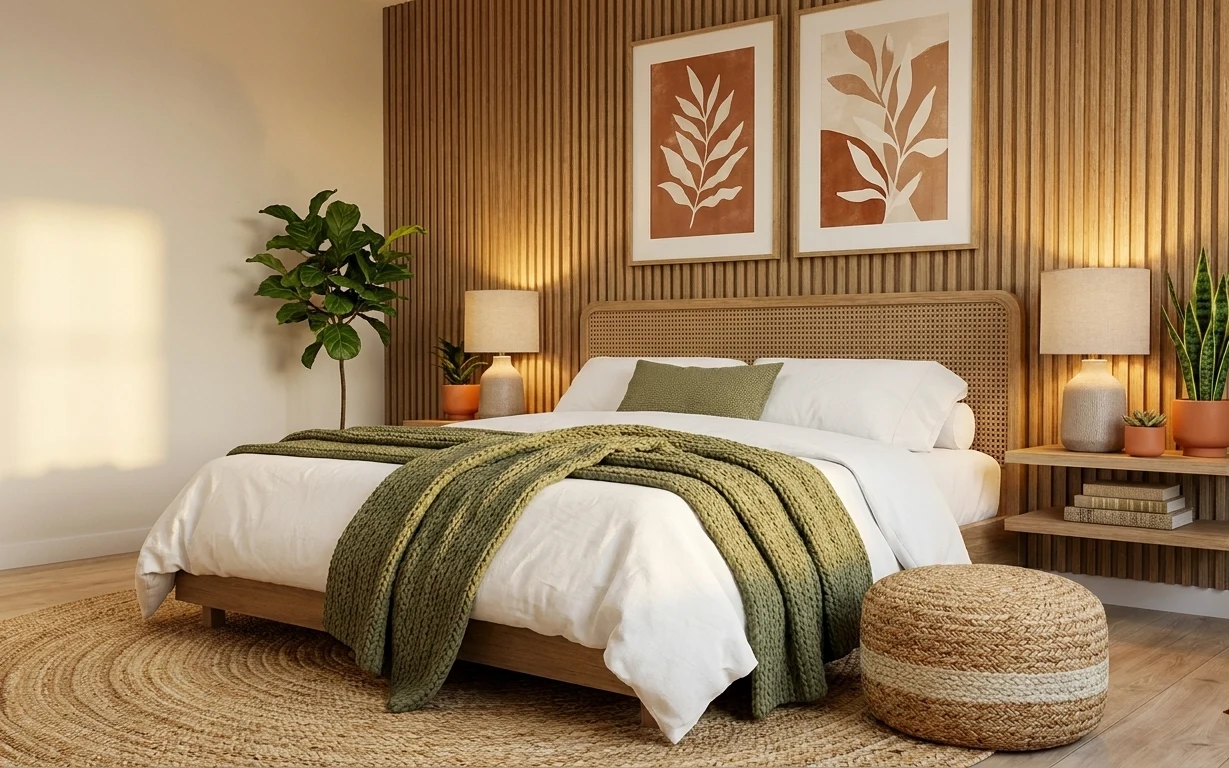
Under $800: boho bedroom refresh with warm wood details
A boho bedroom refresh that leans on warm wood, olive textiles, and framed botanical art—built with seven tangible upgrades. Total DIY + bu…

Under $700: warm neutral bedroom refresh with 7 renter-friendly swaps
A warm beige-and-camel bedroom refresh you can recreate in a rented space with 7 renter-friendly swaps. Focus on the area rug, textured thr…