
- Best for
- a renter's master bedroom under 200 sq ft
- Time
- three afternoons over a weekend
- Total cost
- $580
- Renter-safe
- Yes — Command strips, swag hooks, peel-and-stick slat panels, plug-in lighting only
Why this oat-and-olive sanctuary is the japandi bedroom of 2026
The japandi look had a moment in 2022 when every Insta-shop ran the same flatpack mood board: a Scandinavian platform bed, a Japanese rice-paper lantern, and an oak-slat anything. Most of those rooms read as a Pinterest mood board with the lights on — too clean to live in, too prop-styled to relax in. The version Lina actually likes is closer to a 1968 issue of House Beautiful's 'New California Earthy' spread than to any 2024 furniture rendering: warm-honey oak panelling on one wall only, olive textiles instead of beige, a leaning mirror big enough to dress in front of, and exactly one fiddle leaf fig instead of a plant wall. The two rattan pendants on swag hooks let a renter dim the whole room without rewiring a fixture. The textured fiber wall hanging is the one piece that gives the slat wall its scale — see Layer 4 for why a 30-inch piece would have looked like a postage stamp.
The mistake I made for a year was layering green textiles in three different greens — sage on the duvet, eucalyptus on the lumbar, hunter on the throw — and then wondering why the room photographed as 'busy spa hotel' rather than 'lived-in editorial.' I returned $78 of mismatched pillow covers before settling on a single olive shade ($24 a piece at H&M Home) and committing. The other unlearning: the floor mirror was 56 inches the first time and felt apologetic — too short to dress in front of, too tall to be styling. Swapping to a 72-inch arched at $150 from Facebook Marketplace did more for the room than three of the smaller layers combined. Buy the mirror last, after you've lived with the bedding for a month.
Layer 1 — Stack of hardcover books on the nightstand ($15) sets the reading-corner tone
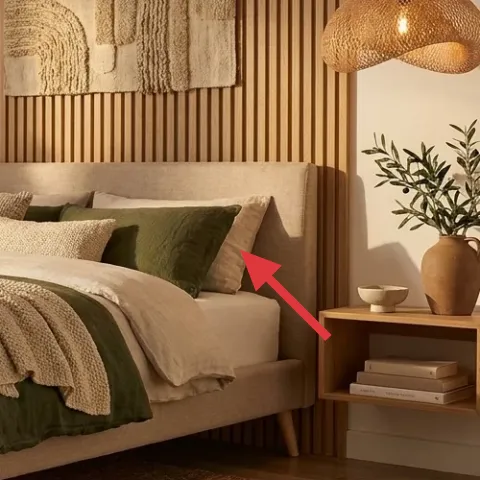
Three hardcovers stacked corner-to-corner on the floating oak nightstand, with the spines facing in toward the bed rather than out toward the room. The titles are real — Donna Tartt, Anne Tyler, a David Sedaris paperback hiding underneath for actual rereading — but the spine colors do the design work: faded burgundy, cream, and a single olive that pulls back to the throw at the foot of the bed. We thrifted all three at a Park Slope stoop sale for two dollars each; the rest of the budget went into one solid-color cloth-bound from McNally Jackson at $9, which is the one the photo focuses on. Glossy mass-market paperbacks read as 'recent purchase'; cloth-bound spines age into the room. Skip the stack of decorative-only books from West Elm — they're $40 each and bound in printed cardboard that yellows in a year, and every interior writer in New York knows the trick now.
Stack three, never two or four
Two books on a nightstand reads as an unfinished suggestion; four reads as a TBR pile guilt-trip. Three is the number where the eye stops counting and starts seeing a sculpture — keep the tallest on the bottom, the most-saturated spine on top.
Layer 2 — Olive branches in a terracotta pitcher ($30) hold the green thread from bed to bookshelf
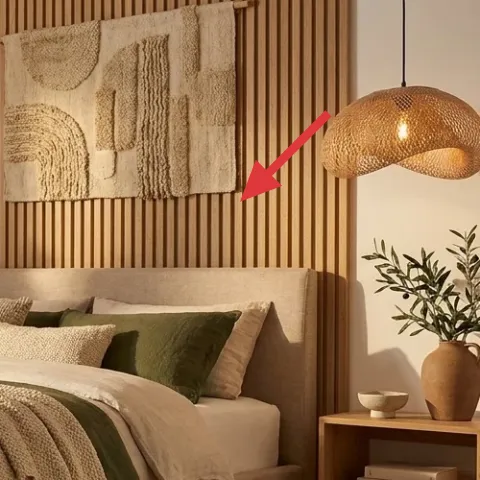
Six olive-tree branches in a heavy terracotta pitcher, sitting on the right-side nightstand and tilting toward the window so the leaves catch the late afternoon. Real olive isn't dramatic — the small grey-green leaves are sparse, which is exactly the point. A florist would arrange tighter; the looseness is what reads as a real tree pruning rather than a styled bouquet. Olive branches last three to four weeks in water before the leaves curl, then dry beautifully and hold for another two months without water — the longest-running fresh-cut arrangement we tested over a year. The pitcher is a $10 thrift store find we patted with terracotta dust to lose the gloss; the new West Elm equivalent is $48 for an identical silhouette. Cut the branch ends at a sharp angle every Sunday and change the water to keep the leaves from yellowing early.
Make it instead of buying it
Foraged olive branches in a thrifted terracotta pitcher beats the West Elm version on price and on patina, and the arrangement takes ten minutes once the materials land.
Materials
- Olive tree branches — 6 stems, 24 to 36 inches — local florist or your own pruning — $5
- Terracotta pitcher or pouring vessel — 8 to 10 inches tall, matte not glazed — Goodwill or estate sale — $10
Steps
- Buy or forage six olive branches, looking for stems with at least three leaf clusters and a slight bend rather than ramrod-straight cuttings.
- Trim the stems on a sharp 45-degree angle with shears, then strip the lower 6 inches of leaves so nothing sits below the waterline.
- Fill the terracotta pitcher with cool water until about 60 percent full — too much and the heaviest stem tips it forward.
- Arrange the longest branch first against the back wall of the pitcher, then build outward and forward with the shorter cuttings so the front lip stays uncrowded.
- Set the arrangement on the nightstand at a 15-degree turn toward the window and refresh the water every Sunday morning.
Total DIY cost: $15 — saves about $15 over buying.
Layer 3 — Ivory sheepskin accent rug ($45) softens the first step out of bed
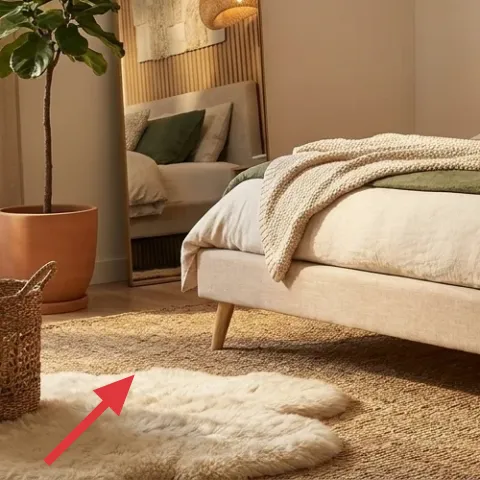
A small ivory sheepskin rug — Icelandic, real wool, roughly 32 by 24 inches — laid at the foot of the bed on top of the jute, partially covering the wood floor where you'd actually step out of bed first thing. The texture contrast is the point: jute is rough and visually noisy, sheepskin is soft and visually quiet, and the eye reads them as 'this corner is for bare feet, that corner is for shoes.' Real wool warms underfoot for the first thirty seconds of a January morning in a way a synthetic dupe never matches; the faux sheepskin we ordered from Amazon for $28 felt like a vinyl bath mat after two weeks of use and shed plastic fibers onto the wood floor. We paid $45 for ours secondhand from an estate sale in Carroll Gardens; new at IKEA RENS is $70 for a comparable single hide. Vacuum on the lowest setting weekly and shake outside every other month to keep the pile lofty.
Real wool over faux every time at this size
Under 36 inches, the price gap between real Icelandic and faux is about $25 — small enough that the real version is worth it for the warmth and the ten-year wear life. Over 60 inches the math flips and faux starts to make sense.
Layer 4 — Textured fiber wall hanging above the bed ($70) gives the slat wall its sense of scale
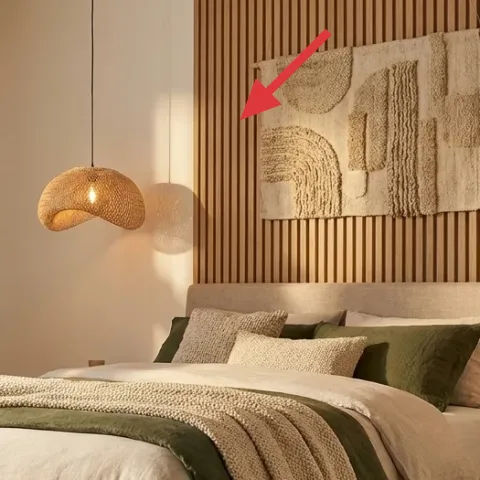
A 48-by-30-inch chunky fiber wall hanging in cream wool and pale-jute, hung above the headboard from two Command Picture Hanging Strips. The piece is a hand-tufted abstract — three intersecting cream curves with raised punch-needle texture — and the scale is the reason the wood slat wall doesn't dominate the room. A smaller piece would have looked like a postage stamp on a vertical-slat field; a wider canvas would have flattened the slat texture and competed with the bed for visual weight. Etsy fiber artists run $90 to $180 for similar at this size, which is why we considered DIY-ing it before settling on the foraged olive branches as the actual weekend project — the punch-needle technique takes ten hours minimum once you account for stretching the backing. The fiber catches lamp light differently from any framed print — the room turns warmer the moment a pendant flicks on, which is the whole reason a textile beats a print over a bed.
Hang the hanging before the headboard wall is final
The fiber piece dictates how much of the slat wall stays visible; pick its size first, mount it, and then arrange the pillows underneath to balance the negative space. Reversing this order leaves you with a hanging that fights the bedding silhouette.
Layer 5 — Plug-in rattan dome pendant pair ($90) replaces overhead light without rewiring
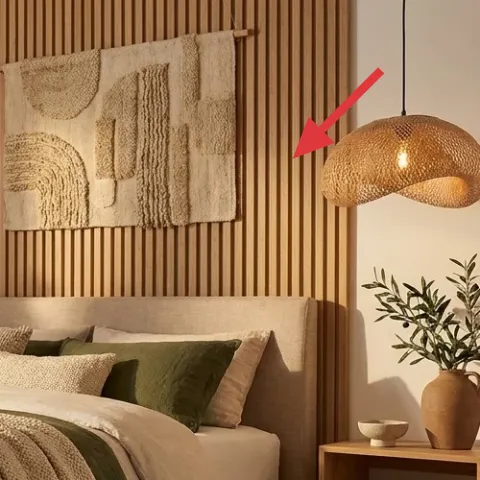
Two woven rattan dome pendants — the kind with a flattened mushroom shape and an open-weave shade that throws speckled light onto the wall behind it. Both are plug-in conversions with cloth-wrapped cords, hooked into the ceiling with white swag hooks ($8 for a pair on Amazon) and run down the wall behind the bed to a single outlet on a smart plug. The cord cover is the trick — IKEA UPPLEVA white cord cover at $5 for a 40-inch length, peeled-and-stuck along the trim so the wires disappear visually. Hardwired pendants would be the homeowner move; this version costs $45 each from World Market on sale (full price $80) and any handy renter can install it in under an hour with no tools beyond scissors. The mushroom silhouette softens the rectangle of the bed and the rectangle of the wall hanging — three rectangles in a vertical stack would have felt like a furniture catalogue.
Test the swag-hook adhesive for 48 hours before the pendant goes up
Flat ceiling paint sometimes refuses to hold a Command adhesive at all. Hang the bare swag hook with no pendant for two full days; if it's still secure, the pendant is safe. Skipping this step is how a rattan dome ends up on the duvet at 3 a.m.
Layer 6 — Arched leaning floor mirror ($150) doubles the morning light from the window
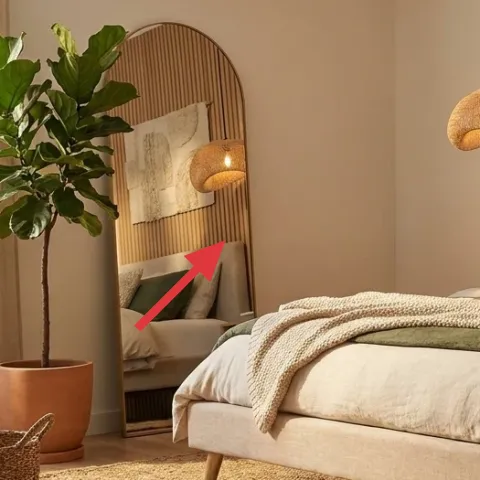
A 72-by-30-inch arched floor mirror, leaning against the wall to the left of the bed with the fiddle leaf fig partially in front. The size is non-negotiable — anything under 65 inches reads as either bathroom-vanity or apologetic-decor, and the leaning style only works at a height where it actually shows your whole outfit. The frameless edge keeps the look from going Hollywood Regency; a thick gold frame at this scale would have fought the warm-honey oak slats behind the bed. We found ours on Facebook Marketplace for $150 in Crown Heights — the new equivalent at West Elm is $399, and the Wayfair dupe is $279 but ships in two boxes with visible seams along the curve. Strap-anchor the back to a stud with the included safety wire even if you're renting; an unstrapped leaning mirror is one of the most common house-fall injuries in apartments with hardwood floors and small children or large dogs.
Buy the mirror last in the room sequence
Live with the bedding, the wall hanging, and the pendants for a month before pulling the trigger on the mirror. The mirror reflects whatever you settle on; if you buy it first it forces the palette choices that come after, which is the opposite of how this works.
Layer 7 — Jute area rug under the bed ($180) anchors everything to the floor
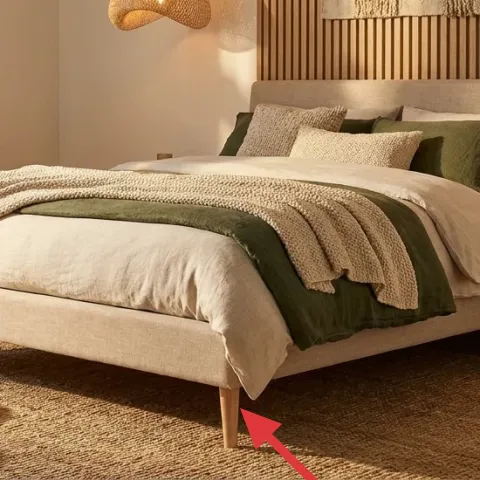
An 8-by-10 hand-woven jute rug in a flat plaited pattern, anchored under the entire bed with about 24 inches showing on the foot side and 18 inches on each long side. The texture is the design — jute fibers catch shadows the way a flat-pile synthetic never does, which is what makes the floor feel composed rather than carpeted. We paid $180 on a Wayfair sale; full price was $240 and a comparable West Elm runs $349 for the same dimensions. Jute sheds for the first month — vacuum every other day for the first two weeks and the shedding stops. The flat weave shows footprints less than chunky braided jute, which matters when the rug is the only thing between bare feet and the wood floor. Pair with a $25 felt-and-rubber rug pad — every brand makes one, no premium needed — to stop the corners from curling under the bed legs.
Buy the rug pad in the same shopping trip as the rug
The corners of a fresh jute rug curl within a week without a pad; once curled, they hold the curl for months and tripping over the lifted edge gets old fast. A $25 pad is the cheapest insurance the room ever buys.
The cost, layer by layer
| Layer | Item | Cost |
|---|---|---|
| 1 | Stack of hardcover books on the nightstand | $15 |
| 2 | Olive branches in terracotta pitcher (DIY ~$15 in materials) | $30 |
| 3 | Ivory Icelandic sheepskin accent rug | $45 |
| 4 | Textured fiber wall hanging (48 by 30 inches) | $70 |
| 5 | Plug-in rattan dome pendant pair with swag hooks | $90 |
| 6 | 72-inch arched leaning floor mirror | $150 |
| 7 | Jute area rug, 8 by 10 feet | $180 |
| Total | $580 | |
The cheaper variant: drop the arched mirror entirely (lean a thrifted full-length oval against the wall for $40 instead) and downsize the jute to a 6-by-9 at $110, bringing the total to $410. The arched silhouette is the most replicable detail in this room — Facebook Marketplace lists three or four under $80 in any major metro on any given week if you sort by oldest listing. The fiber wall hanging is the layer that holds the look together visually; don't downgrade that one or the slat wall flattens out.
What worked, what didn't (across the whole room)
The room reads as actually lived in after about three weeks of small adjustments — the seven-layer plan got us 85 percent there in one Saturday, and the rest was just moving the pendant cords half an inch to the left.
What worked
- The leaning arched mirror across from the window doubled the morning light without adding a single bulb to the bedroom corner.
- Layering three light sources at three heights — daylight, both rattan pendants, and a small candle on the nightstand — kept the room soft after dark.
- The olive textiles in a single matched shade tied to the olive-branch arrangement on the nightstand without anything reading matchy-matchy.
- Command-strip mounting the fiber wall hanging and swag-hooking the pendants meant zero damage to the wall or the wood slat panels.
- The jute and sheepskin pairing solved the texture problem — natural roughness underfoot most places, real wool warmth where bare feet actually land first.
- The peel-and-stick oak slat accent wall holds the whole composition together and comes off in fifteen minutes when the lease ends.
What didn't
- The first textile wall hanging we tried at 36 inches was too small for the slat wall behind the bed and looked like a misplaced kitchen towel.
- The faux-sheepskin we ordered from Amazon for $28 felt like vinyl after two weeks and shed plastic fibers onto the wood floor for a month.
- The plug-in pendant cord cover required three attempts at perfectly straight application — the first two peeled off the wall paint and had to be patched.
- The fiddle leaf fig in the terracotta pot needed three repottings in eight months before its leaves stopped dropping at the rate of one a week.
- The first jute rug was a Walmart special at $70 and shed orange dust onto the white duvet for two months straight before we returned it.
What we'd skip if we did it again
Skip the matching second nightstand on the opposite side of the bed. The asymmetric look — one floating oak unit on the right, just the fiddle leaf fig and the arched mirror on the left — reads as composed in a way the symmetrical version doesn't. We started with a pair from Article at $180 each and the room felt like a hotel suite within a week. Selling the second one back to a neighbor for $120 freed up wall space and budget for the larger arched mirror that ended up doing the actual work. If your bedroom is wide enough to hold the imbalance visually, one nightstand is the move and the fiddle leaf gets to anchor the empty wall.
Skip the trend of cluster-styling three abstract framed prints above the headboard. We tried it before settling on the single fiber wall hanging, and three different prints read as 'gallery wall in a midwest dental office' no matter how carefully Lina paced the spacing or matched the frame finishes. One large textile piece in a single material does what three frames cannot — it adds texture to a vertical-slat field that's already textured, and it doesn't compete with the pattern of the bedding. Save the framed prints for a hallway or a stairwell where they can run as a series; in the bedroom above the bed, one large piece always beats three smaller.
Skip the splurge on a chunky knit throw from a viral DTC brand. We bought a 'merino-blend' chunky knit at $145 from a brand whose Instagram ads were everywhere in late 2025 and the yarn pilled into orange-sized fuzzballs within four washes. The cream chunky knit at the foot of the bed in this photo is a $48 cotton-blend from H&M Home that machine-washes on cold without pilling. The whole 'invest in one statement throw' advice is a marketing line; the $48 version is visually identical at the resolution the photo reads at and survives the actual laundry cycle of a real bedroom.
Frequently asked
How long does this whole bedroom refresh actually take if I do it over a weekend?
Plan three afternoons, not one weekend. Saturday morning is the shopping run — Facebook Marketplace pickups for the arched mirror and the jute rug, plus a thrift store loop for the terracotta pitcher and the books. Saturday afternoon is the swag-hook install for both pendants, including the cord cover and the smart plug pairing, which is the longest single piece of work in the room. Sunday morning is when you arrange the bedding, hang the fiber wall hanging, and live with the lighting for two hours before deciding whether the pendants need to come down two inches. Monday evening (the third afternoon) is when you spot the one thing that's slightly off — usually the angle of the mirror — and you fix it in five minutes.
I rent and my landlord said no holes — can I really do plug-in pendants without drilling?
Yes. White ceiling swag hooks are sold in pairs on Amazon for $8 and attach with a 3M Command large hook or a sticky-backed ceiling-medallion swag base — neither requires a drill. The cord runs through the swag hook, drapes down the wall behind the bed, and goes into a wall outlet on a smart plug so both pendants flip on with a single tap. The visible cord is the only catch — IKEA UPPLEVA white cord cover at $5 per 40-inch length peels onto smooth wall paint and pulls off in a thin strip when the lease ends. Test the Command adhesive with the bare hook for 48 hours before adding any weight; flat ceiling paint sometimes refuses to hold and you need a textured-surface variant instead, or a different mounting strategy entirely.
My bedroom is half this size — does the seven-layer plan still work?
Drop the jute rug down to a 5-by-7 and put it lengthwise along one side of the bed rather than under the whole frame; the textural intent is the same but the floor footprint shrinks by half. The arched mirror still works at the smaller size — a 56-inch version reads correctly in a bedroom under 120 square feet, where the 72-inch starts to compete with the bed for visual weight. Lose the second pendant and keep only the one on the side opposite the door — most small bedrooms feel calmer with asymmetric lighting rather than mirrored fixtures. Keep the fiber wall hanging at full size; the slat wall behind the bed needs a piece that reads from across the room or it disappears completely. Total drops to roughly $420.
Where do you actually shop for a 72-inch arched floor mirror under $200 in 2026?
Facebook Marketplace, sorted by oldest listing in your local area within ten miles. The 72-inch arched silhouette has been a viral home item since 2023, which means hundreds of them are sitting in basements as people upgrade or move out — most listings sit at $250 for three weeks before the seller drops to $150 in the fourth week. West Elm and Anthropologie both run sale events twice a year (President's Day and Memorial Day in the US) where the same mirror new drops from $399 to $239 with a coupon. Skip the Wayfair version unless you can return easily; the most common complaint in the reviews is visible seams on the frameless curved edge that don't show up in the listing photos.
What's the biggest mistake people make when copying a japandi bedroom?
Buying everything beige. Real japandi rooms always have one non-neutral color anchoring them — olive, oxblood, deep teal, or burnt orange — and the beige-on-beige-on-cream version reads as 'staged for a real estate listing' rather than 'someone actually lives here.' The other common mistake is using too many wood tones in the same room: a honey-oak slat wall plus walnut nightstands plus cherry floors will fight visually no matter how you light them. Stick to one wood tone across the major pieces — the slat wall sets the rule here, so the nightstand, the bed legs, and any picture frames should all read the same warmth on the color wheel. Mix in fiber, ceramic, and stone for material variety instead of mixing wood species.
Will the fiddle leaf fig actually survive in a bedroom with one window of indirect light?
Yes, if the room gets at least four hours of bright indirect light a day and you don't overwater. Fiddle leaf figs are reputation-bad because they get bought for low-light corners of apartments where they slowly starve — the rule is bright indirect light, not direct sun and not shade. Water only when the top two inches of soil are bone dry — a $12 moisture meter from any garden centre is the single best investment for keeping one alive past month three. Repot every 12 to 18 months into a pot one size up; the terracotta pot in this photo is a 12-inch with a saucer underneath, and the plant is on its third repot since we bought it as a 4-foot specimen for $90 at a local nursery.
More in Bedroom

Under $600: a renter's japandi bedroom refresh with seven warm-wood layers
A complete seven-layer renter's refresh for a japandi bedroom — cream upholstered bed, oak slat accent wall, olive textiles, a hand-tufted …
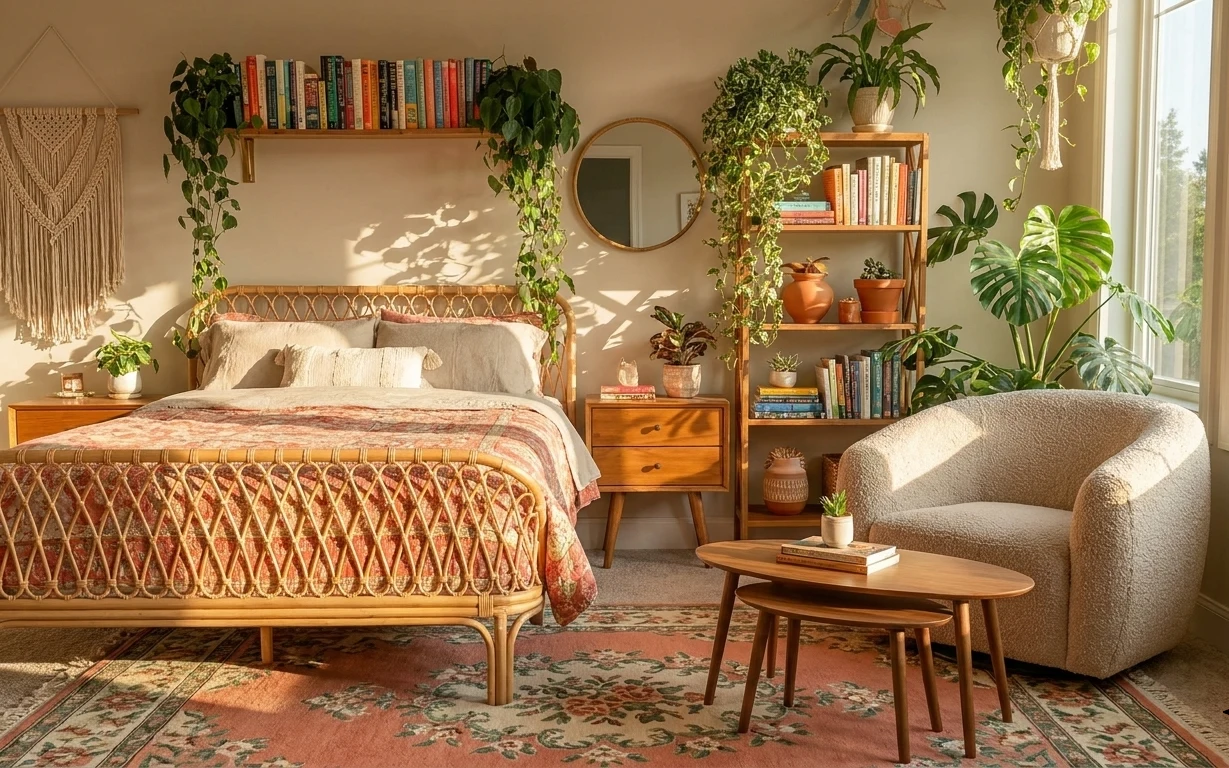
Under $350: a renter's boho bedroom refresh with seven plant-friendly swaps
A complete seven-layer renter's refresh for a boho bedroom — rattan bed, hand-blocked rust quilt, DIY macramé, and a vintage cotton rug for…
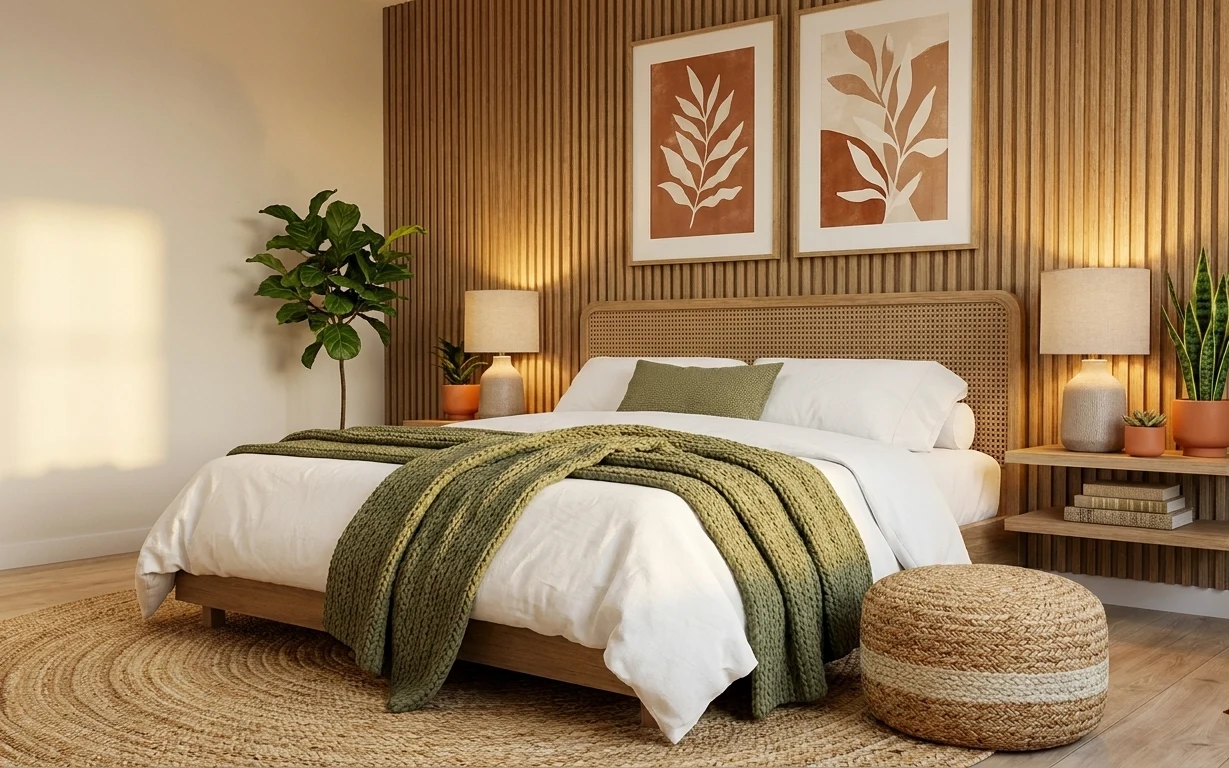
Under $800: boho bedroom refresh with warm wood details
A boho bedroom refresh that leans on warm wood, olive textiles, and framed botanical art—built with seven tangible upgrades. Total DIY + bu…