- Best for
- no-drill bedroom corner refresh
- Time
- 1 weekend
- Total cost
- $530
- Renter-safe
- yes (textiles + plug-in pieces)
Why warm boho bedroom corner is the move-friendly bedroom of 2026
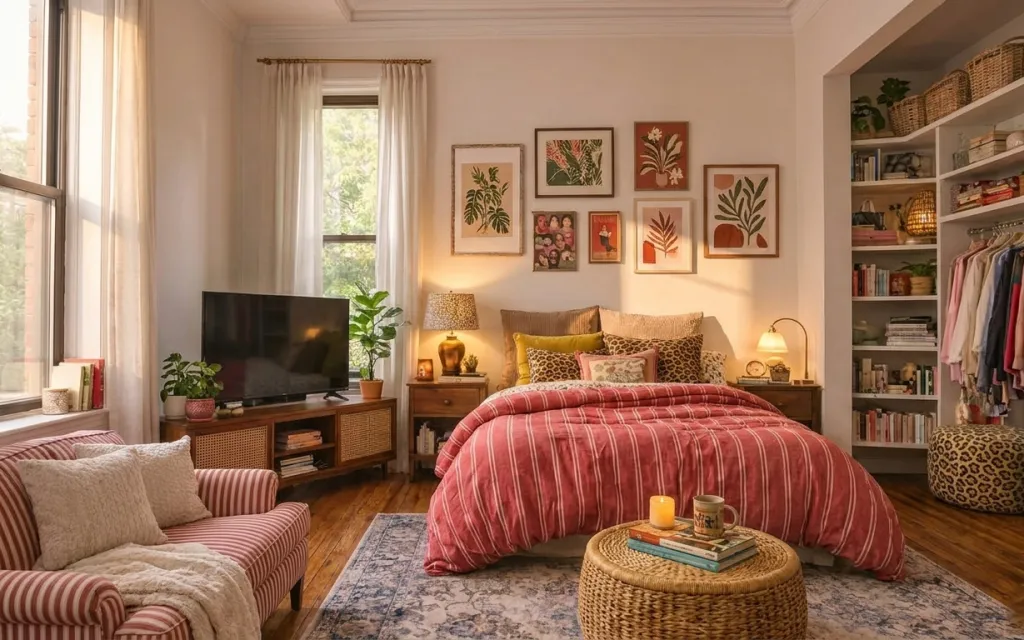
What I love about this setup is how the room’s personality comes from soft layers, not fixtures you can’t take with you. The blue patterned area rug anchors everything on the wood floor, while the striped red comforter brings that bold, graphic rhythm right to the center of the bed. On the sofa side, the striped throw blanket and pillows add texture without adding bulk. Even the wall of framed botanical prints feels curated because each piece is lightweight and easy to pack. This is achievable for shared housing because most of it lives in textiles and freestanding pieces.
The first time I tried to copy a look like this, I overspent on wall decor and underbought the “quiet” parts—like a rug that could actually ground the floor. Here, the trade-off is clear: you invest in one big anchor (the rug) and then support it with smaller, movable moments—throw, lamp glow, and a few frames. The result reads intentional without needing any drilling, sawing, or landlord drama.
Layer 1 — Blue patterned area rug ($200) Grounds the floor in one big anchor
{{LAYER_1_FIGURE}}
The blue patterned area rug is the visual anchor in this bedroom corner, and it’s doing more work than it looks like it’s doing. In the photo, it sits under the bed and pulls the sofa vibe into the same color family, so the space feels connected instead of two separate zones. I’m choosing a pattern here over a solid because the botanical wall frames need something with movement to match. The trade-off: you’ll see lint and foot scuffs faster than on a plain rug, but the pattern hides them and keeps it forgiving for roommates. Pick a size that covers the main walking path between bed and seating.
Use the rug to “budget” the rest
Once the rug’s colors feel right, the pillows and throw can stay simple and still look planned.
Layer 2 — Striped throw blanket on the sofa ($30) Adds that casual, textile rhythm
{{LAYER_2_FIGURE}}
This striped throw blanket on the sofa gives the room its homey texture without making the seating corner feel heavy. The stripes mirror the graphic energy of the striped comforter, so the room doesn’t feel like it’s borrowing patterns randomly. I’m deliberately keeping it as a throw instead of a full coverlet because it’s easier to pack, easier to wash, and it lets you rotate color intensity by season. The trade-off is less coverage than a fitted blanket, but shared housing is exactly where you want “swap-able” layers. Drape it where it’s visible when you walk in—left side, end of the sofa, or over an arm.
Match vibe, not exact stripe width
Different stripe scales still read cohesive when they share the same warm-neutral palette.
Layer 3 — Striped red comforter set ($90) Makes the bed the readable focal point
{{LAYER_3_FIGURE}}
The striped red comforter set is the focal point because it’s color-forward and centered, the kind of piece your eye goes to before it notices anything else. The stripes also play nicely with the botanical wall frames above the bed: both have organic forms, so the contrast doesn’t feel chaotic. I’m calling out the comforter because it’s one of the easiest move-friendly swaps—pack it in a vacuum bag or folded in a box and it’s ready for the next place. The trade-off is that it’s bolder than you’d pick for a rental that needs to look neutral, but that’s exactly why it works here. Keep pillow covers simpler so the bed doesn’t get busy.
Let the comforter choose the palette
Start with the red, then pull blue from the rug so everything has one shared color thread.
Layer 4 — Framed botanical print above the bed ($80) Creates an “easy wall” that packs as pieces
{{LAYER_4_FIGURE}}
The framed botanical print above the bed keeps the wall interesting without making it permanent. In the photo, the frames act like a gallery that’s light enough to move—each print is its own object you can box and label. I’m choosing a single framed botanical print as the core layer because it scratches the “something on the wall” itch without the cost of building a full wall system at once. The trade-off is you’ll have to commit to spacing—too tight looks cluttered, too far looks empty. If you’re recreating the effect later, add one more frame at a time so you can adjust the rhythm between prints.
Skip anything that requires wall hardware
For shared housing, use clip-on, freestanding, or renter-safe hanging methods so removal doesn’t damage plaster or paint.
Layer 5 — Table lamp on the right nightstand ($60) Brings the warm, golden-hour mood
{{LAYER_5_FIGURE}}
The table lamp on the right nightstand is what turns this bedroom corner from “styled in daylight” into “livable after dark.” The shade shape throws a soft pool of light across the bedding and wall frames, so the botanicals feel warm instead of flat. I’m choosing a plug-in lamp over something overhead because it’s fast to set up, doesn’t touch fixed wiring, and moves with you. The trade-off is you’ll need a second light source if you want the whole bed area equally bright, but that’s also why this looks layered—light levels are part of the design. Put the lamp where you can see the glow when you’re sitting up in bed.
Light should hit the wall, not just the floor
Even a small nightstand lamp looks richer when it bounces off the wall behind the bed.
Layer 6 — Round wicker storage stool ($35) Adds a textural “in-between” surface
{{LAYER_6_FIGURE}}
The round wicker storage stool is the in-between piece—between bed and sofa, and between soft textiles and hard surfaces. In this photo it reads as practical styling: it gives you a place for books and candles while also adding woven texture that matches the warm wood tones and baskets on the bookshelf. I’m selecting it over a standard side table because it packs more easily (and you can use it as a stool later, too). The trade-off is that woven surfaces can snag small items, so keep styling objects flat and avoid dragging it across the rug. If your next place has different furniture placement, the stool’s flexible footprint makes it an easy carry.
Style it like a surface, not storage
Use trays and one small stack so the stool stays tidy even when life gets busy.
Layer 7 — Candle on the round wicker storage stool ($35) Makes the corner feel lived-in in minutes
{{LAYER_7_FIGURE}}
The candle on the round wicker storage stool is small, but it’s a high-impact finishing touch. The photo uses it like jewelry: it adds a warm glow that makes the striped comforter and botanical prints feel softer, especially once the lamps are on. I’m choosing candlelight here instead of another object because it changes the mood without changing the layout, which matters in shared housing where you’re constantly recalibrating. The trade-off is you’ll be mindful about safety and placement, especially around textiles and roommates. Keep the candle near the edge of the tray so it’s visible, and pair it with one more candle or match holder only if your space feels balanced.
Pick a vessel you can pack
Choose a candle container that’s easy to box and won’t leak wax everywhere during moves.
The cost, layer by layer
| Layer | Item | Cost |
|---|---|---|
| 1 | Blue patterned area rug | $200 |
| 2 | Striped throw blanket | $30 |
| 3 | Striped red comforter set | $90 |
| 4 | Framed botanical print | $80 |
| 5 | Table lamp | $60 |
| 6 | Round wicker storage stool | $35 |
| 7 | Candle | $35 |
| Total | $530 | |
If you want a cheaper variant, keep the blue rug and red comforter, but swap the framed botanical print for a single larger print and choose a basic plug-in lamp. A thrifted wicker stool and a simple store-bought candle can bring the styling cost down without losing the warm, textured look.
What worked, what didn't (across the whole room)
This bedroom corner works because the “big decisions” happen in soft goods and movable items: rug scale, bed color, and warm lamp light. The botanical frames add interest without needing permanent installs. What didn’t work as well was trying to match too many patterns at once—when the striped throw and pillows and wall prints all get busy, the room loses its calm.
What worked
- The blue rug anchors both the bed and sofa so the space feels like one cohesive corner.
- Red stripes on the comforter create a clear focal point with minimal visual clutter.
- Warm table-lamp light makes the botanical frames feel softer instead of flat.
- Woven wicker texture from the stool and baskets adds depth without adding bulk.
- Framed botanical prints add art presence while staying easy to box for a move.
- Throw and pillow stripes echo the comforter so the textiles look intentional.
What didn't
- Too many competing patterns (stripes plus bold pillows plus framed art) can feel busy.
- A small lamp placed too far from the bed can leave shadows across the comforter.
- Relying on only accent lighting can make the rug pattern harder to read.
- Using an oversized stool without a tray makes candle and book styling look messy.
What we'd skip if we did it again
Skip trying to match the exact same stripe widths across the sofa throw and bed comforter. The look stays cohesive when stripes share a color family, not when they’re identical.
Skip buying a bunch of small decor objects before the rug and comforter are in place. When you style too early, you end up chasing “coordination” instead of building a palette.
Skip full wall installs or anything that can’t survive a move. Framed prints and freestanding lighting give you the art impact with far less removal stress.
Frequently asked
How long does this kind of bedroom corner refresh take?
Plan on about one weekend. The fastest wins are the textiles (throw, comforter, rug placement) and plug-in lighting. Wall art is next—pace it out so the framed botanicals feel evenly spaced. Final day is for styling: adding the candle glow and a simple stack of books on the wicker stool.
What’s the most move-friendly part of this look for shared housing?
The move-friendly parts are the things that pack flat or into boxes: the rug, the striped throw, the comforter, and the framed prints. The table lamp and candle styling also travel easily. Try to keep your “anchor decisions” to objects you can carry without disassembling furniture or touching fixed fixtures.
If my room is smaller, what would you adjust?
Use a rug that still covers the main walking path between bed and seating, even if it’s slightly smaller than the photo. Keep only one or two big textiles (one throw and one main comforter) and reduce the number of framed prints so the wall doesn’t feel crowded. One lamp with warm light is enough if it reaches the bed area.
If my room is bigger, how do I keep the look from feeling sparse?
Go up one size on the rug if you can, and consider adding one more framed botanical print so the wall composition reads intentional. For lighting, add a second table lamp only if the bed area feels dim at night. Keep the styling on the wicker stool minimal—tray plus candle plus books—so the extra space doesn’t make everything look scattered.
Where should I shop differently to keep it budget-friendly?
For the rug and comforter, look for sale sections or high-quality basics at major retailers, then upgrade only the rug if your floor shows through. For framed botanical prints, a smaller set of individual prints costs less than a pre-made gallery bundle. The lamp can be thrifted if the shade is intact and the lamp base works.
What’s the biggest mistake people make when copying this style?
They try to make every surface match at once. Instead, pick one anchor color (the comforter red), one grounding pattern (the blue rug), and then let everything else be supporting texture: throw stripes, woven wicker, and a few botanical frames. When you do that, the room looks curated even if you buy items in pieces over time.
More in Bedroom
What $600 buys: a bedroom corner refresh with warm boho texture
A bedroom corner refresh built for move-friendly shared housing: blue rug, striped throws and comforter, a framed botanical print, warm tab…
6 no-drill ways to warm up a bedroom, $400
A warm, renter-friendly bedroom refresh built around rust linen, layered throws, and earthy plants—no drilling required. This look is achie…
7 move-ready bedroom swaps for a $600 refresh
A botanical, earthy-bedroom look that still packs up: rug, patterned throw, warm brass lamp, and plant styling—plus renter-safe wall decor.…