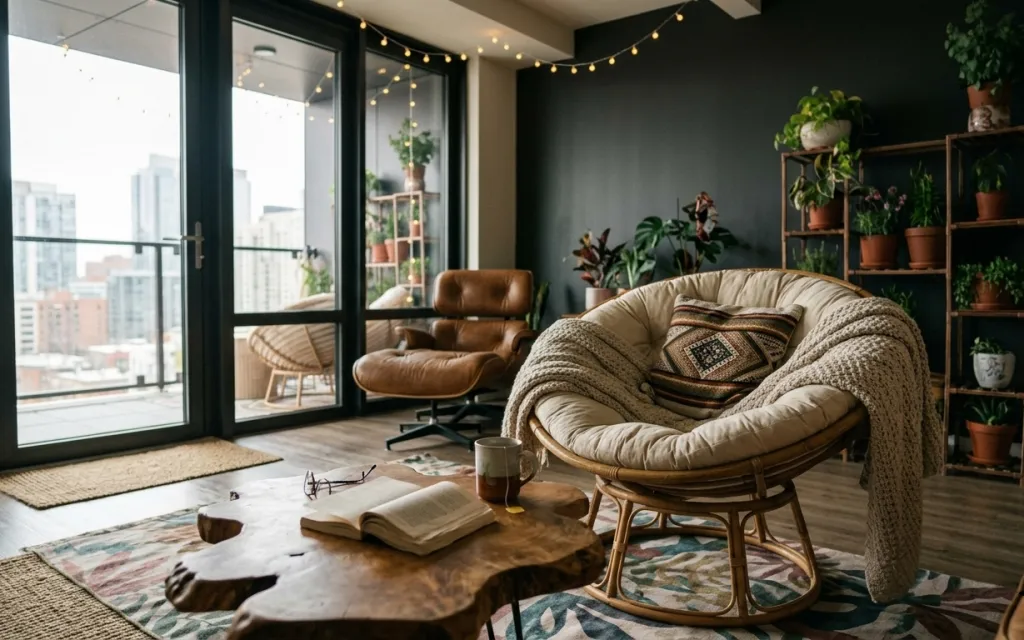
- Best for
- Move-friendly living room seating corners
- Cost
- $253 total (budget $300)
- Difficulty
- Easy
- Renter-safe
- No-drill swaps + DIY pots
Why warm tan-and-forest-green seating is the sunlit living room seating corner of 2026
Start with the flooring: the woven jute texture and the patterned rug give you two “grounds” underfoot, which makes the whole space feel styled instead of accidental. Then pile on softness with a chunky throw blanket and a patterned throw pillow sitting right on the rattan papasan chair. The string lights are doing more than decoration too—they create that warm, low-contrast glow that reads cozy even in daylight. For shared-housing living rooms, this approach works because rugs, textiles, and plants pack flat or travel as-is.
I used to think string lights were the last step—the tiny detail you add when everything else is perfect. But in a place with big windows and a darker wall, the lights become structure. I also caught myself overbuying “matching” decor sets once, and the room felt too curated. What changed my mind: mixing texture directions on purpose (woven rug + knotted cord + smooth leather) gives you depth without any permanent installs.
Layer 1 — jute area rug ($80) Texture that anchors the seating
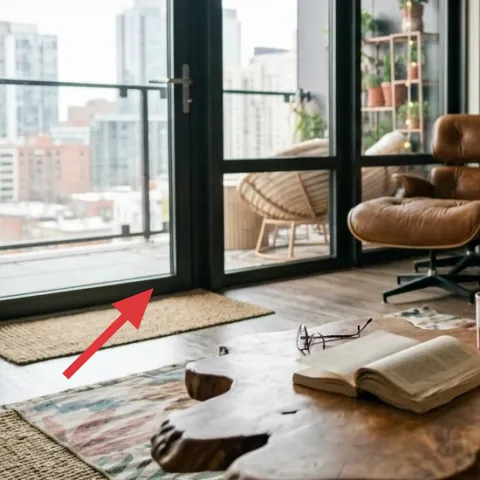
This jute area rug sits under the front part of the seating area and adds that ropey, handwoven look that ties in with the rattan papasan chair. It’s the layer that makes the patterned rug feel intentional instead of busy. The trade-off is comfort: jute can feel a little crisp under bare feet, so it works best when you add a second soft rug on top. Compared with going straight to a plush rug, jute also hides everyday scuffs and keeps the room from looking too precious for shared-house life.
Layer rugs so one feels “grounded” and the other feels “styled”
Use a neutral texture like jute as the bottom layer, then bring in pattern on top to create depth.
Layer 2 — patterned area rug ($80) Color that shows through without clutter
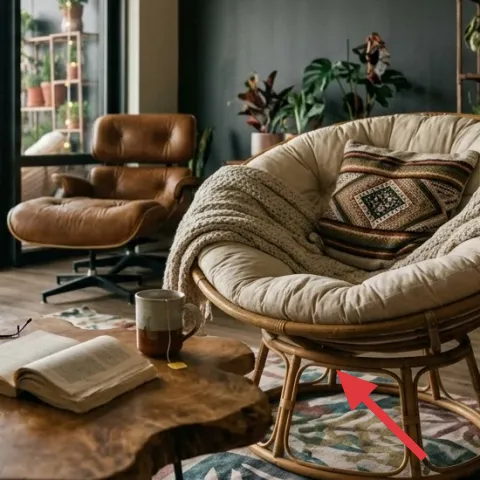
The patterned area rug lives in the center of the seating zone, where your eye lands when you enter. Its leafy shapes echo the green plants on the shelf, so the room reads connected instead of like separate decor piles. I like this over choosing one giant plain rug because the pattern makes the chair and coffee table look “framed,” especially against the darker wall. The downside is you’ll want to keep the smaller objects fairly cohesive—otherwise the pattern can compete with pillows, books, and planters.
Pick a pattern that repeats your plant colors
Leafy greens in the rug make terracotta planters look richer, not random.
Layer 3 — throw blanket draped over papasan chair ($25) Soft weight at shoulder height
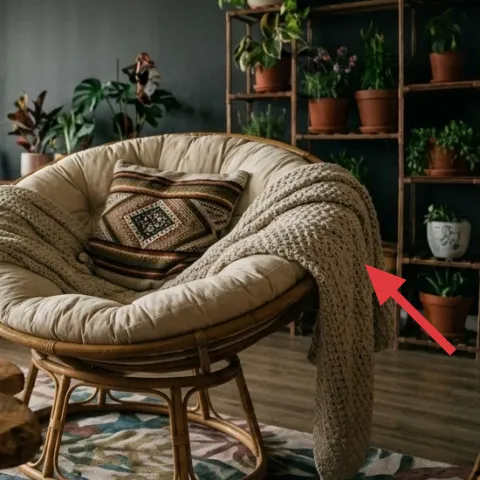
This throw blanket is draped over the papasan chair like a casual fold, which is exactly why it works in a move-friendly room. It adds visual thickness without taking up floor space, and it also bridges the gap between the natural tan chair texture and the darker wall. You could go for a fitted slipcover on a larger chair, but that’s usually harder to pack and harder to change. The trade-off here is washability: chunky throws need a plan for laundering, so choose one you can actually handle when life gets busy.
Drape, don’t tuck
A relaxed drape reads intentional and still looks good after you shove it back for a move.
Layer 4 — decorative throw pillow on papasan chair ($18) Pattern where it counts
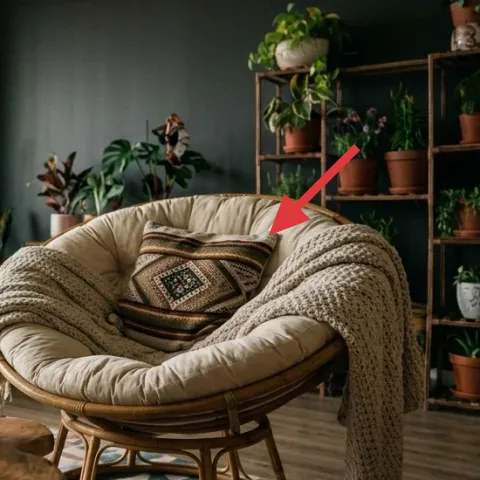
The decorative throw pillow sits near the center cushion on the papasan chair, so it’s the color “anchor” that makes the chair feel finished. The small-scale pattern helps pick up the string-light warmth and the plant greens without turning the rug into the only star. I’d normally recommend going for a pillow in one solid color, but the trade-off is that solids can look flat next to woven textures. Keeping one patterned pillow is the sweet spot: enough detail to feel designed, easy to replace later when you change your palette.
Choose one patterned textile, max two
In a layered rug setup, too many patterns start to fight even when they “match.”
Layer 5 — string lights along window ($15) Warm punctuation after dark
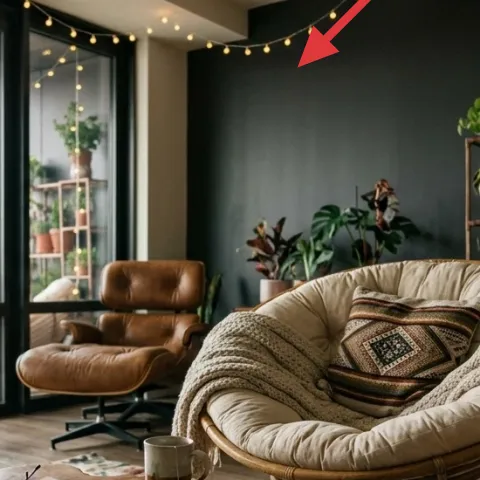
Those string lights trace along the window line, and that placement matters: it puts the glow near eye level, so the whole seating corner feels softer. Because the lights are ceiling-adjacent and horizontal, they also visually widen the space, especially in front of big glass panels. The obvious alternative is a floor lamp, but a plugged-in lamp takes up a footprint you may not have in a shared living room. String lights are simpler to pack and swap, but you do need to manage the cord so it doesn’t become a trip hazard around rugs and the coffee table.
Keep cords off the rug edge
Secure the cord route so it doesn’t snag when you vacuum or when roommates move furniture.
Layer 6 — decorative book stack ($5) A small styling surface that travels
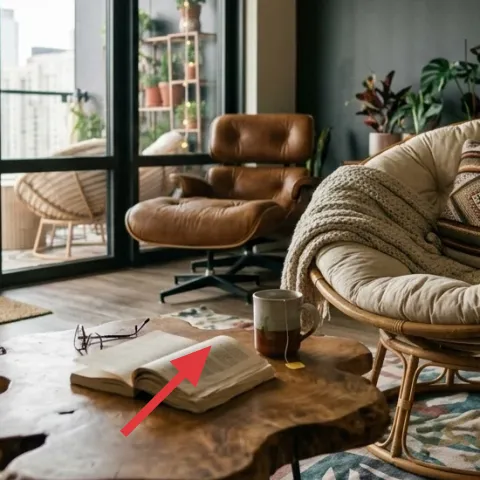
The open, stacked books on the coffee table act like a tiny “still life.” They add height and texture on a hard surface without needing any permanent wall changes. This is also a smart shared-housing move because books go with you—no awkward packing of fragile decor. I like choosing books over adding another object like a heavy tray because it’s easier to adjust the look by swapping in a different stack later. The trade-off is that it can look cluttered if the stack is too tall, so keep it tight and leave some table surface visible.
Let the table show through
If everything is stacked to the edge, the coffee table reads smaller in photos and in person.
Layer 7 — terracotta planters on plant shelf ($40) Make the shelf feel intentional
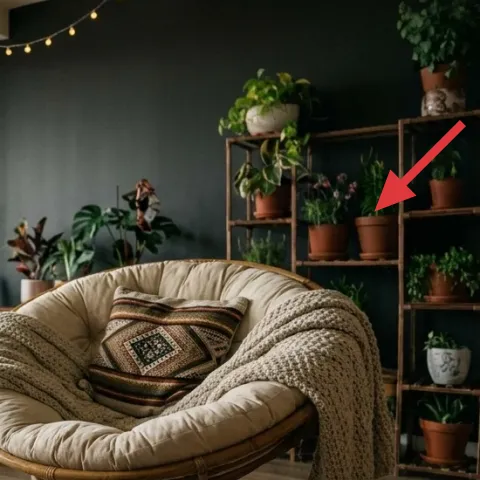
The terracotta planters on the tiered shelf bring in that warm, clay tone that matches the chair and the rug fibers. Even if the shelf already holds plants, the planters are what you’ll notice first—especially against the dark green wall. Giving them a simple paint refresh makes the shelf look curated instead of leftover, and it’s a DIY you can redo in a new color for the next apartment. The trade-off is that terracotta needs light prep so the paint adheres, but the result is still fully moveable—no landlord conversations required.
Paint only the pots, not the stems
Keeping plant parts untouched preserves growth and reduces mess during packing.
Make it instead of buying it
Paint a small set of terracotta planters to match the warm tan and forest-green palette, so the shelf looks designed without buying new planters.
Materials
- Outdoor-safe acrylic paint — small bottle set (about 4–6 oz total) — $15
- Paintbrush (foam or small brush) — 1 pack — $6
- Painter’s tape — 1 roll — $5
- Drop cloth or paper — 1 roll — $7
- Sandpaper (fine grit) — 1 sheet — $2
Steps
- Lightly scuff the terracotta surface with fine sandpaper so paint grips better.
- Wipe away dust, then set pots on a drop cloth to protect the floor.
- Tape any clean bands you want (like a stripe), keeping edges crisp.
- Apply the first coat in thin layers, letting it fully dry between coats.
- Add a second coat for even coverage, then remove tape while paint is slightly tacky.
- Let the pots dry completely before placing them back on the shelf with plants.
Total DIY cost: $35 — saves about $5 over buying.
The cost, layer by layer
| Layer | Item | Cost |
|---|---|---|
| 1 | Jute area rug | $80 |
| 2 | Patterned area rug | $80 |
| 3 | Throw blanket | $25 |
| 4 | Throw pillow cover | $18 |
| 5 | String lights (set) | $15 |
| 6 | Decorative book stack | $5 |
| 7 | Terracotta planters (set) | $40 |
| Total | $253 | |
If you want a cheaper variant, skip the second rug and keep only the patterned one, then put the jute away for your next place. You can also reduce costs by choosing one throw pillow cover instead of both a pillow and a blanket refresh.
What worked, what didn't (across the whole room)
The biggest win is layering texture: the two rugs plus the draped throw makes the seating corner feel finished without any permanent changes. String lights also help the dark green wall feel intentional rather than heavy. The only part that needs restraint is pattern—too much on the textiles can start to compete with the leafiness of the plants.
What worked
- Two rug layers made the seating area feel “framed,” especially in front of large windows.
- Draped throw placement on the papasan chair adds softness without needing extra furniture.
- The patterned throw pillow brings color focus right where you sit, not across the whole room.
- String lights placed along the window line create warm contrast against the dark green wall.
- Terracotta planters connect the chair and rug warmth to the plants on the shelf.
- A small book stack adds height on the coffee table without extra clutter.
What didn't
- Going too matchy with pillow patterns can make the chair look busy instead of styled.
- Skipping a bottom rug under the patterned rug makes the whole area feel less grounded.
- String-light cords left loose can snag during cleaning around rug edges.
- Plant shelves can look random if the pots aren’t visually cohesive.
- A tall, over-stacked table styling moment can make the coffee table read smaller.
What we'd skip if we did it again
Skip buying a matching “set” of decor for the shelf and coffee table. In shared spaces, it looks quick but it ages fast, and it limits how easily you can swap pieces when your roommates change what they own.
Skip going pattern-heavy on every textile. Keeping one patterned rug and one patterned pillow prevents visual noise while still reading boho and layered in photos.
Skip adding another floor lamp to “compensate” for darker walls. The string lights already give you warm, horizontal glow, and lamps take up the floor space that small rental rooms need.
Frequently asked
How long does this living room refresh take?
Plan for about a half day if the rugs and textiles are already on hand. The main time sink is positioning rugs so the edges look intentional and the chair sits centered over the pattern. Painting terracotta planters takes the longest only because you’re waiting for drying time; you can do the rest while pots dry.
Is this renter-friendly if I can’t change anything permanent?
Yes. The look relies on moveable elements: rugs, throw textiles, plug-in string lights, and painted planters. Nothing requires drilling, replacing fixed fixtures, or changing the wall. Even the string lights can be handled with removable hooks or cord management that doesn’t alter the windows.
What if my space is smaller or the seating corner is tighter?
Use the same strategy but scale back the “stack.” If the room is small, keep just one rug layer and make sure the patterned rug is large enough for the front chair legs to land on it. Instead of two throw layers, choose one: either the blanket or the pillow.
What if my room is bigger and feels too open?
In a larger room, don’t remove layers—expand them. Choose a larger patterned area rug so it reaches farther under the coffee table, and add a second small styling surface moment (like a book stack plus one small planter) to keep the corner from floating. String lights can also run a longer arc along the window line.
Where should I shop for these pieces on a budget?
Rugs are usually best at discount home stores and reputable marketplaces, especially for textured jute and leafy patterns. Throws and pillow covers are easiest at big-box home and online textile retailers, because you’re buying fabric, not fixed furniture. For planters, thrift stores and plant shops can be ideal—paint them afterward for a cohesive palette.
What’s the biggest mistake people make with this type of living room setup?
Overdoing matching. When every element comes from the same “set,” the corner feels staged instead of lived-in. Another common miss is skipping rug layering: the room then looks flatter and the chair textures don’t get the contrast they need.
More in Living Room
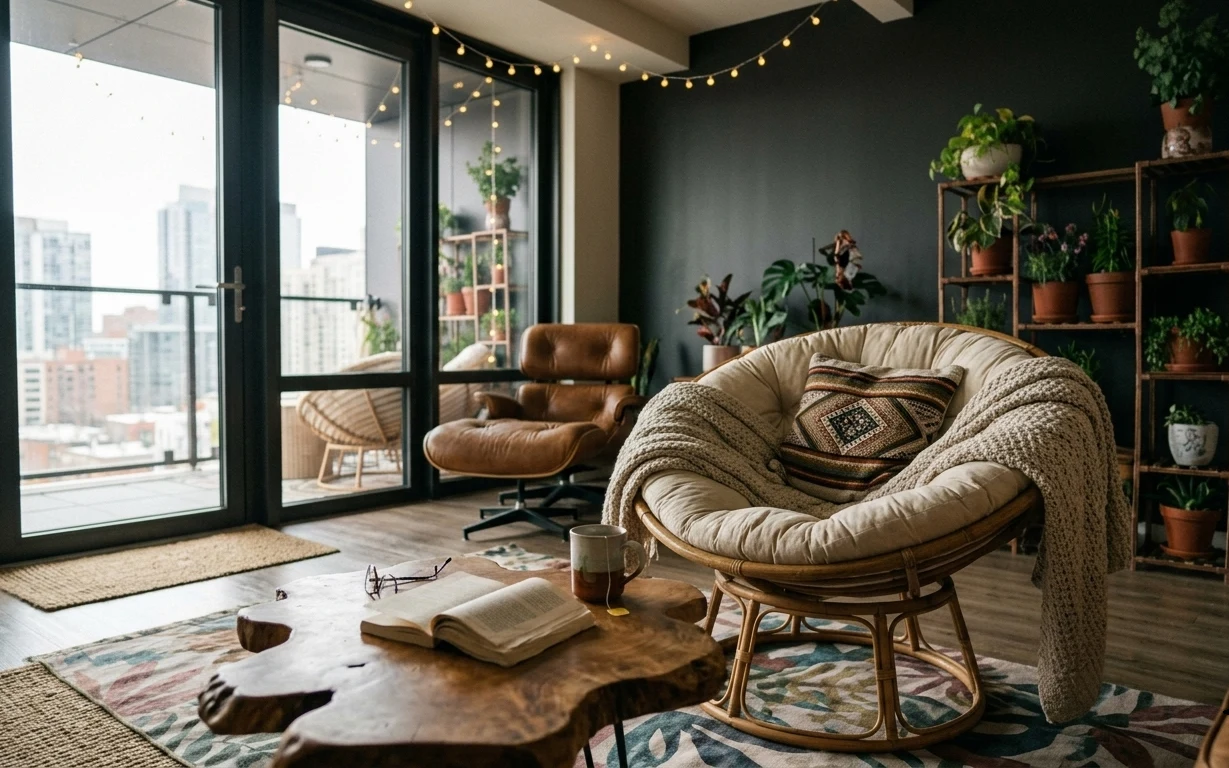
300 living room refresh ideas for a move-friendly seating corner
A sunlit living room seating corner in rich green and natural tan can be re-made for $300 using 7 move-friendly swaps. The biggest visual w…
How to refresh a living room for under $500
A renter-friendly living room refresh for under $500: a bold multi-color rug, a patterned throw, and movable plant styling around the sofa …
Under $700: warm walnut-and-cream living room seating area refresh
A renter-friendly living room seating area refresh that leans mid-century modern warmth: rug first, then lamp glow, plus a move-out-safe wa…