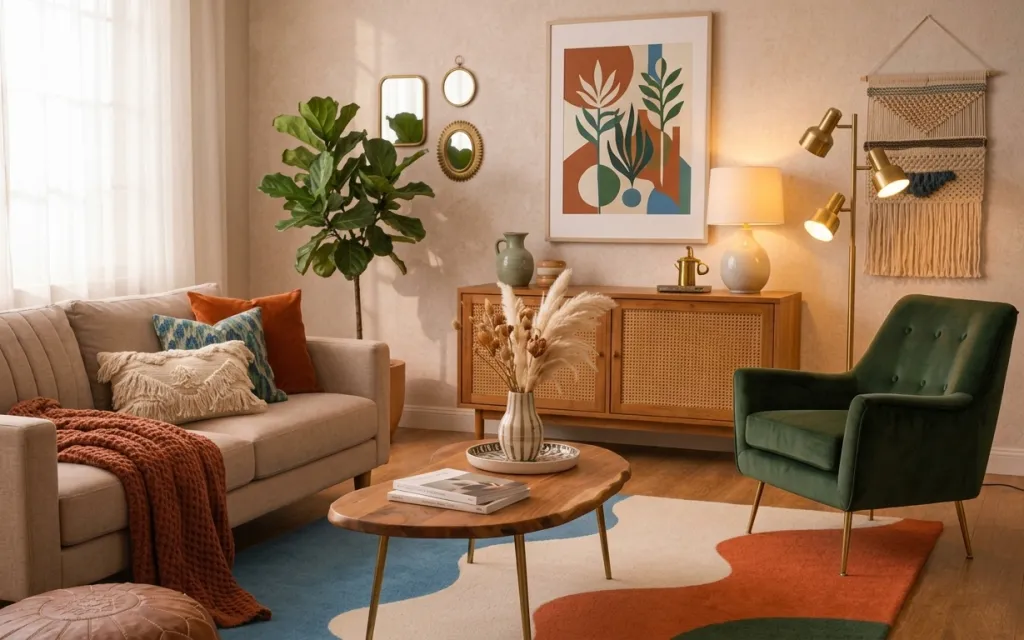
- Best for
- coffee table zones
- Time
- 2–4 hours
- Total cost
- $525
- Renter-safe
- mostly clip-on, plug-in, removable
Why this sage-and-rust seating is the coffee table zone of 2026
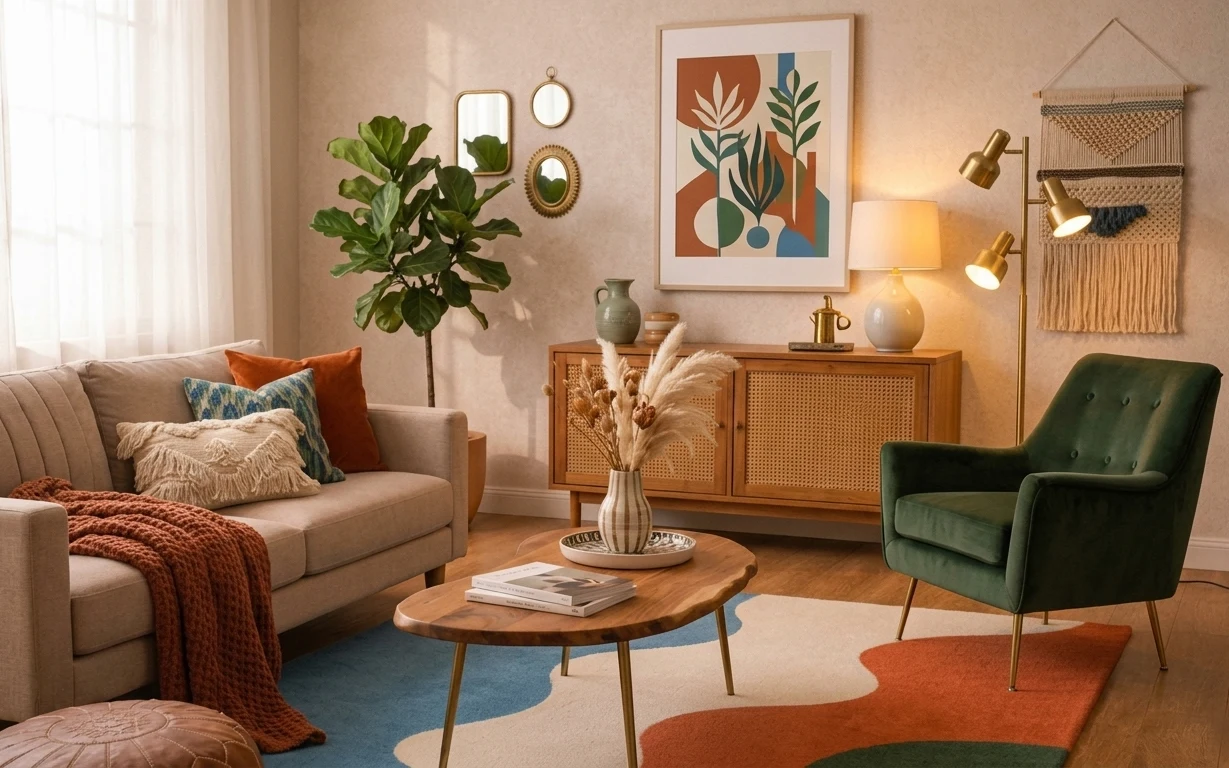
The first thing I notice here is how texture does the heavy lifting: a rust throw blanket on the sofa, a warm-toned rug under a round coffee table, and that macramé wall hanging for vertical interest. The colors feel intentionally limited—sage green, beige wall, and rust orange—so nothing fights when there are plants, brass lighting, and art in the frame. This is a style you can actually recreate in a shared rental because everything pictured is either freestanding or hangs with removable hardware. It’s also very “magazine styling” without needing built-ins: warm brass finishes, layered textiles, and one statement pattern.
I used to overdo it by chasing “one perfect centerpiece,” and the room would feel lopsided. The change for me was accepting that the center can be a zone instead—coffee table, rug, and the pillow/throw stack all playing together. Seeing the rug’s abstract shapes echo the rust throw made it click: when the pattern repeats by color (not by exact design), the whole corner reads cohesive. That’s what this setup nails, even with a busy wall and a tall plant nearby.
Layer 1 — abstract area rug ($200) Patterned enough to ground the corner
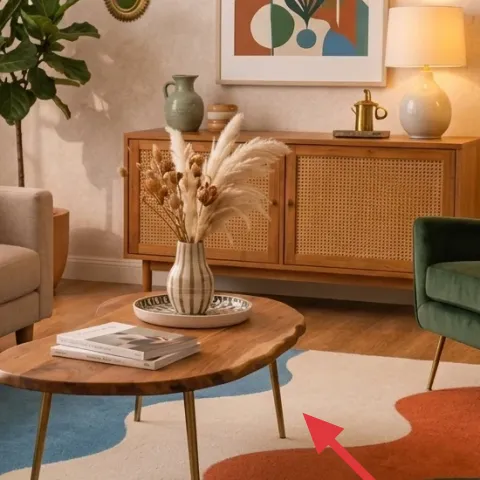
This abstract area rug is the foundation because it visually “holds” the entire coffee table zone in place. The blue-and-cream base keeps the room from going all warm and beige, while the rust touches tie directly into the throw blanket on the sofa. If you’re moving within a year, a rug like this is worth prioritizing over bigger furniture changes because it’s roll-able and still looks intentional even if the room’s lighting isn’t. The trade-off is size: go big enough that the coffee table legs sit fully on it, or the corner will look like it’s floating.
Pick the rug by the color you already own
If you know you’ll keep rust-toned throws or pillows, start with a rug that contains that hue so everything else feels coordinated instead of matched.
Layer 2 — round coffee table ($120) The shape that softens the patterns
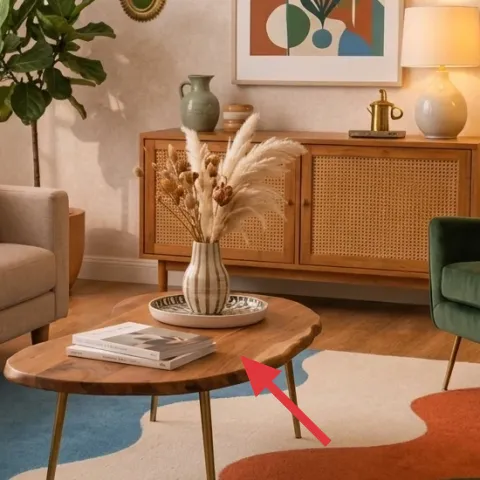
A round coffee table makes this corner feel calmer than a rectangular one because it blurs the edges of busy elements—the abstract rug and the illustrated wall art. In the photo, the tabletop reads warm wood, which is why the brass floor lamp and beige wall don’t feel cold. For shared housing, a round table is also practical: it gives you more “usable” walking space around the coffee table zone because corners don’t snag. The trade-off is that round tables can be harder to find in truly compact sizes, so choose a model that still leaves a clear path to the sofa.
Keep the decor low on top
A tray plus a vase of dried stems is enough. Tall objects can block sightlines to your wall art, especially in narrower living rooms.
Layer 3 — framed botanical-style art print ($25) One print that sets the plant tone
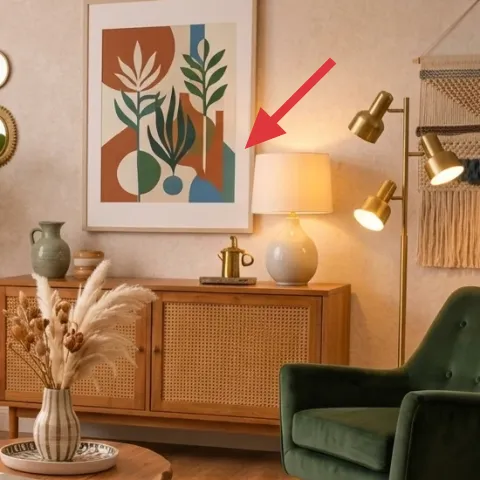
This framed botanical-style art print works because it’s a color bridge: greens echo the tall leafy plant, while the warm neutrals play nicely with the textured beige wall. Choosing a print you can remove cleanly matters in a shared rental—frames are easy to box and carry. The trade-off is that you’ll want to resist swapping too many prints later; pick one that already contains your main palette (sage/green and rust/warm tones) and let it be the anchor. Also, keep it at eye level so it looks like part of the coffee table zone rather than a random wall decoration.
Frame the art, then leave space around it
A simple, medium-weight frame plus generous wall breathing room prevents the corner from feeling cluttered.
Layer 4 — macramé wall hanging tapestry ($45) Texture you can hang with removable hardware
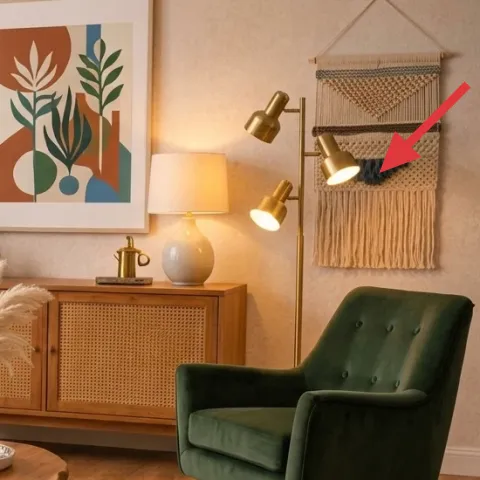
The macramé tapestry adds vertical texture, which is exactly what the room needs when you already have a patterned rug and illustrated art. It also brings “handmade” movement, so the brass lighting doesn’t feel too sleek. Since shared housing isn’t the time for drilling, this is a smart move: a lightweight macramé can be hung with removable hooks and dismantled quickly at move-out. The trade-off is that fibers collect dust, so you’ll want to shake it outside occasionally or spot-clean gently.
Make it instead of buying it
DIY a macramé wall hanging using a dowel and cord so you get the same boho texture without drilling into the wall.
Materials
- Macramé cord — ~200 ft — craft store — $14
- Wood dowel — 1 piece, ~12–16 in — craft store — $8
- Command Strips multi-pack — for a single hook — store — $8
- Metal ring or small loop (for hanging) — 1 — craft store — $6
- Trim scissors or small comb tool — 1 — dollar or craft store — $2
Steps
- Measure your dowel width and cut cords so you’ll have even strands (count the cords before you knot).
- Fold cords in half, then attach them to the dowel using a secure lark’s head knot.
- Work the main pattern (like square knots) in repeating rows, keeping tension consistent.
- Create the fringe bottom by leaving some strands unknotted and trimming to a uniform length.
- Attach a hanging loop to the dowel ends and test that it sits straight.
- Hang with a removable hook, then gently fluff the fibers so the texture shows.
Total DIY cost: $38 — saves about $7 over buying.
Layer 5 — brass multi-shade floor lamp ($80) Warm light that makes beige feel expensive
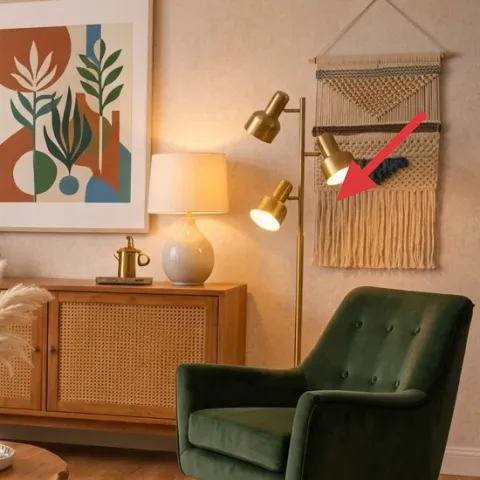
This brass multi-shade floor lamp reads like “jewelry” for the room: the warm metal tone pairs with the beige wall and makes the rug and art feel more dimensional. Multiple shades also let you keep the lighting soft instead of relying on one harsh overhead source, which is a big win for shared spaces where you don’t control ceiling fixtures. In a move, floor lamps are easiest when they’re plug-in and not heavy—this style typically breaks down or tilts for transport. The trade-off is brightness: test bulb wattage so you don’t end up with glare on the art print.
Don’t buy for looks alone—check the bulb type
If the lamp uses a bulb you can’t easily replace, you’ll hate it later. Confirm the socket type and dimmer compatibility first.
Layer 6 — rust throw blanket ($30) Color repeat without matching everything
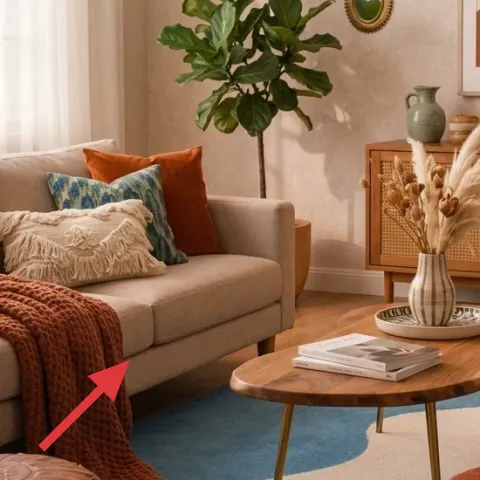
The rust throw blanket is the easiest “palette glue” in this room because it repeats the rug’s warm accents without requiring a full matching set. Drape it over the sofa arm so the color shows when you’re sitting, not hidden in a closet. This also scratches that “designed” itch—one throw reads intentional, while trying to match every pillow and cushion often looks costume-y. The trade-off is practicality: textured throws can shed, so shake it once before guests arrive and consider a fabric that feels good in hand, not just on camera.
Use the throw to anchor one side
If the sofa faces a TV or a shared doorway, keep the throw on the side the room draws you toward.
Layer 7 — tall leafy green plant in a pot ($25) Bring scale and life to the wall zone
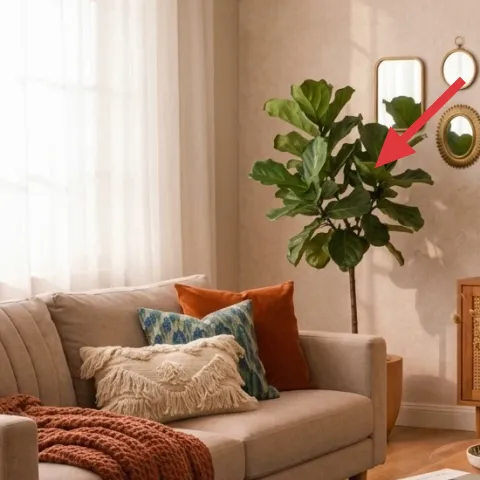
That tall leafy plant works because it adds height near the wall without needing any wall installation beyond what you already have for the art. Visually, it balances the verticality of the macramé tapestry and gives your coffee table zone a natural “frame” instead of leaving the corner empty. In a shared rental, plants are also move-friendly: you can transport the pot and refresh the leaves if the lighting changes. The trade-off is upkeep—pick a plant that matches your actual window exposure, or swap to a less picky option so it survives your move schedule.
Rotate the pot weekly
Even one small weekly turn helps the plant grow evenly, so it stays photogenic from more than one angle.
The cost, layer by layer
| Layer | Item | Cost |
|---|---|---|
| 1 | Abstract area rug (5×7) | $200 |
| 2 | Round coffee table | $120 |
| 3 | Framed botanical-style art print | $25 |
| 4 | Macramé wall hanging tapestry (DIY retail equivalent) | $45 |
| 5 | Brass multi-shade floor lamp | $80 |
| 6 | Rust throw blanket | $30 |
| 7 | Tall leafy green plant in a pot | $25 |
| Total | $525 | |
If you want a cheaper version, swap the brass floor lamp for a single plug-in table lamp and choose a simpler solid rug with rust in the palette. That keeps the sage-and-rust color story while lowering the biggest “anchor” costs.
What worked, what didn't (across the whole room)
The look works because the palette repeats by color (sage/green and rust) and the textures keep the room from feeling flat: rug pattern, knit-like throw, woven macramé, and plant greenery. Lighting also helps—warm brass tones keep beige from looking dull.
What worked
- The abstract rug anchors the coffee table zone and makes the sofa styling feel intentional.
- The round coffee table softens the edges created by rug pattern and framed art.
- Rust repeats across throw + rug, so the room reads cohesive without literal matching.
- Macramé adds vertical texture where the wall would otherwise feel empty.
- Warm brass lighting keeps the beige wall looking richer instead of flat.
- The tall plant provides height balance and makes the corner feel “finished,” not staged.
What didn't
- If the rug is too small, the coffee table looks like it’s floating over the floor.
- If the lamp’s light is too cool, the beige wall can feel gray instead of warm.
- If the macramé is hung too low, it competes with the coffee table decor.
- Trying to match every pillow color exactly can make the corner feel over-coordinated.
What we'd skip if we did it again
Skip a second “statement” wall item in the same area as the framed botanical print. In this photo, the art is already doing the color-bringing work, and the macramé adds texture—stacking another bold print often turns the wall into visual noise.
Skip a rug with only one warm neutral tone. The abstract shapes in the rug are part of why the palette feels dimensional, and a plain beige rug would hide the rust + blue contrast that makes the coffee table zone look styled.
Skip heavy, wall-tied storage baskets that need perfect placement. For shared housing, it’s better to keep the coffee table zone light and move-ready so you can re-style quickly when your roommates’ schedules (and your own move timeline) change.
Frequently asked
How long does this kind of living room refresh take?
For a shared-housing setup like this, plan on about 2–4 hours total. Most of the time goes to positioning the rug so the coffee table legs sit correctly and styling the throw/pillow stack. The macramé DIY can add an extra 1–3 hours depending on your knot rhythm. The rest is just swapping in lighting bulbs and fluffing the plant so the corner looks intentional right away.
Is this renter-friendly if I can’t drill or change fixed fixtures?
Yes. The key pieces here are freestanding or removable: the rug rolls up, the coffee table is transportable, the floor lamp plugs in, and the framed art can be hung with removable hooks. For the wall hanging tapestry, use removable Command-style hooks (and test on a small spot if you have textured walls). The approach is built around moving everything in boxes when your lease ends.
What if my living room is smaller than this photo?
Scale down without losing the zone idea. Go for a smaller rug that still lands under the coffee table legs, and keep the throw/blanket styling to one main warm color (rust) rather than multiple accents. If the room is tight, place the floor lamp slightly closer to the sofa so it doesn’t “claim” floor space. One vertical texture piece (macramé or tall plant) is usually enough—avoid multiple tall items in the same corner.
What if my room is bigger—how do I keep the look balanced?
For a larger living room, the simplest upgrade is rug size: move up until the coffee table is comfortably seated on the rug. Then keep the palette tight and add one more texture layer (another soft throw or a second plant) rather than adding more patterns. If the wall feels far away, choose a slightly larger framed print so the botanical art matches the scale of the room.
Where should I shop for these move-friendly decor pieces?
Start with big anchors that come in standard sizes—area rugs, framed prints, and plug-in lamps are easy to find at home goods stores and marketplaces. For the macramé, craft stores are the best bet for cord and dowel, and thrift shops can be great for picture frames. For the plant, local nurseries or big-box garden sections usually have the right height and pot sizes for corner balance.
What’s the biggest mistake people make with this style?
The biggest mistake is mixing too many dominant patterns without repeating a single color. In this room, the palette stays disciplined—sage and rust show up in multiple places—so the rug pattern and botanical art don’t feel chaotic. If you choose one patterned rug, keep the pillows and throw in solids or small-scale prints that repeat the rug’s warm tones.
More in Living Room
6 no-drill swaps for a sage-and-rust coffee table zone, $600
A sage-and-rust coffee table zone, styled for shared housing and easy moves. This $600 refresh leans boho-modern with an abstract rug, warm…
7 budget-friendly desert living room upgrades for $800
A desert living room refresh with 7 weekend upgrades, including a woven area rug, layered throw texture, and bold wall art. This $800 plan …
5 no-drill swaps for a renter-friendly living room nook, $700
A sunlit living room seating nook gets a maroon-and-cobalt makeover with no-drill renter upgrades. This $700 refresh leans on a patterned r…