- Best for
- First weekend visual upgrades
- Cost
- About $800
- Time
- One to two weekends
- Renter-safe
- Mostly peel-and-stick friendly
Why rattan-and-jungle wallpaper weekend refresh is the bathroom vanity nook of 2026
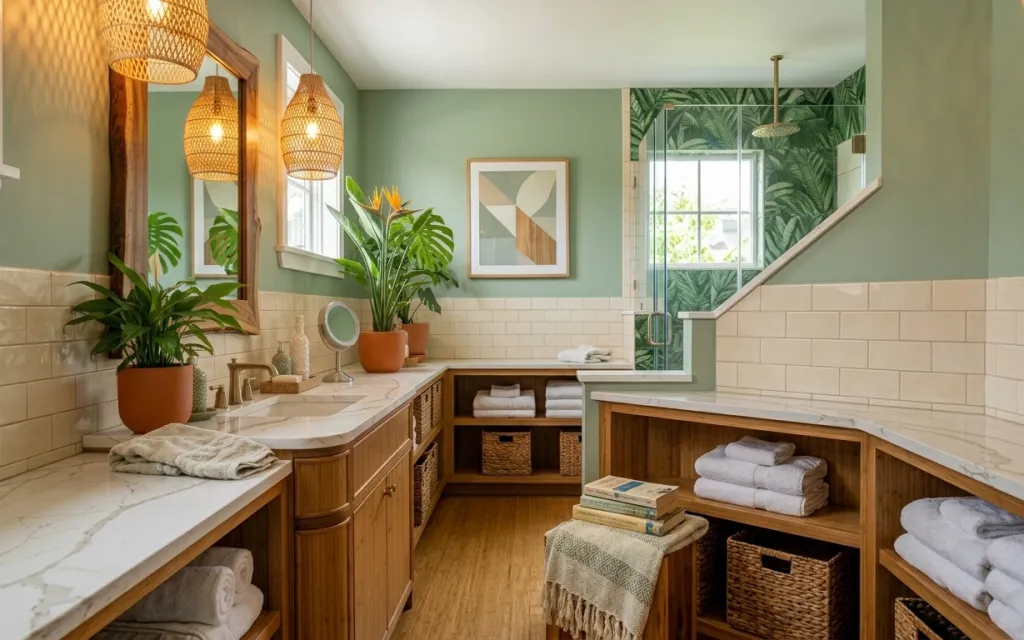
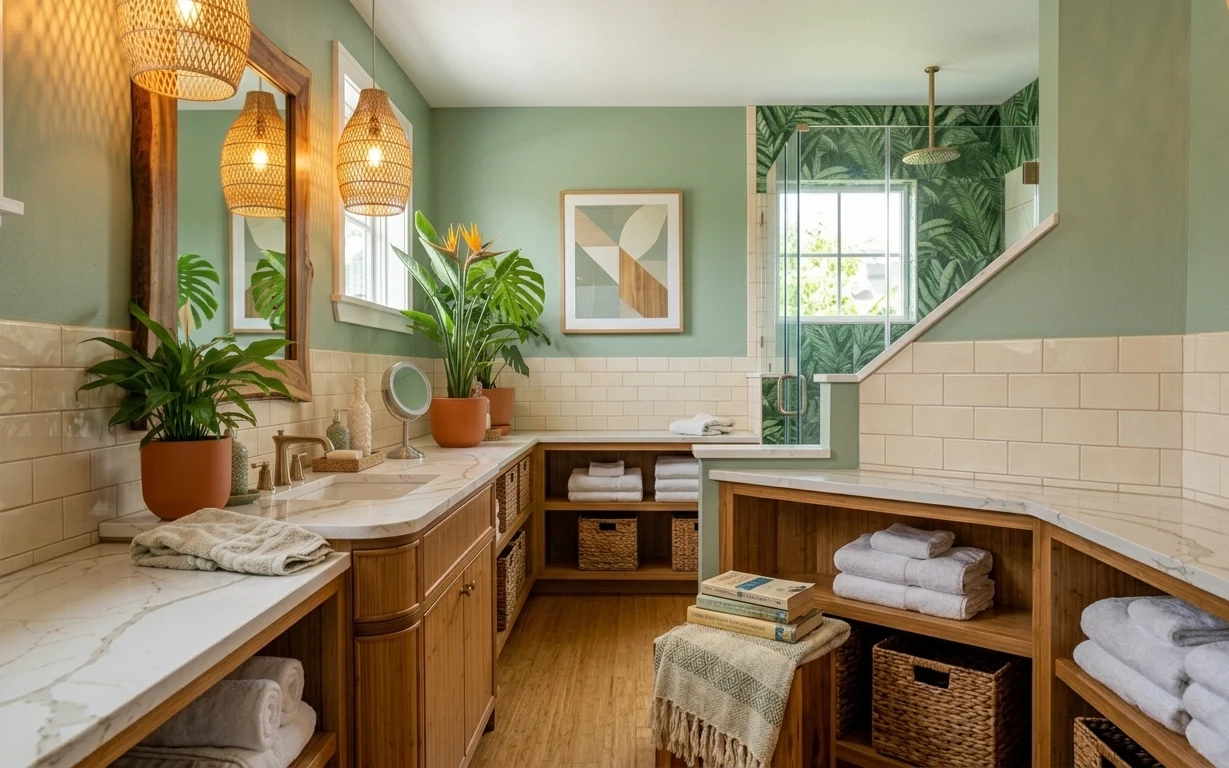
The quickest way I’ve changed a bathroom is to treat it like a mini living room: pick one wall with real pattern, then repeat your warmth in lighting and natural materials. Here, the sage-green painted wall and beige subway tile backdrop make the tropical leaf wallpaper feel intentional instead of loud. The white marble countertop reads crisp, while the terracotta pots and the woven baskets add texture. That balance is achievable even if you’re working fast, because most of the heavy lifting is peel-and-stick plus a couple of fixtures and decor.
My first instinct was always to match everything—the same towel color, the same wood tone, the same frame size. This time, I stopped trying to “perfectly match” and leaned into contrast: warm rattan against cool tile, and leafy greens beside cream stone. The room instantly started looking collected instead of assembled. If you’ve ever felt like your bathroom looked a little flat after you got the big pieces, that’s usually why: you need texture and depth, not just color.
Layer 1 — Peel-and-stick tropical leaf wallpaper ($150) Wallpaper pattern on the wall that catches your eye
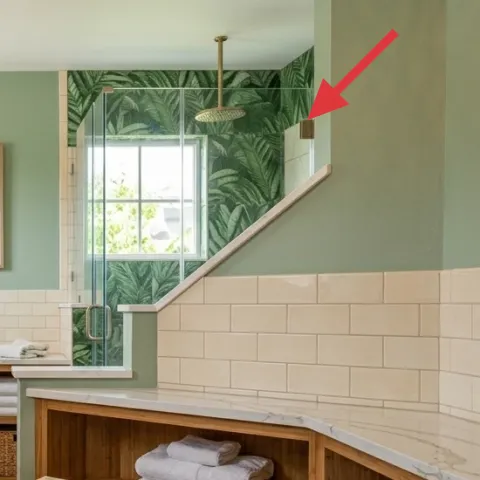
Peel-and-stick tropical leaf wallpaper is the fastest way to give this vanity nook an identity, especially on a single accent wall. The photo’s jungle pattern sits behind the mirror zone, so you notice it as soon as you walk in—before you even focus on towels or plants. Because the wallpaper is on one wall, it won’t fight the beige subway tile backsplash. The trade-off: you’ll need to measure carefully and take your time smoothing seams so it looks straight in the mirror reflection. Keep the rest of the palette cream, sage, and warm wood so the pattern stays the star.
Measure from the corner, not the tile grout
If your tile wall isn’t perfectly square, starting from a grout line can skew the pattern placement. Use a level to mark the first vertical edge before you apply the first strip.
Layer 2 — Two rattan pendant lights ($180) Warm woven light above the vanity
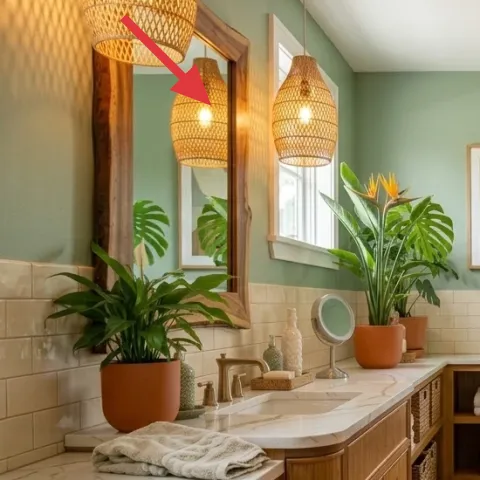
Two rattan pendant lights add that “spa meets beach cabana” warmth that ceiling lighting alone can’t deliver. In the photo, the woven shades glow softly and bring texture right into the mirror view. That’s the big reason to choose pendant lighting over a basic flush-mount: it creates depth and turns overhead light into a design element. The trade-off is height—too low will feel cramped around the mirror, too high will look skimpy. Aim for a visually centered placement above the vanity area so both sinks share the light.
Target a warm bulb temperature
Warm bulbs keep the sage green from reading gray and make the terracotta pots look richer. If you’re not changing wiring, use plug-in compatible fixtures where possible.
Layer 3 — Framed abstract wall print ($80) Color-block art to soften the tile
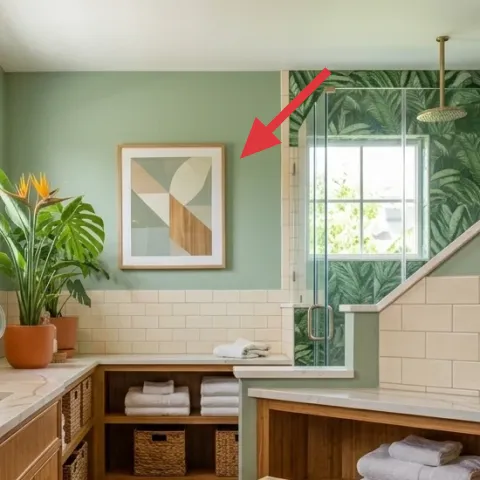
This framed abstract print works because it echoes the room’s colors without competing with the leaf pattern behind it. The artwork sits between the mirror and the window zone, so it acts like a visual pause: your eyes travel from mirror to art to wallpaper, instead of bouncing only off tile. The trade-off is choosing the wrong scale—if the print is too small, it feels lost, especially with a bold wallpaper behind it. With a medium-size frame, you get contrast and polish without needing an entire gallery wall.
Make it instead of buying it
Paint a simple abstract print on cardstock so you get the same color-block look as the framed piece for less money.
Materials
- Cardstock or watercolor paper — 1 pad — craft store — $6
- Craft acrylic paint assortment — assorted small bottles — craft store — $12
- Small foam roller and brushes — set — craft store — $10
- Matte clear spray (paper-safe) — 1 can — craft store — $5
Steps
- Sketch a few rough shapes that pull color from the room (sage, cream, warm tan).
- Paint the largest shape first, then layer smaller blocks once dry.
- Use a foam roller for soft edges and a brush for crisp lines where you want contrast.
- Let everything dry fully, then spot-fix any thin paint areas.
- Spray a light matte coat from a distance to protect the surface.
- Trim to fit your existing frame and slide it in with the backing.
Total DIY cost: $33 — saves about $47 over buying.
Layer 4 — Rectangular framed mirror above the vanity ($120) A clean frame line for the marble and tile
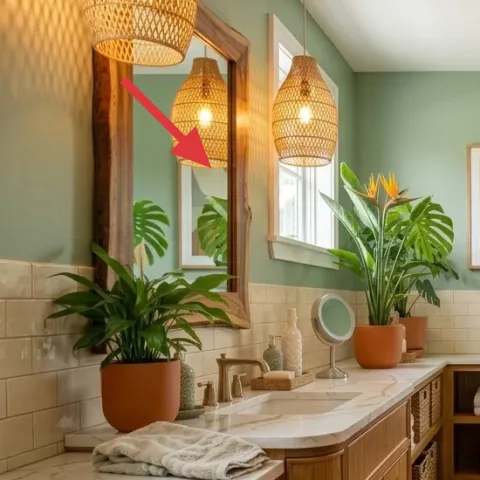
A rectangular framed mirror makes the vanity feel intentional, especially against the beige tile half-wall. The frame adds structure to a space that already has strong horizontal lines (counter, tile band, shelf/bench). Compared with an unframed mirror, the visible border helps your wall decor look “finished,” and it gives the wallpaper behind it a design rhythm. The trade-off is glare—shiny frames can reflect lights, which makes photos look washed out. Choose a matte or lightly textured frame so your pendant glow stays soft.
Don’t pick a frame that’s too reflective
If the frame surface is glossy, it can throw back cabinet and ceiling light and make the mirror area look harsh.
Layer 5 — Large potted plant in a terracotta pot ($35) Instant texture on the marble counter
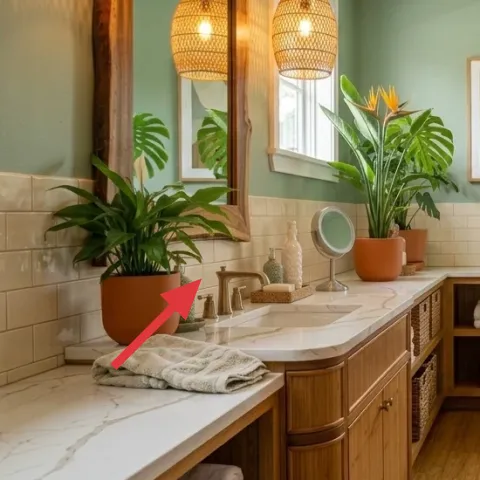
A large potted plant in a terracotta pot is doing more work than it looks like it’s doing. On marble, it brings softness—both visually and in how your eye relaxes after tile and grout lines. In the photo, the plant also ties into the woven baskets and the warm pendant lights, so the warmth reads consistent. The trade-off: plants can look “too new” if the pot is bare or the leaves are overly symmetrical. Choose something with a fuller silhouette and a slightly organic arrangement so it looks like it belongs, not like a prop.
Rotate the pot once a week
Light in bathrooms is uneven; rotating keeps the plant from leaning and keeps the leaf shape looking intentional.
Layer 6 — Woven baskets for under-bench storage ($50) Hidden towels, still visible texture
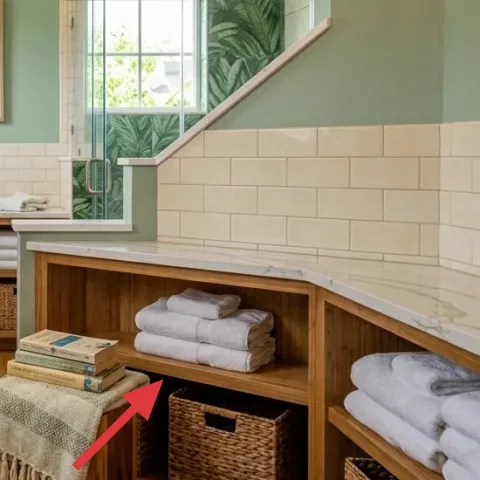
Woven baskets under the bench give you two benefits at once: storage and design texture. When you pull the towels out of piles and tuck them into baskets, the room instantly reads calmer—especially with the wallpaper and framed art adding pattern. The trade-off is that you’ll want to match basket sizes so the openings line up neatly and don’t look haphazard. In a vanity nook, uniform basket placement makes the whole zone feel styled even when towels aren’t perfectly folded. Stick to natural woven tones so they echo rattan lighting instead of clashing with tile.
Keep baskets low and chunky
Lower, wider baskets fill the cubbies without leaving big empty gaps that make storage look unfinished.
Layer 7 — Small decorative tray on the countertop ($25) A landing spot for small bottles and daily items
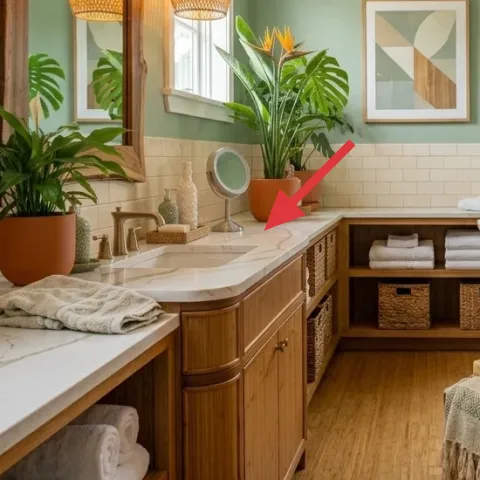
A small decorative tray is the easiest way to make bathroom counters look curated instead of accidental. The photo’s tray groups a few small items into one “still life,” which is important because the countertop is otherwise busy with tile reflections and marble veining. The trade-off: the tray can turn into clutter if it’s too small for daily essentials. Choose a tray that holds your most-used bottles and one small object—enough to make a moment, not enough to become a dumping ground. This is where you keep order without making the bathroom feel sterile.
Use trays to limit the number of surfaces you clean
If items live on the tray, you wipe one area instead of five tiny ones.
The cost, layer by layer
| Layer | Item | Cost |
|---|---|---|
| 1 | Peel-and-stick tropical leaf wallpaper (one accent wall) | $150 |
| 2 | Rattan pendant lights (pair) | $180 |
| 3 | Framed abstract wall print | $80 |
| 4 | Rectangular framed mirror | $120 |
| 5 | Indoor plant in terracotta pot (4–6 ft) | $35 |
| 6 | Woven storage baskets (set) | $50 |
| 7 | Small decorative tray | $25 |
| Total | $640 | |
If the tropical wallpaper feels like too much, swap to a simpler botanical peel-and-stick pattern or a small-scale repeat. Keep the same mirror frame shape and use rattan lighting plus terracotta plants so the nook still feels warm and layered.
What worked, what didn't (across the whole room)
The biggest win is that the design changes the “entry view” of the bathroom: wallpaper behind the mirror, warm woven pendants, and natural texture right where you look. The second win is storage styling—baskets make the towels look intentional instead of temporary. The main miss is letting overhead light be the only lighting; when the light is harsh, the sage wall and tile can read cooler than they do in person.
What worked
- One accent wall of tropical leaf wallpaper gives instant depth behind the mirror.
- Rattan pendant lights soften beige tile and make the marble read warmer.
- The framed abstract print adds color-block contrast without building a full gallery wall.
- Terracotta planters repeat the room’s warm materials for a cohesive look.
- Woven baskets make towel storage look styled instead of hidden clutter.
- A countertop tray keeps small bottles from spreading across the marble.
What didn't
- Choosing a glossy mirror frame can bounce pendant light and feel harsh in photos.
- Buying a print that’s too small makes the mirror wall look unfinished with the wallpaper.
- Using a plant with sparse leaves leaves empty counter space that marble highlights.
- Overstuffing baskets makes the cubbies feel messy instead of organized.
What we'd skip if we did it again
Skip matching sets of towels that all come from the same “coastal” collection. In this kind of bathroom, the texture and materials do the work—one or two well-chosen tones look better than a perfectly coordinated set.
Skip a second accent pattern on top of the leaf wallpaper. Wallpaper already brings movement; if you add more prints, the sage wall and tile lose their calm backdrop role.
Skip a tiny tray that can only hold one bottle. A slightly larger tray lets you group items into a mini vignette, so the countertop looks intentional the first time you walk in—not five minutes into the day.
Frequently asked
How long does this bathroom vanity nook refresh take?
Expect about 4–7 hours for prep and install of peel-and-stick wallpaper (including smoothing and trimming) plus 2–3 hours for hanging the mirror, swapping pendant fixtures if needed, and styling the countertop. If you add the DIY abstract print, include an extra day for drying and a second pass if you want cleaner edges. The decor and baskets are the fastest part—usually 30–60 minutes.
Is this renter-friendly if I can’t change fixtures or walls?
The wallpaper and decor are the most renter-friendly pieces here. If you can’t swap the mirror or lighting, keep your existing mirror and focus on adding the accent wallpaper behind it and styling the countertop with the tray, plants, and baskets. For lighting, choose a plug-in compatible rattan-style option or use a warm bulb in your current fixture. The key is repeating warmth and texture, not changing everything at once.
What if my bathroom is smaller or the mirror wall is narrower?
On a smaller wall, scale down the wallpaper coverage to one clearly defined section and keep the rest of the walls simple. For decor, choose a slightly smaller framed print and one larger plant instead of two small ones. Storage baskets can be taller or shallower depending on your bench cubbies, but aim for consistent woven tones so the nook still reads cohesive.
Where can I shop for the wallpaper look and the rattan lighting?
For wallpaper, look for peel-and-stick tropical leaf patterns sold in repeat rolls that note easy repositioning. For rattan lighting, search for woven pendant lights sold as pairs or for compatible plug-in pendant kits if wiring isn’t an option. Plants in terracotta are widely available—choose a shape with fuller leaves so it fills the counter area without constant repositioning.
What’s the biggest mistake people make with this kind of bathroom style?
The biggest mistake is letting one bold element dictate everything else—usually adding multiple patterns or using cool, daylight bulbs that flatten the warmth. Pair the leaf wallpaper with warm lighting and a short list of materials: marble/cream tile, warm wood, rattan, terracotta, and woven baskets. If the palette is consistent, the room feels designed even when you’re working on a deadline.
More in Bathroom
Boho bathroom refresh, $800
A weekend bathroom refresh with peel-and-stick tropical leaf wallpaper, two rattan pendant lights, and a new framed mirror. For about $800,…
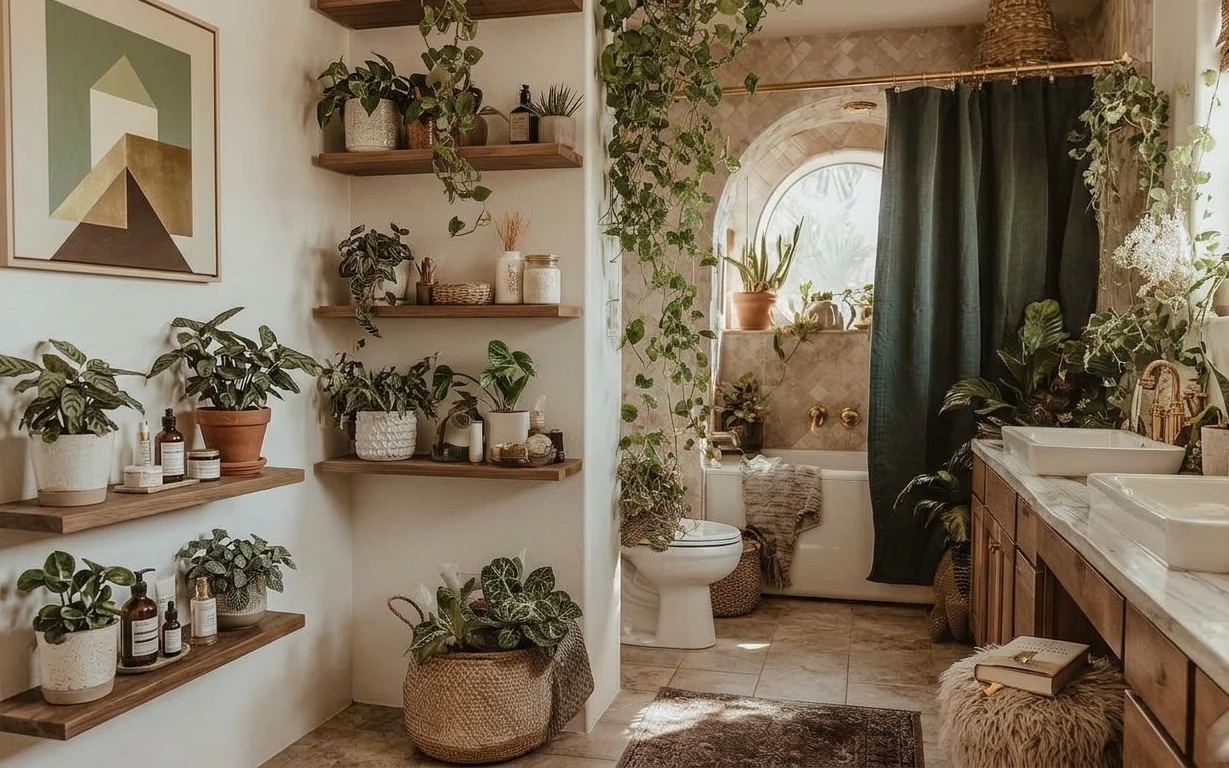
5 no-drill upgrades for a botanical bathroom under $350
A botanical bathroom refresh on a $350 budget that leans on move-friendly swaps: framed wall art, a patterned area rug, and a dark green sh…
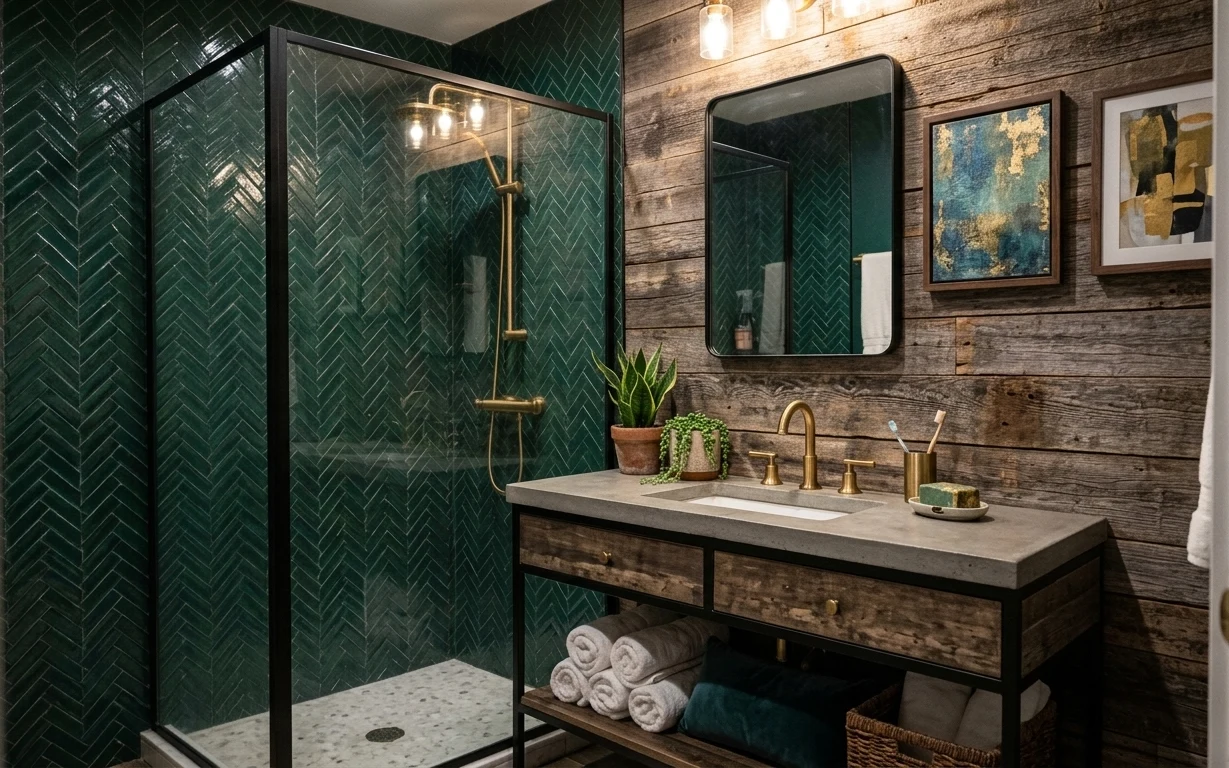
7 counter upgrades for a $600 spa bathroom
A spa bathroom already has great bones: deep green herringbone tile, warm wood panels, and brass fixtures. This weekend refresh adds 7 coun…