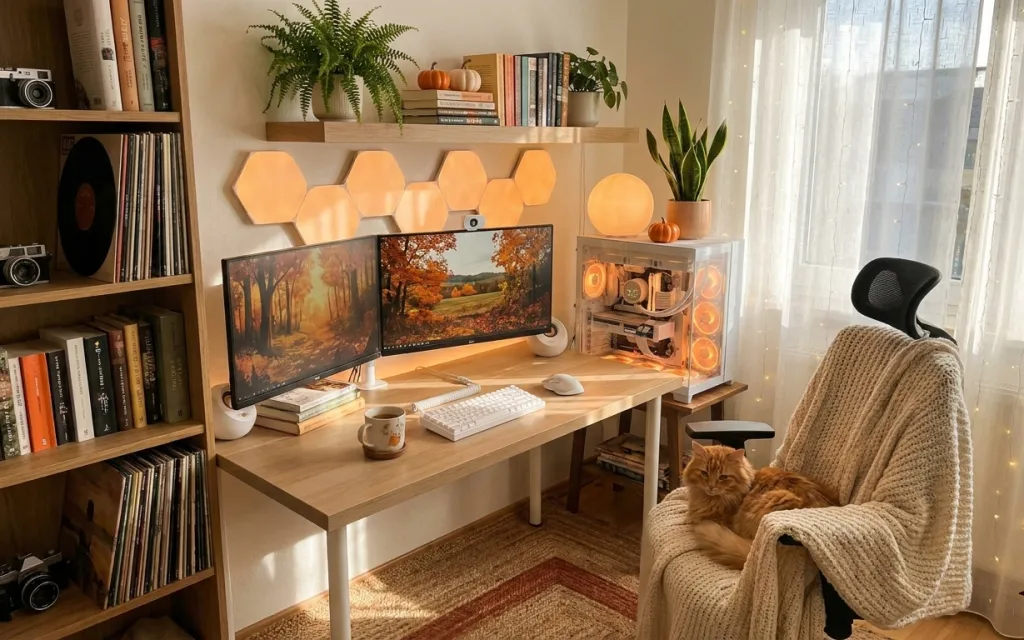
- Square footage
- Fits a small desk corner
- Cost
- $400 total
- Difficulty
- Easy
- Renter-safe
- No-drill swaps
Why warm beige-and-terracotta home office corner is the move-friendly nook of 2026
In this setup, the warm beige rug anchors the floor, while sheer curtain panels keep daylight feeling diffused instead of harsh. The desk’s light wood surface gives you a clean working zone, and the hexagon wall shelf adds shape without needing a full gallery wall. Soft string lights thread through the curtains for that gentle glow, especially when monitors are doing most of the heavy visual lifting. For shared housing, this kind of styling is achievable because every change here is either a soft good or a freestanding swap.
I caught myself once trying to “fix” a shared setup with hardware—then I remembered I was moving in a year, and the next tenant would be stuck with the holes. I’ve since leaned into what actually packs: textiles, clip-on lighting effects, and shelf styling that comes down in minutes. This look works because it starts with a base (rug + curtains) and then layers warm details you can box up without fuss.
Layer 1 — area rug 5×7 ($80) Defines the work zone
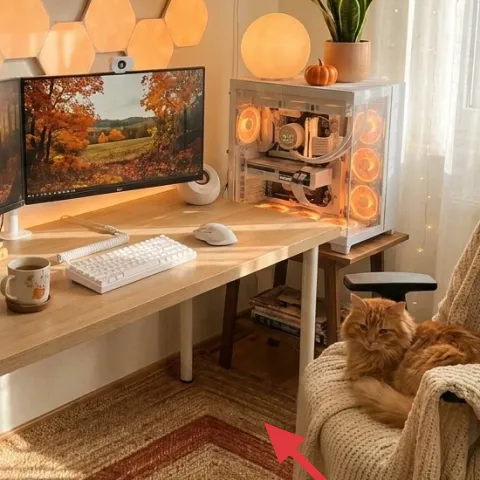
A 5×7 area rug in a warm neutral pattern does the unglamorous job of making a small corner feel intentional. In the photo, it sits under the desk and extends toward the chair, so your feet don’t hit bare flooring every time you stand up for a break. The trade-off is that patterned rugs show less dust than fully light solids, but they still clean up quickly with a vacuum and spot treatment. The obvious alternative is a runner, but a runner leaves the “desk-at-the-edge” feeling that makes tight layouts look busier.
Anchor under the desk legs
Let the front edge of the rug land before the chair so your whole seating moment reads as one zone.
Layer 2 — sheer curtain panels ($30) Softens the daylight
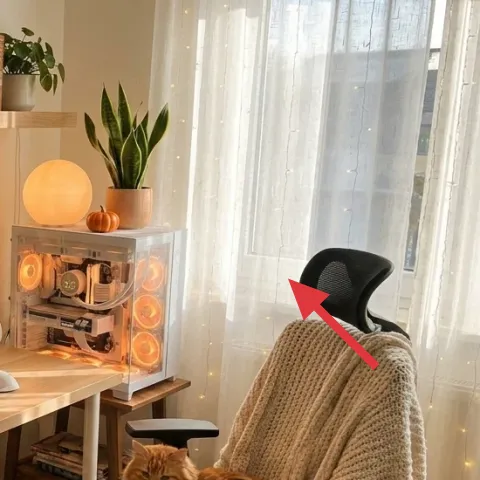
Sheer curtain panels bring a calm, airy layer that keeps your screens from competing with harsh window glare. Here they hang along the right side and add vertical softness beside the desk, which is especially helpful in small rooms where walls can feel too flat. This is a textile swap, so it packs and dismantles easily at move time. The trade-off is that sheers don’t block light the way blackout curtains do, but the payoff is a lighter, warmer look during the day—perfect for a home office where you need natural illumination.
Pick an off-white, not stark white
Off-white blends with the rug warmth and wood tones without turning the corner into a sterile photo backdrop.
Layer 3 — string lights ($15) Adds a warm evening glow
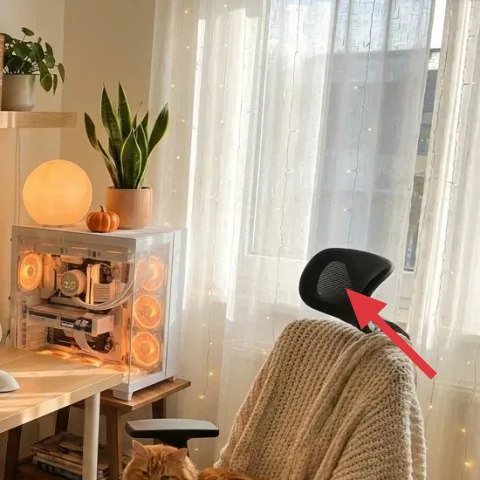
String lights are doing quiet work in this corner: they add a soft, warm glow that makes the desk area feel inviting after dark. They’re also easy to move—coil them into a box, and you’re done. The trade-off is that you have to get placement right so the lights look intentional, not tangled; in this photo, the strands run down the window side and catch the curtain texture. If you swap them for a single brighter lamp, the room can look either too focused or too dim in the corners around the chair and bookshelf.
Avoid high-heat lighting near textiles
Use LED string lights and keep the cords routed so they don’t sit too close to fabric folds for long hours.
Layer 4 — desk ($90) Creates a clear command center

A simple desk with a light wood top gives you a visual reset every time you sit down. In the photo, the desk surface holds the keyboard area and keeps the line of sight clean, which matters when you also have monitors and shelves in the same zone. The trade-off is that light wood can show small scuffs, but it’s also forgiving: a desk mat and a quick wipe keep it looking fresh. The alternative is a darker desk, which can make a small room feel heavier—especially when the curtain layer is already soft and bright.
Keep the surface “repeatable”
Use one tray or one grouping so the layout looks styled even on busy weeks.
Layer 5 — bookshelf ($80) Turns storage into styling
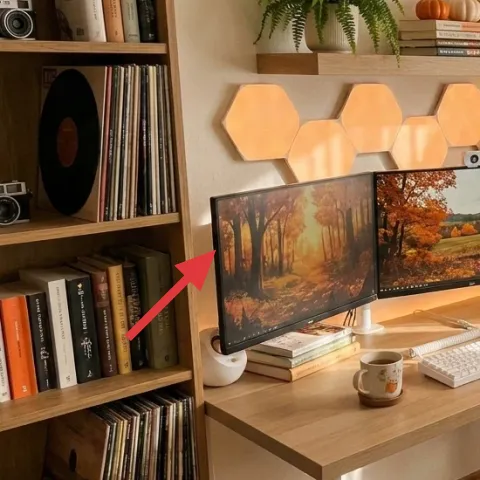
The bookshelf is what makes this corner feel lived-in rather than temporary. It holds books with visible spines, plus small objects that add height—so the wall side doesn’t feel empty next to the desk. In a shared space, storage is styling: when your books and decor have a home, you’re less likely to stack things randomly on the desk. The trade-off is shelf dust—bookshelves need a quick wipe now and then—but the payoff is instant personality that doesn’t require any permanent installs.
Use a few “rest points”
Leave a small empty patch between clusters so the eye can breathe.
Layer 6 — hexagon wall shelf ($70) Adds shape without drilling
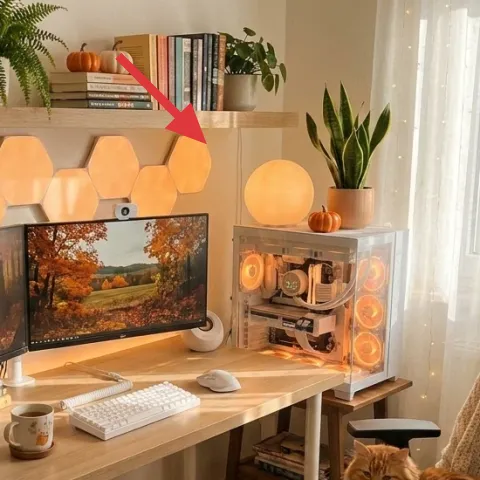
The hexagon wall shelf introduces geometric interest above the monitors, where flat wall space would otherwise look plain. Because it’s a wall-mounted shelf, the move-friendly part is choosing versions that come off cleanly—no drilling, no permanent hardware—so it can travel to the next place. The trade-off is that wall decor needs to be spaced thoughtfully: too many items and it reads cluttered right under screen height. The alternative—one big rectangular shelf—lacks that “collected” feel and tends to dominate the visual center of the room.
Style in odd numbers
Try three objects per hexagon cluster to keep the shelf balanced.
Layer 7 — painted terracotta planter set ($35) Brings life to the shelf
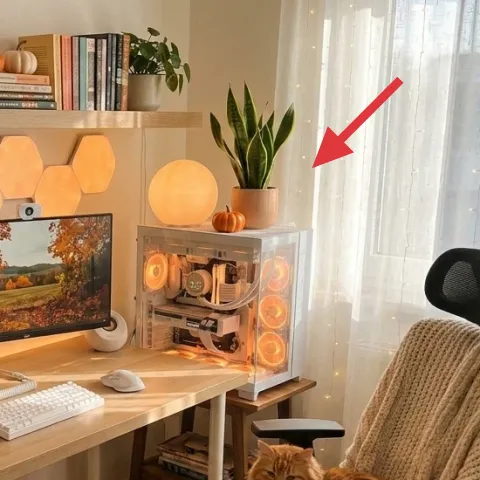
Terracotta pots add instant warmth, and painting them lets you tune the color to the rug and curtain tones. In the photo, the terracotta planters sit on the hexagon shelf area, where they break up the warm wood with a softer, earthy orange note. The trade-off is that painted pots need a little handling care—don’t scrub aggressively—so they stay looking good through repeated moves. The obvious alternative is leaving pots unpainted, but a coordinated pot color is what makes the shelf feel designed instead of accidental.
Choose paint that you can pack flat later
Let everything cure fully and keep pots wrapped so painted finishes don’t get scuffed.
The cost, layer by layer
| Layer | Item | Cost |
|---|---|---|
| 1 | Area rug 5×7 | $80 |
| 2 | Curtain panel pair (sheer) | $30 |
| 3 | String lights (set) | $15 |
| 4 | Desk | $90 |
| 5 | Bookshelf | $80 |
| 6 | Hexagon wall shelf | $70 |
| 7 | Planter / pot (medium) | $35 |
| Total | $400 | |
If you want a cheaper variant, swap the bookshelf look for fewer shelves and rely more on textiles: a rug, sheers, and string lights can do most of the mood work, while the wall shelf becomes a single focal piece instead of a multi-object moment.
What worked, what didn't (across the whole room)
The overall win here is the layering order: a grounded rug, soft window texture, then warm lighting over a defined desk zone. The shelves and plants add personality without needing permanent changes. The one weak point is that too many small objects under screen height can feel busy fast.
What worked
- The rug grounds the desk-and-chair zone so the corner reads like a real room.
- Sheer curtain panels soften window light and make monitor glare feel less distracting.
- String lights add warmth at night without taking up floor or desk space.
- Hexagon shelving brings geometric interest above the monitors.
- Books and small decor on the bookshelf make the corner feel lived-in.
- Terracotta pots add earthy color that matches the rug and wood tones.
What didn't
- If the wall shelf gets crowded, the eye fights the screens instead of relaxing.
- A too-bright string-light placement can look harsh against sheer fabric.
- Leaving the desk surface ungrouped makes clutter spread across the whole workspace.
- Using only solids (no pattern in the rug) can make the corner feel flatter.
What we'd skip if we did it again
Skip replacing any fixed elements (like ceiling lights or built-in finishes) just to get “better lighting.” In a shared, moving-a-lot setup, lighting upgrades that pack easily—string lights and warm bulbs—do more for less stress.
Skip a too-expensive matching furniture set. A desk and chair can be separate styles; what matters is one cohesive texture family (wood + soft textiles) and a single anchor rug.
Skip adding more framed pieces right under the monitors. Keep the wall shelf as the main visual, and let the screens stay the second focal point so the whole corner doesn’t feel busy.
Frequently asked
How long does this home office corner refresh take?
Plan for about 2–4 hours the first day, mostly because rugs and curtains take time to position and smooth. Day two is for styling: spacing books on the shelf, grouping decor, and checking that string lights look tidy and aren’t tangling. If everything is already on hand, it can be closer to 1–2 hours total.
Is this renter-friendly if I can’t drill into the wall?
Yes—this look leans on textiles and freestanding or removable options. The rug, curtain panels, and string lights are classic no-drill moves. For the hexagon wall shelf, choose a version that comes off cleanly and doesn’t require permanent installs.
What if my room is smaller (or the desk feels too big)?
Keep the desk but scale the “soft” layers: choose a smaller 4×6 rug if needed, and keep curtain panels narrow so they don’t crowd the window. The string lights can stay—route them along the curtain edge rather than spreading across the whole window.
Where should I shop if I want this exact warm-neutral vibe?
Start with rugs and curtains first, since they set the palette. Then shop for warm wood or wood-tone shelving. For color accents, pick terracotta pots and a pumpkin-style seasonal decor piece that can pack away later. The monitor wallpaper look will always be a big part of the vibe—switching it is free.
What’s the biggest mistake people make in a small home office corner?
Overloading the wall area above the screens. When shelves are too busy, the room feels visually noisy even if everything is nice. The fix is simple: fewer objects per shelf cluster and more intentional spacing so the wall becomes a calm backdrop.
How do I move this without it feeling like a total re-do?
Pack by category: curtains rolled, string lights coiled, rug folded, and shelf decor in labeled boxes. Keep your “desk grouping” in one tray so you can set it down again quickly in the next place. The goal is that the setup becomes repeatable, not something you redesign from scratch every lease.
More in Small Spaces
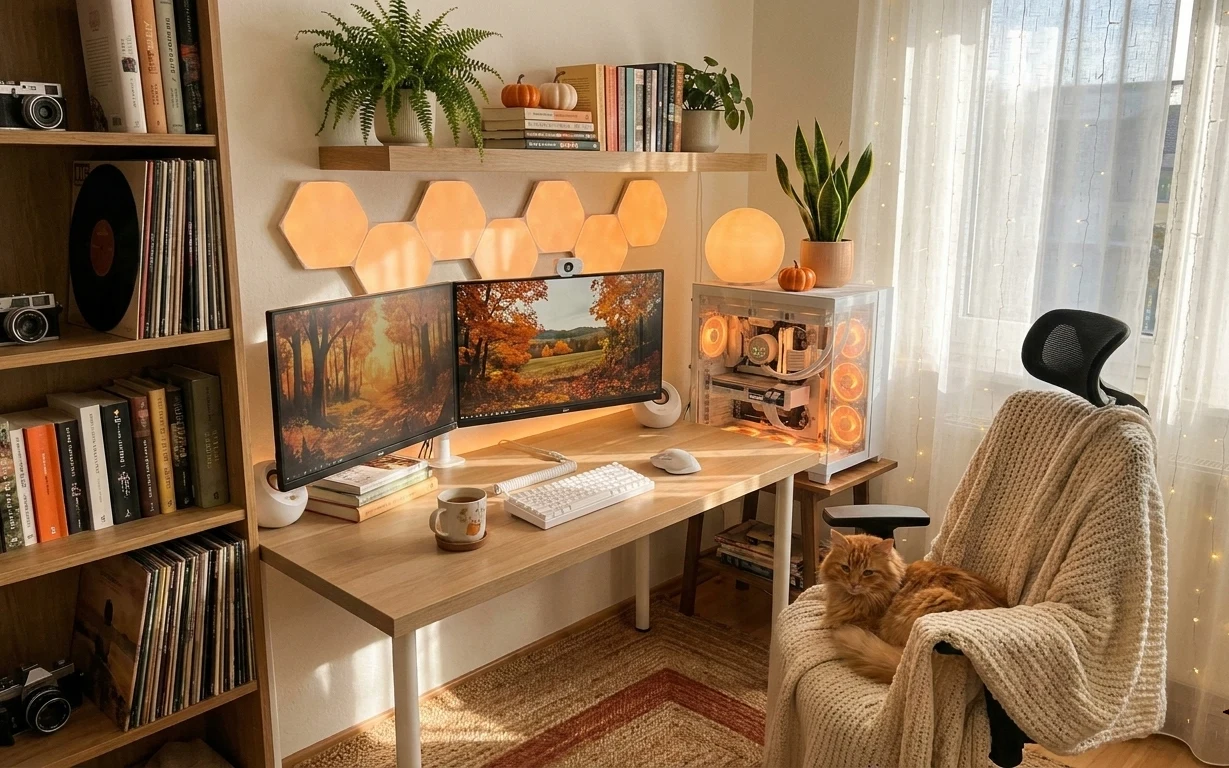
How to refresh a home office corner for under $400
A small home office corner can look warm and put-together without permanent changes. This $400, move-friendly refresh uses a rug, sheer cur…
Under $800: sunlit window office nook refresh with 7 swaps
Turn a compact, plant-filled window nook into a brighter workspace using 7 swaps you can do over a weekend. This refresh is built around a …
Under $400: 7 move-friendly swaps for a daybed nook
A $400 daybed nook refresh built for shared housing: jute underfoot, bold framed color, a plug-in lamp, and plants that pack out in a year.…