- Best for
- olive-and-wood living rooms
- Cost
- about $500
- Difficulty
- easy (mostly textiles)
- Time
- one weekend
Why olive-and-fern fireplace lounge style is the fireplace lounge of 2026
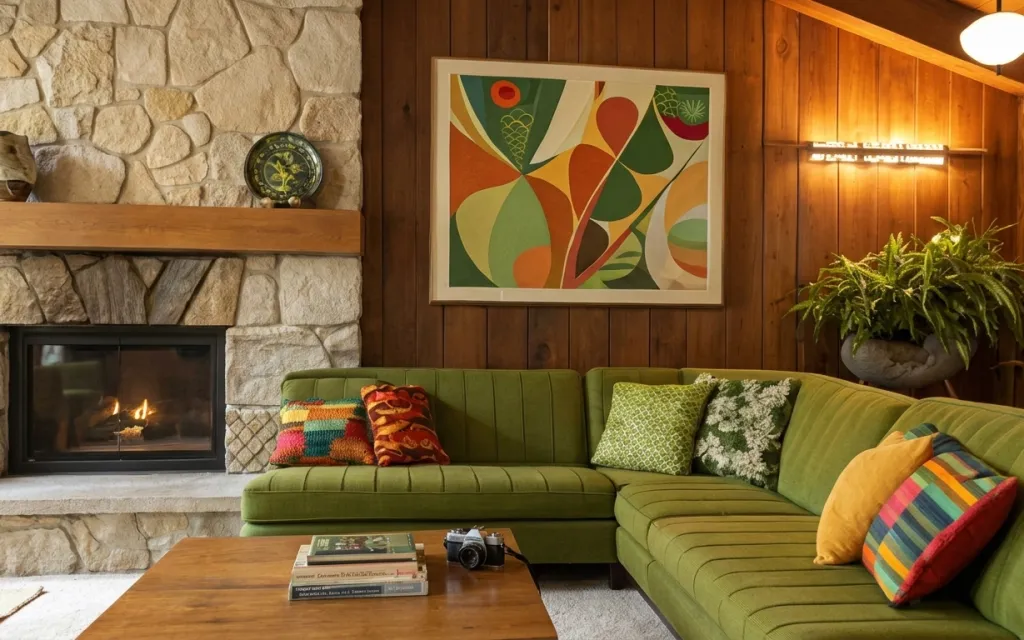
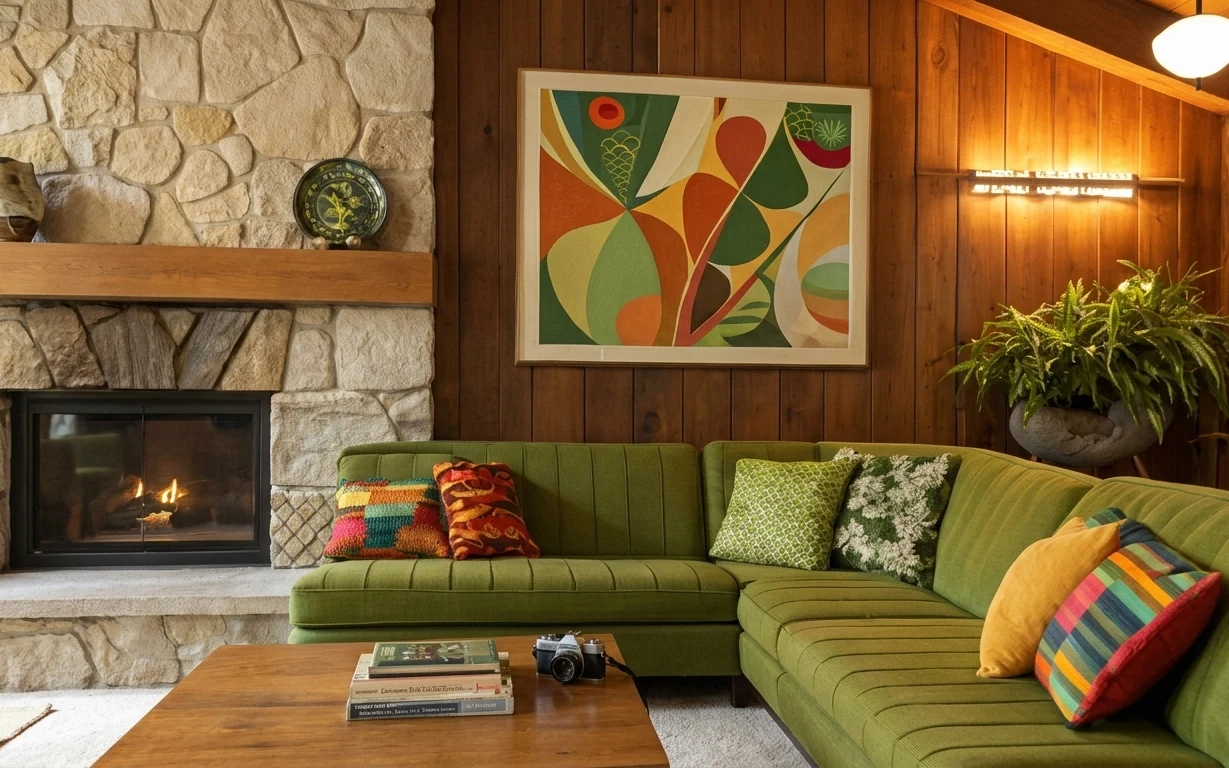
Warm wood paneling and stone around the fireplace do a lot of the heavy lifting here, so the refresh focuses on texture and contrast. The off-white rug grounds the olive-green sectional and makes the room feel larger when it’s pulled out from the hearth. On the sofa, the green textured throw pillow adds a matte, fabric “pause” next to the brighter striped and earth-toned cushions. A potted fern on the right brings the same natural palette the wall art hints at—without needing any wall changes.
I used to overdo the wall right away—like, immediately order a big matching set of prints. Then I remembered this room already has plenty of visual structure: wood planks up top and a fireplace opening below. Shifting to one framed abstract piece, plus softer layers on the sofa, made everything feel intentional instead of crowded. That’s the version of “cozy” I can actually sustain while living in the place.
Layer 1 — Off-white area rug 5×7 ($150) Texture underfoot that looks good in daylight and at night
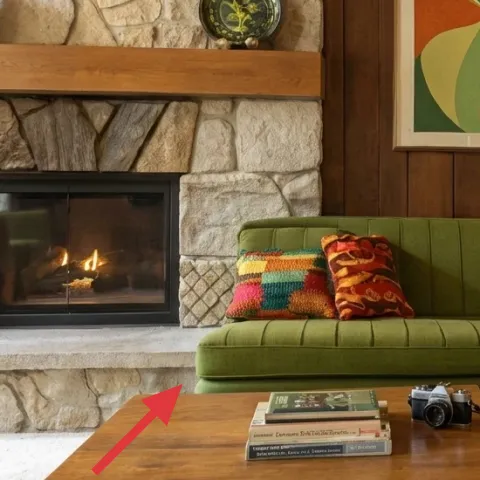
This off-white rug sits in front of the fireplace and under the sofa’s seating edge, which is exactly where it earns its keep. The light tone plays well with the cream wall/stone and gives the olive upholstery breathing room. A plain rug also helps when there are already multiple pillow colors—red, green, yellow, and earth tones—because it won’t compete. The trade-off: you’ll want to vacuum often and consider a rug pad if your floor is slick, since lighter rugs can show traffic lines. Still, for a renter, this is one of the easiest upgrades to pack and reuse.
Rug placement rule: pull it forward
Keep the front sofa legs on the rug (or just in it) so the room reads as one grounded zone.
Layer 2 — Green textured throw pillow cover ($25) Matte fabric that makes olive feel less intense
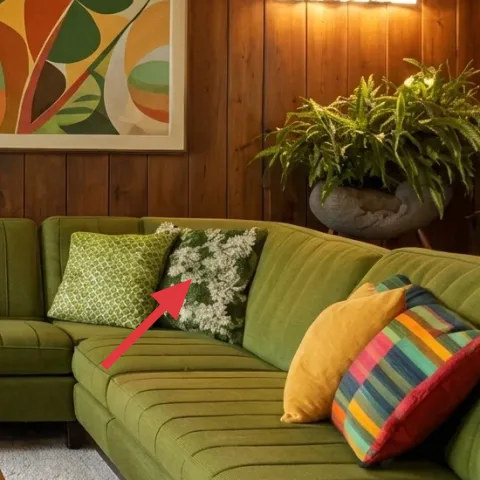
The green textured throw pillow is the most “quiet” color in the mix, so it softens the brighter striped cushion and the warmer patterned pillow. Visually, it works because its surface looks like woven fabric rather than glossy print—so it catches the room’s warm light without shining. In a rented space, a pillow cover is also the lowest-commitment swap: you can choose a new cover and still keep the same sofa shape. The main trade-off is that textured fabrics can snag if there are pets or rough sleeves, so handle it gently during cleaning and rotation.
Choose texture over another color
When the room already has wood + stone, adding fabric texture is often more flattering than adding more hue.
Layer 3 — Decorative candle in the fireplace ($18) A small flame moment that turns styling into atmosphere
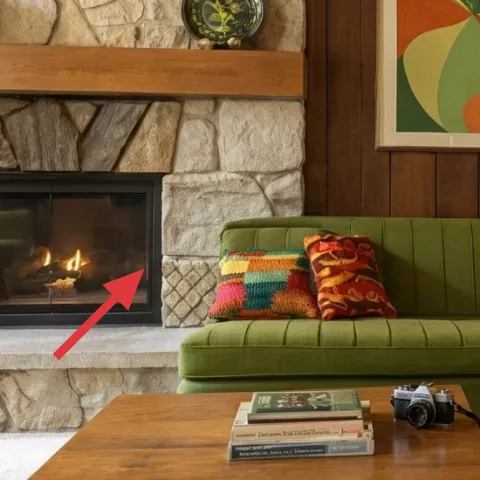
The candle in the fireplace opening is a simple detail, but it changes the “read” of the whole lounge after dark. During the day, it’s just a visual highlight; at night, that warm glow pulls the eye toward the hearth and makes the olive cushions look richer. This layer is also renter-safe: it doesn’t require changes to the fireplace itself, and it packs away easily when the lease ends. The trade-off is practical—always place candles safely and keep them away from anything flammable—so it’s a styling step you do intentionally, not a leave-it-alone habit.
Don’t put decor where heat can reach it
If your fireplace is used, keep styling pieces at a safe distance from the flame and follow local safety guidance.
Layer 4 — Large potted fern plant ($35) Leafy height that balances the right side
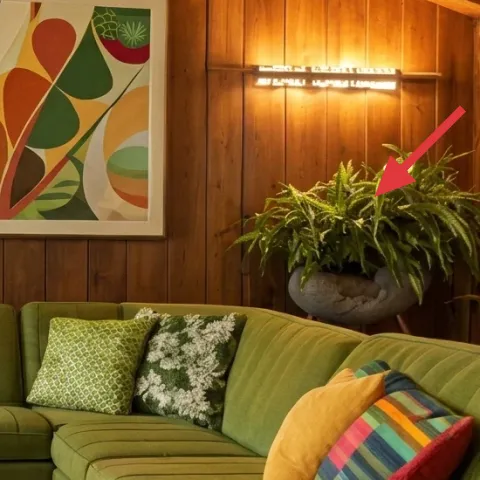
The large potted fern sits to the right of the sofa and adds the “vertical third” the room needs—between the stone fireplace’s bulk and the framed art above. Its color echoes the green pillows, but because it’s organic and variegated, it never feels flat like a repeated print might. This is also one of the few living-room upgrades that improves both daytime and evening vibes, since the leaves catch warm overhead light. Trade-off: plants need light and a quick watering rhythm, and fern leaves can brown if the air is very dry. For renters, pick a spot near the window and treat it like a routine.
Turn the plant for even growth
Rotate it a quarter turn weekly so new fronds don’t lean hard to one side.
Layer 5 — Framed abstract wall art print ($60) One removable focal piece that pulls the palette together
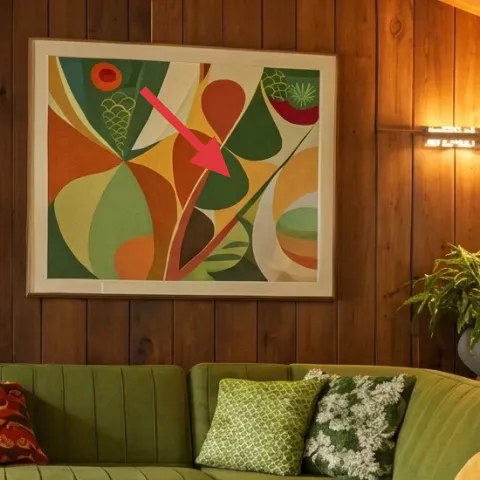
The framed abstract wall art anchors the whole look because it repeats the room’s color story—greens and warm earth tones—without matching every cushion exactly. A single piece works better than a multi-print gallery here since the wood paneling already creates strong texture on the wall. As a renter, this is a smart move because you can swap it out later, and you don’t have to commit to new hardware beyond a removable hanging method. The trade-off: you’ll want to get the scale right, or the art will feel either tiny next to the sofa or too loud against the fireplace. Aim for a clear focal size that spans the wall above the seating.
Make it instead of buying it
This pressed flower frame copies the framed-art role: a removable focal piece that repeats the room’s leaf-and-earth palette.
Materials
- Dried botanicals (foraged or dried) — small handful — $5
- Cardstock backing — 1 sheet — $10
- Frame with glass (8×10 or similar) — 1 frame — $25
- Archival tape or thin craft glue stick — small pack — $20
Steps
- Flatten dried leaves/flowers on a book page for 30 minutes.
- Pick a layout on cardstock (curves at the top, stems flowing down).
- Trim botanicals so they fit inside the inner border without touching glass.
- Secure pieces lightly with archival tape or a glue stick, not thick glue blobs.
- Place the cardstock into the frame backing slot.
- Close the frame, then check spacing from every edge.
- Let the adhesive set for 10–15 minutes.
- Clean the glass and wipe fingerprints off the artwork surface.
- Hang using removable methods appropriate for your frame weight.
- Step back and adjust composition by swapping one dried element.
- Seal the edges with a final tiny piece of tape if any botanicals lift.
- Done—pack it away easily at move-out.
Layer 6 — Wood coffee table ($140) A warm platform for books, candle moments, and daily use
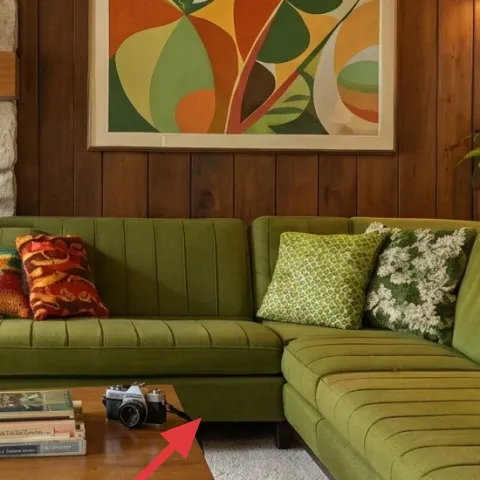
The wood coffee table is where the room’s warm tones become practical, not just decorative. In the photo, it sits centered in front of the sectional, and that positioning makes it the right height for stacking books and styling a small object tray. Choosing wood (or a wood-look finish) is key here because it echoes the wall paneling and keeps the room from feeling too cool against the stone. The trade-off is maintenance: wood surfaces can show water rings and fingerprints, so you’ll want coasters and quick wipes. Still, this is a renter-friendly centerpiece because a coffee table is usually movable and easy to repurpose.
Style at one height
Keep most objects within a few inches of each other so the tabletop looks calm.
Layer 7 — Decorative tray and stacked books on coffee table ($30) A tidy “landing pad” for everyday clutter
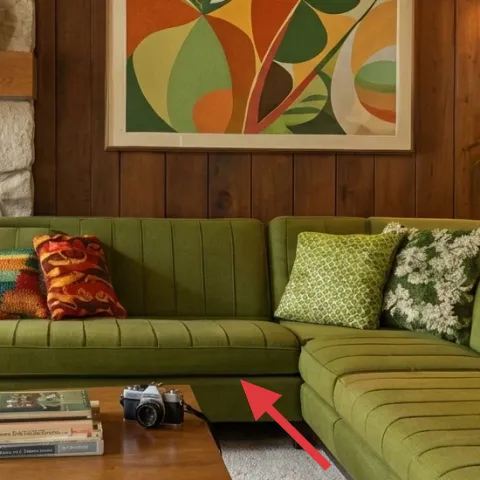
The decorative tray with stacked books creates order on top of a table that’s meant for real life. In the hero, it brings the camera-and-books moment together so the surface doesn’t look accidental, even with multiple small items. A tray also helps if the room gets busy quickly—resetting takes seconds because everything has one designated zone. The trade-off is that a tray can feel too precious if you never clear it, so pick one you actually like touching. If you want the look to last, keep the tray’s contents limited to three to five items.
Use the “three cluster” trick
Books + one small object + one textural element reads layered without feeling busy.
The cost, layer by layer
| Layer | Item | Cost |
|---|---|---|
| 1 | Off-white area rug 5×7 | $150 |
| 2 | Green textured throw pillow cover | $25 |
| 3 | Decorative candle in the fireplace | $18 |
| 4 | Large potted fern plant | $35 |
| 5 | Framed abstract wall art print | $60 |
| 6 | Wood coffee table | $140 |
| 7 | Decorative tray and stacked books on coffee table | $30 |
| Total | $458 | |
Cheaper variant: choose a smaller 5×7 rug ($80), pick one throw pillow instead of two ($15–$20), and use a thrifted framed print ($25–$40). The fern can also be a smaller 3–4 ft plant to bring the total down fast.
What worked, what didn't (across the whole room)
This look stays cohesive because the palette repeats across soft goods and natural elements while the fireplace and wood paneling provide structure. The few bold pops (striped pillow + abstract art) feel deliberate instead of random.
What worked
- The off-white rug keeps the olive sectional from feeling heavy and visually expands the seating zone.
- Textured green pillow fabric calms the brighter red-and-yellow striped accent.
- The fern plant adds needed height and echoes the wall palette without matching exactly.
- The framed abstract print creates a single focal moment against busy wood paneling.
- The tray-and-books grouping turns a busy tabletop into an intentional vignette.
- The fireplace candle adds warm nighttime focus right where the eye lands first.
What didn't
- Too many small objects on the coffee table makes the room feel visually cluttered against the wood.
- Using only flat-pattern pillows made the olive sofa look a touch flat and overly saturated.
- A rug that’s too small would push the seating area apart and weaken the fireplace connection.
- If the fern sits too far from the sofa edge, the right side stops balancing the hearth.
What we'd skip if we did it again
Skip replacing anything permanent. When the fireplace surround and wood paneling are already doing the structural work, the best return comes from removable textiles and styling objects, not hardware changes.
Skip adding a multi-piece wall gallery above the seating. In this room, one framed abstract print reads cleaner and lets the wood texture stay the backdrop.
Skip a plant that’s too short. The fern needs height to bridge the stone fireplace bulk and the wall art, so a taller fronded plant keeps the composition balanced.
Frequently asked
How long does this kind of fireplace lounge refresh take?
Plan on a weekend. The rug and pillow swaps are quick (often under an hour total). Styling the coffee table and placing the fern usually takes another hour, plus time to swap the tray contents until it looks balanced. The framed print placement is the only step that can stretch longer, mostly because you may want to test height and centering with a tape measure or painter’s tape.
Is this renter-safe if I can’t drill or use wall anchors?
Yes—this approach is built for renters. The layers are removable textiles (rug, pillow covers), tabletop items (tray, books, candle), and freestanding decor (fern). For the framed print, use a renter-appropriate hanging method that matches your frame weight and avoids anchors or drilling into walls.
What if my room is smaller than the photo?
Go smaller but keep the relationships. Keep the rug big enough that the front sofa legs land on it (that’s what makes the zone feel connected). Use one statement pillow instead of multiple, and consider a fern that’s tall but narrower so it doesn’t overwhelm the walkway. Finally, choose one framed print, not several, to keep the wall from feeling busy.
What if my space is larger or the ceiling feels taller?
Increase scale before you add extra objects. Use a larger rug that reaches farther under the sofa, and consider a taller fern to create the same visual “bridge” from floor to wall art. For the framed print, lean slightly bigger if it’s the focal point above the seating.
Where can I shop for these pieces without it getting expensive?
Start with resale and then fill in the gaps with one or two new items. Pillows and candles are easy to find on discount. Rugs can be sourced from home stores during sales or picked up secondhand if you check for stains. For the framed print, look for a used frame you can reuse, or buy one print you can switch out later.
What’s the biggest mistake people make in rooms like this?
Over-styling the coffee table and adding too many competing wall elements. The wood paneling and fireplace already create strong texture and shape, so the safer move is a simple tray vignette and one focal artwork. The second most common mistake is choosing a rug that’s too small—then the seating area feels disconnected.
More in Living Room
How to style a rented fireplace lounge for under $500
A renter-friendly fireplace lounge refresh built around olive-green seating, warm wood tones, and framed art. For about $500, swap in a sta…
7 renter-friendly swaps for a sunlit seating corner, $1000
A renter-friendly plan for recreating a sunlit seating corner with pink patterned flooring, earthy pillows, botanical wall art, and plant s…
6 renter-friendly living room swaps for a $600 refresh
A bright renter living room refresh under $600: rug + throw + layered pillows, with one framed print, curtains, and a terracotta plant for …