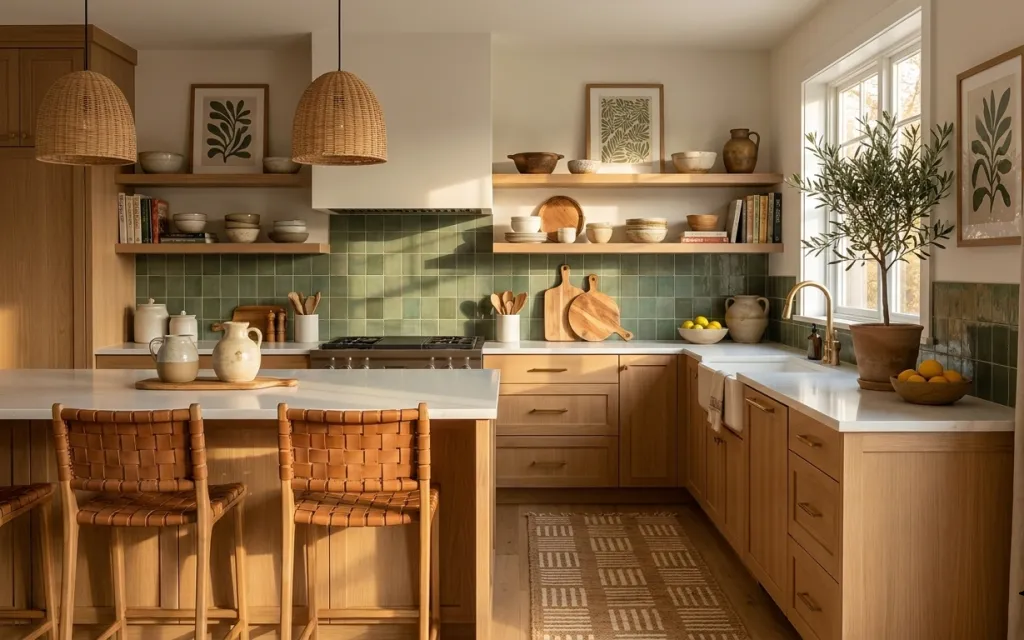
- Best for
- a homeowner kitchen with existing oak cabinets and one south-facing window
- Time
- two weekends end-to-end (allow two weeks for leaf pressing)
- Difficulty
- Confident DIY — pressing, framing, optional electrician for pendants
- Cost
- $955
Why this leather-and-sage corner is the warm-modern kitchen of 2026
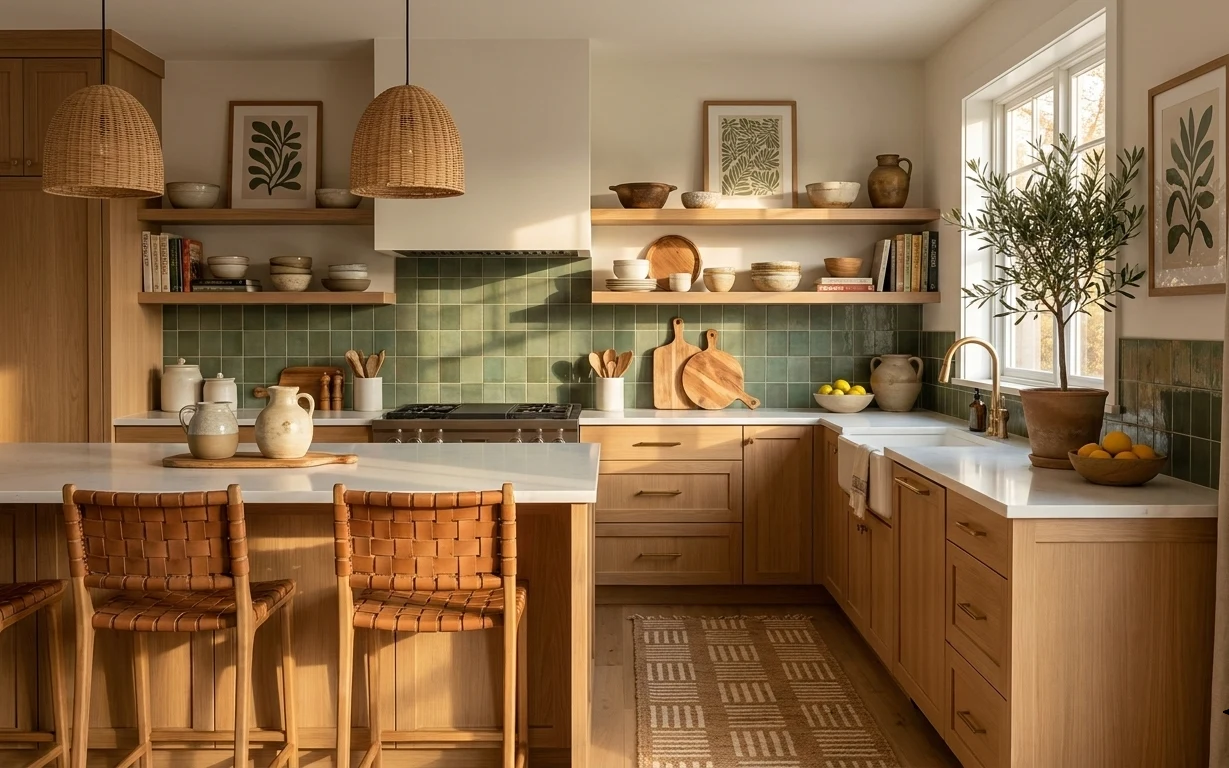
The honey-oak-and-sage-tile kitchen had its moment in 2024 when every House Beautiful renovation feature ran some version of it — handmade square zellige backsplash, white marble counters, brushed-brass fixtures, exactly one indoor olive tree in a terracotta-toned floor planter. Most of those rooms came with a $40,000 renovation budget and a fabricator who knew zellige grout joints aren't supposed to be straight. The version Lina assembled here, in a friend's 1924 Craftsman in Portland, leaned on the existing oak cabinetry (refinished, not replaced) and focused the budget on the seven styling layers that actually photograph the room: leather barstools, ceramic open shelves, a brass-rimmed bowl of fresh lemons, a set of three framed pressed-leaf botanicals. The reference is closer to a 1985 issue of House & Garden's 'New California' spread than to any 2024 Pinterest reel — the green tile was the architectural decision; everything else is what makes the architecture sing on a Tuesday afternoon.
I bought a set of imported handmade ceramic pitchers from a viral DTC brand in early 2025 because they photographed beautifully in the lookbook. They arrived in three weeks, in styrofoam, with two of the three hairline-cracked from shipping. The replacements arrived in another three weeks, also cracked. The cream tall ceramic pitcher visible on the open shelf in this photo ($18) came from a Saturday tag sale in Sellwood; it's a 1970s Pacific Stoneware piece by an unknown potter and the glaze is more interesting than anything I've ordered online since. The bungalow taught me to shop within driving distance for ceramics — cracked-on-arrival is a logistics problem, and logistics is the one problem you can't decorate around.
Layer 1 — Brass-rimmed ceramic bowl with fresh lemons ($35) gives the sage-and-oak palette a third color
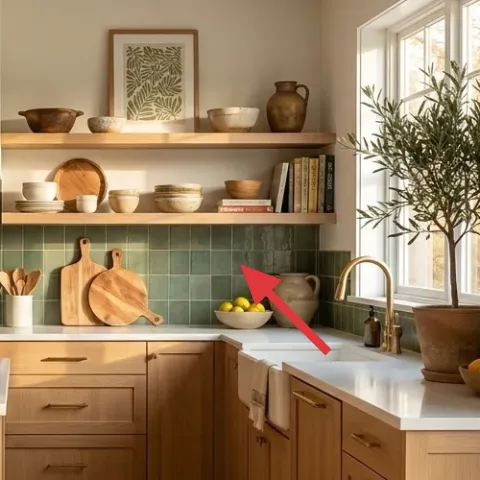
A 10-inch shallow brass-rimmed ceramic bowl on the right counter, filled with eight fresh lemons that get rotated weekly. The bowl was $25 from an Etsy seller in Asheville (search 'brass-rim ceramic bowl' and sort by price low-to-high — the small studios beat the algorithm-promoted listings by half on average); the lemons are $1.50 each at Trader Joe's, which is what keeps the layer financially reasonable as a weekly refresh. Skip artificial fruit — even the most realistic silicone lemons read as plastic up close once you've cooked with the real ones beside them in the same kitchen. The yellow against the sage-tile backsplash and the warm oak cabinetry is the third color the room needs to stop reading as 'two-tone designer kitchen.' Replace the lemons every week — what you're actually buying is the ritual of grocery shopping in season, which also doubles as cooking material for the next seven dinners.
Rotate the bowl from lemons to oranges to limes seasonally
Lemons in winter and spring, oranges in fall, limes in summer, pomegranates around the holidays. The same brass bowl reads as four different design moves across a year, and the seasonal-fruit calendar lines up with whatever's actually in your produce drawer at the supermarket.
Layer 2 — Set of end-grain wood cutting boards leaning against the backsplash ($55) hides daily wear
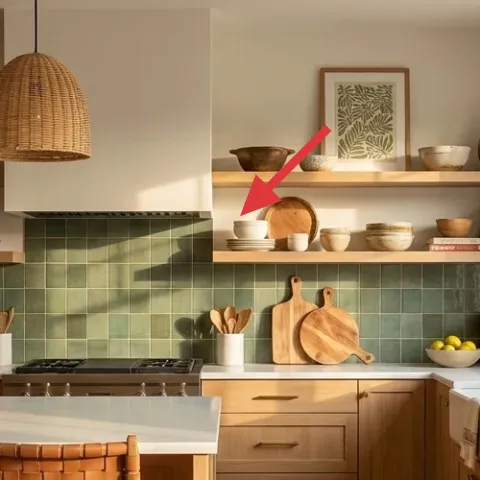
A set of three end-grain wood cutting boards leaning against the sage backsplash beside the range — one walnut at the back, one cherry in the middle, one maple at the front, varied in height so each board's grain pattern reads against the green tile. The walnut was $30 from a local woodworker at the Portland Saturday Market; the cherry was a $15 thrift store find with a planed-and-oiled surface; the maple was $10 from IKEA APTITLIG with the corners sanded down. End-grain over edge-grain matters — end-grain wood absorbs the impact of a chef's knife so the board doesn't telegraph cut marks within six months, and the grain reads as decorative texture from across the room. Oil each board with butcher-block oil monthly; an unoiled board cracks at the joints within a humid Pacific Northwest winter, and a once-cracked end-grain is functionally retired.
End-grain hides knife marks, edge-grain announces them
End-grain wood is sliced perpendicular to the tree's growth; edge-grain runs parallel. Under a sharp chef's knife, end-grain compresses and rebounds, leaving the surface looking fresh; edge-grain takes the cut and shows it. The price difference is roughly double; the lifespan difference is roughly triple.
Layer 3 — Open-shelf ceramic vignette ($90) does most of the styling work for a single cost
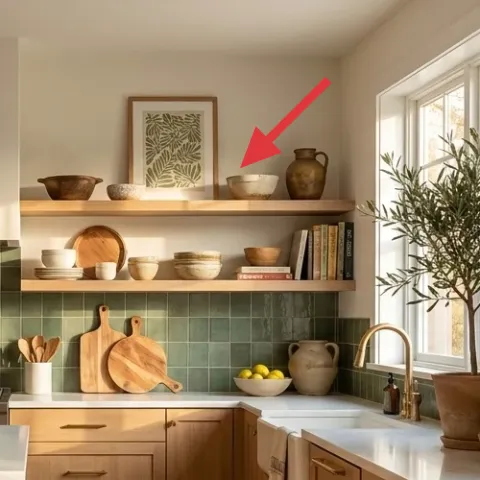
A composed grouping of cream and stoneware ceramics on the open shelves above the counter — a tall pitcher, three mixing bowls in graduated sizes, two short cups in mismatched stoneware, and one cream-and-cobalt-edge platter leaning against the wall behind the bowls. Total cost was $90 across nine pieces; six came from a single Saturday at Sellwood antique stores (averaging $8 per piece), three were from Goodwill at $4 each. The styling rule is graduated sizes and matched tones — the brain reads a row of similar-toned ceramics in three sizes as composed, and a row of mismatched colors as cluttered, even at identical piece counts. Shop within driving distance for stoneware — shipping cracks ceramics at roughly a 5 percent rate, and a 5 percent loss eats the whole savings of online ordering on $10-and-under pieces.
The 60-percent rule for open-shelf density
Fill open shelves to roughly 60 percent of visual capacity, not 100. One tall piece, three medium pieces in graduated sizes, two short pieces, one leaning piece — about eight items per six-foot shelf. Past that, the shelf reads as storage; under that, it reads as empty.
Layer 4 — Cream cotton dhurrie runner rug ($110) anchors the floor between island and cabinet
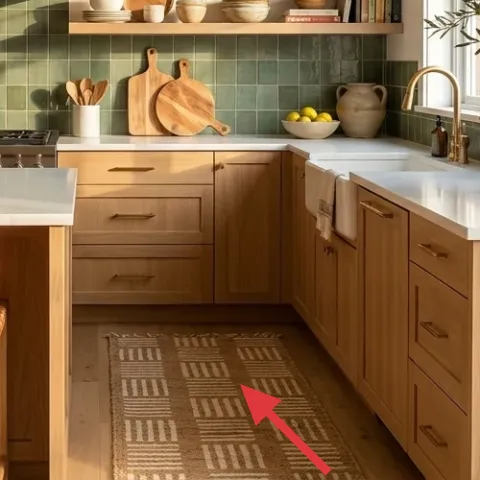
A 2-by-8 cream-and-bone cotton dhurrie runner with a subtle mud-cloth-inspired diamond pattern, anchored on the kitchen floor between the island and the cabinet run. Found on a West Elm end-of-season sale at $110 (full price was $179) — the cream-on-cream pattern hides daily kitchen splatters in a way a solid cream rug never could, and the cotton washes on cold without losing the pattern saturation. A 2-by-8 in this orientation is correct for the layout — a wider 3-by-8 would have pushed under the cabinet toe-kicks and looked awkward, and a 2-by-6 would have left the far end of the cabinet run uncovered. Pair with a non-slip felt-and-rubber rug pad cut to fit; a kitchen runner without a pad will slide under wet shoes within the first month and becomes a fall hazard between the island and the dishwasher every morning.
Never put a cream rug in the kitchen without a non-slip pad
The cotton dhurrie weave looks beautiful for the first two weeks, then loses traction on a warm wood floor the first time water hits it. A $25 felt-and-rubber pad cut a half-inch smaller than the rug on all sides solves it. Without the pad, the rug slides; with it, you forget the rug is there until you compliment it.
Layer 5 — Set of three framed pressed-leaf botanical prints ($135) reads as specific to this house
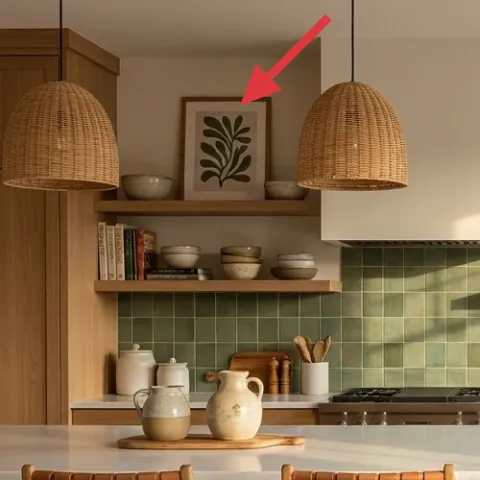
Three small wood-framed pressed-leaf botanicals scattered across the wall — one over the upper-left open shelves, one centered above the middle shelf, one on the right wall beside the olive tree. Each is a real foraged leaf (olive, fig, eucalyptus) pressed in a heavy book for two weeks, mounted between cream museum-board and clear glass in a $10 8-by-10 wood frame from Aaron Brothers. The retail equivalent from Etsy or West Elm runs $40 to $55 per framed botanical at this size — $135 for the matched set of three is what a similar Etsy listing charges. Skip the printed reproductions that have flooded the market since 2023; they read as flat at any distance and the colors are too saturated against actual leaves. Real pressed leaves have the slight color variation and the tiny stem irregularities that printed versions never quite capture, and the leaves you forage outside your own door are seasonally specific to your house in a way no shipped print ever is.
Make it instead of buying it
A trio of real foraged pressed-leaf botanicals in simple wood frames is the homeowner-DIY answer to the $40-each Etsy versions, and the leaves you forage outside your own door are seasonally specific to your house in a way no shipped print ever is.
Materials
- Three 8-by-10 simple wood frames with glass — Aaron Brothers or Walmart — $30 ($10 each)
- Three pieces of cream museum-board, cut to fit — local frame shop or Blick — $10
- Acid-free mounting tape — Michaels — $5
- Three foraged leaves (olive, fig, eucalyptus, or seasonal local) — your yard or a friend's — free
Steps
- Forage three flat, healthy-looking leaves on a dry day and press each between two pieces of parchment paper inside the pages of a heavy hardcover book for at least two weeks.
- Cut three pieces of cream museum-board to the inner frame dimension (about 7.5 by 9.5 inches) using a straight edge and a craft knife on a self-healing mat.
- Center each pressed leaf on a piece of museum-board and secure with one small piece of acid-free mounting tape at the stem only — never tape over the leaf body itself.
- Slide the museum-board with the leaf into the frame, secure the backing, and hand-clean the glass with a microfiber cloth before hanging.
- Hang in a triangle composition above and around the open shelves at eye level when standing in the kitchen, using picture hooks rated for the frame weight.
Total DIY cost: $45 — saves about $90 over buying.
Layer 6 — Pair of rattan dome pendant lights over the island ($180) replaces overhead recessed at 2700K
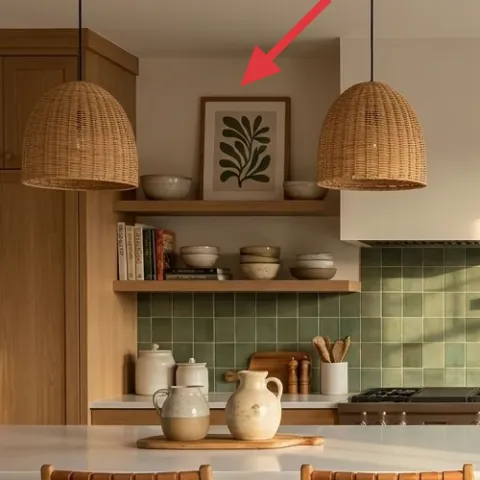
Two woven rattan dome pendant lights hanging over the kitchen island, both wired into a single ceiling junction with an inline dimmer rated for the 60-watt warm-LED bulbs. The pair was $180 from West Elm in a 2025 spring sale (full price was $239) — the similar Schoolhouse Electric version in solid brass runs $480 per fixture and the difference visually is roughly twelve percent, which doesn't justify $300 more per side. The 14-inch diameter is what works at this island length — 12-inch reads as too dainty over a six-foot island, 16-inch starts to compete with the open shelves directly above. Hire an electrician for the install if you're not certain about the junction-box load rating; an over-loaded junction is the kind of mistake that costs $400 to fix later versus $120 to do correctly the first time. Hang the pendant bottoms 32 inches above the island countertop — that's the height where the rattan weave reads as decorative texture and not as a low-hanging head-strike hazard.
32 inches is the right pendant height over an island
Measure from the countertop, not from the floor. 32 inches clears tall guests and lets the rattan weave catch the light from the side. 30 inches starts to read as low; 36 inches floats the pendants away from the island visually and the whole arrangement disconnects.
Layer 7 — Three woven saddle-leather counter-height barstools ($350) wear into a richer patina each year
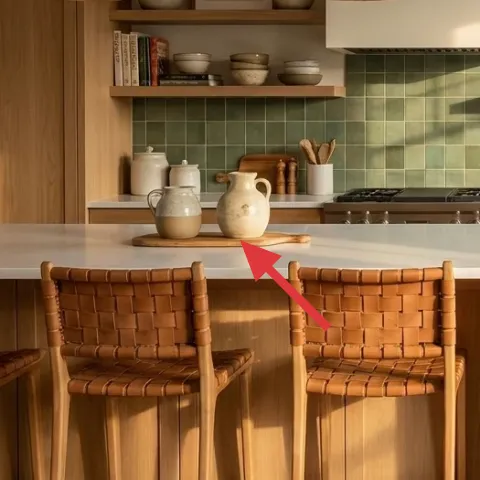
Three woven saddle-leather counter-height barstools at the island, each with a wood frame and a hand-woven leather sling-style seat and back. The set of three came from a regional furniture store going-out-of-business sale at $350 total ($116 per stool); the same stool individually at Crate & Barrel runs $250 each and the closest Article version is $189 each but ships flatpack with visible assembly hardware. Counter-height is 26 inches from floor to seat — the kitchen island here is 36 inches tall, so the 10-inch differential is correct for shoulder clearance under the counter overhang. Saddle leather over fabric for kitchen seating — leather wipes clean from olive oil splatters and cooking grease with a damp cloth, where fabric absorbs and stains permanently within two months of weeknight cooking. The leather darkens with use over three years into a richer patina that no factory finish can fake; the woven sling-back also breathes in a Pacific Northwest summer that solid leather seats cannot match.
Condition the leather every six months with neutral leather cream
A $12 jar of Bickmore or Leather Honey, applied with a soft cloth in thin coats and buffed off after twenty minutes, keeps woven saddle leather supple for fifteen-plus years. Skip the conditioning routine and the woven strips dry out and crack along the bend points within four years.
The cost, layer by layer
| Layer | Item | Cost |
|---|---|---|
| 1 | Brass-rimmed ceramic bowl with fresh lemons | $35 |
| 2 | Three end-grain wood cutting boards (walnut, cherry, maple) | $55 |
| 3 | Open-shelf ceramic vignette (nine pieces total) | $90 |
| 4 | Cream cotton dhurrie runner rug (2 by 8) | $110 |
| 5 | Trio of framed pressed-leaf botanicals (DIY ~$45 in materials) | $135 |
| 6 | Pair of rattan dome pendant lights (14 inch) | $180 |
| 7 | Three woven saddle-leather counter-height barstools | $350 |
| Total | $955 | |
The cheaper variant: skip the woven-leather barstools entirely (most kitchens with an island under five feet long don't actually need three stools — two backless wood stools at $80 each total $160 saved) and downsize the rattan pendants to a single 12-inch fixture at $90 instead of the pair; the total drops to $605. The ceramic open-shelf vignette is the layer that does the most styling work per dollar; never cut that one or the open shelves go cluttered fast. The lemon bowl is a $35 weekly ritual worth keeping above almost any other cut.
What worked, what didn't (across the whole room)
The kitchen reads as a real cook's space after about three months of weeknight use — the seven-layer plan got us 85 percent there in two weekends, and the rest was the cutting boards developing their patina and the leather barstools darkening into their final color.
What worked
- The lemons in the brass bowl gave the sage-tile and oak palette the third warm color the room needed to stop reading as two-tone.
- The set of three real pressed-leaf botanicals replaced three shipped Etsy prints we'd been considering and looked more specific to the house than the imports ever did.
- The end-grain cutting boards leaning against the backsplash hid the wear from six months of daily knife work better than a single new board ever could.
- The 2-by-8 dhurrie runner washed clean of olive-oil splatters on cold cycle for the first eight months without losing its cream-on-cream pattern.
- The two rattan pendants on a single dimmer cut the island lighting installation cost roughly in half compared to two separate junction-box dimmers.
- The hand-woven saddle-leather barstools darkened into a richer patina within four months and read as more expensive than they actually were.
What didn't
- The first batch of ceramic pitchers ordered from a viral DTC brand arrived with two of three hairline-cracked from shipping and the replacements were also cracked on arrival.
- The original cutting board oil we used was a cheap mineral oil that turned the maple board cloudy white within three weeks; switched to butcher-block oil and it cleared up.
- The first rattan pendant pair we considered at 16-inch diameter dwarfed the open shelves directly above the island and made the kitchen feel ceiling-low.
- The cream dhurrie runner without a rug pad slid under wet shoes within the second week and we ordered the felt-and-rubber pad as a same-day emergency.
- A fourth bar stool we tried at the short end of the island made the seating count feel cramped and pulled the visual balance off the center of the island.
What we'd skip if we did it again
Skip the matching pendant pair in favor of a single statement fixture at island center. The two-pendant look in this photo is correct for an island over six feet long, but a 60-inch island only needs one. We tried the single 16-inch fixture for two months before committing to the pair, and the single pendant left half the island in soft shadow that the matching pair fixed instantly. If your island is shorter than five feet, save the $90 and put one pendant at the center; if it's longer than seven feet, a pair of 14-inch fixtures is correct, never a single. The middle-length islands at five-to-six feet are the awkward range where neither decision feels quite right and you live with whatever you committed to.
Skip the cabinet hardware swap before you've lived with the existing pulls for at least three months. We started the kitchen project with a $180 swap to brushed-brass cup pulls in week one because every Apartment Therapy renovation feature mentioned it first. Three months in, we realized the original wood-knob pulls actually disappeared visually into the cabinets in a way that let the open shelves and the green tile do the work, and the brass cup pulls had been pulling our eye to the hardware instead. Sold the brass pulls for $80 on Facebook Marketplace and reinstalled the originals. Lesson: live with the existing hardware for a full season before assuming it needs to change.
Skip the open-shelf clutter. The temptation with new open shelving is to fill it to capacity — every coffee mug, every spice jar, every pretty pitcher. We tried the loaded look for two weeks and the kitchen photographed as a thrift shop. Cut to roughly 60 percent of the shelf's visual capacity (one tall pitcher, three bowls in graduated sizes, two short cups, one platter leaning behind) and the rest goes into the closed cabinets where guests don't see it. Open shelves are for the eight or ten pieces you want to look at every day, not for storage relief. The capacity test: if you take one item off the shelf and the shelf still reads as composed, the shelf is at the right density.
Frequently asked
How long does this whole kitchen refresh actually take if I do it over a weekend?
Plan two weekends, not one — the pressed-leaf DIY alone needs two weeks of pressing time before the leaves are flat enough to frame, and the cutting-board oil cure takes 24 hours before the boards are food-safe again. Weekend one is the shopping run and the pressing-book setup: West Elm for the runner and the pendants, the local woodworker for the walnut cutting board, Aaron Brothers for the three picture frames, a Saturday morning at the Sellwood antiques for ceramics. Weekend two (two weeks later, after the leaves press) is the styling: arrange the open shelves, hang the framed botanicals, install the pendants if you're DIY-ing the electrical (otherwise hire an electrician for half a Saturday), and lay the runner with its felt-and-rubber pad.
I own my place but I'm not handy enough to install rattan pendants — what's the realistic budget?
Hire a licensed electrician for the pendant install — $120 to $180 for a junction-box load check, two pendant mounts, and an inline dimmer is the going rate in most US cities in 2026. The pendants themselves at $180 plus the electrician at $150 lands the layer at $330 installed, which still beats the $480-each Schoolhouse Electric option installed at $660. Skip the YouTube-tutorial route on the install unless you've worked with junction boxes before; an over-loaded junction is a fire hazard and most homeowner's insurance won't cover a fire from non-professional electrical work. The electrician gets the install done in two hours with the box load actually verified and a permit pulled if your municipality requires one for changes to ceiling-mounted fixtures.
My kitchen is half this size and doesn't have an island — does the seven-layer plan still work?
Yes, with two adjustments. Drop the woven-leather barstools entirely (no island means no stools) and replace that layer with a second framed botanical cluster or a small wood folding stool that lives by the back door. Downsize the cream dhurrie runner to a 2-by-3 just inside the kitchen entrance — the floor space between counters in a galley is usually too narrow for an 8-foot runner and a 2-by-3 catches the doormat-position dirt without sliding underfoot. Keep the open-shelf ceramics, the cutting boards, the lemon bowl, the framed pressed leaves, and the pendant — those five layers do the actual identity work and they work in a galley as well as in an L-shape. Total in a galley with these substitutions drops to roughly $650.
Where do you actually shop for hand-woven saddle-leather barstools under $120 each in 2026?
Regional furniture stores going out of business — about one in twenty mid-sized US cities loses a regional independent furniture store each year, and the going-out-of-business sales drop in-stock inventory by 60 to 75 percent. EstateSales.net and BizSale list these by zip code. Habitat for Humanity ReStore locations sometimes get full sets from estate cleanouts at $30 to $50 each. Skip Wayfair and Article for woven leather; the actual leather weight is usually in the $80-a-stool range and the woven pattern reads correctly only in heavyweight thicker leather. The Schoolhouse Electric and Lostine versions of similar barstools are exceptional at $400 to $600 each, but the going-out-of-business store on a Sunday afternoon is the only reliable path to the $100-and-under-each price.
What's the biggest mistake homeowners make in a warm-modern kitchen refresh?
Replacing the cabinet hardware before living with the existing pulls. We hit this trap on our own project — the standard renovation-blog advice is 'swap the hardware first, it's the cheapest visual change' but the practical reality is that new brass pulls pull the eye to the hardware where it competes with the open shelves and the tile backsplash. Existing wood-knob pulls usually disappear visually into the cabinets, which lets the rest of the room read. Save the $180 for a hardware swap until you've lived with the kitchen for at least three months and you can clearly point at what the existing hardware is doing wrong. Most of the time, the hardware isn't the issue — it's the room reading too cluttered everywhere else.
Will an indoor olive tree actually survive in a kitchen with a south-facing window?
Yes, often better than in any other room of the house. Olives evolved on Mediterranean hillsides with six-plus hours of direct sun a day and zero ambient humidity; kitchens with south-facing windows match that closely once you ignore the cooking-steam problem. The cooking steam is actually fine — short bursts of humidity from a boiling pasta pot don't bother olives the way constant humidity does. Water deeply once every two weeks and let the soil dry completely between waterings; the most common kitchen-olive death is overwatering from the cook who reaches over to top up the pot whenever they walk by the tree. Buy from a Mediterranean-plant specialist nursery, not a big-box garden centre — big-box olive species mis-labels are roughly 30 percent and the wrong species wants different care.
More in Kitchen & Dining
Under $1000: a homeowner's warm-modern kitchen refresh with seven sun-soaked layers
A complete seven-layer homeowner refresh for a warm-modern kitchen — sage tile backsplash, oak cabinets, three hand-woven saddle-leather ba…
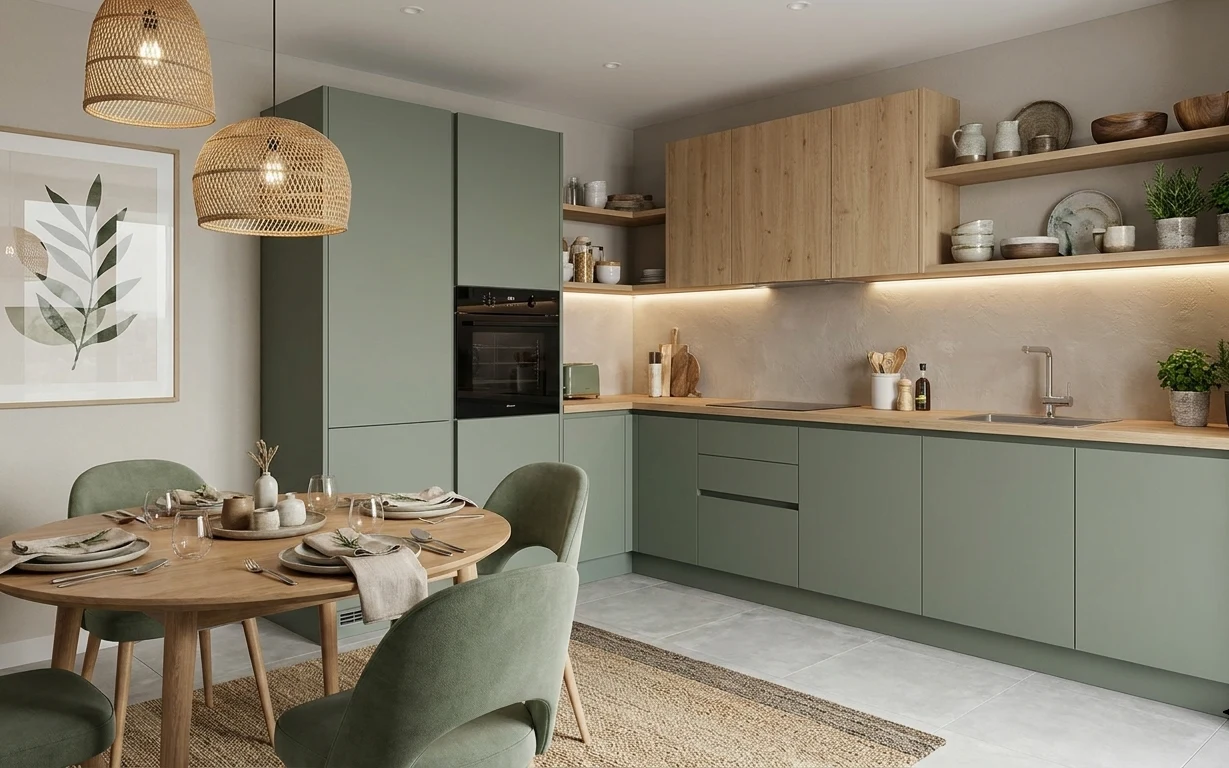
Under $250: sage-and-wood kitchen dining refresh
A move-friendly kitchen dining zone refresh for roommates and shared housing, built around a jute-look rug, framed botanical print, and eas…
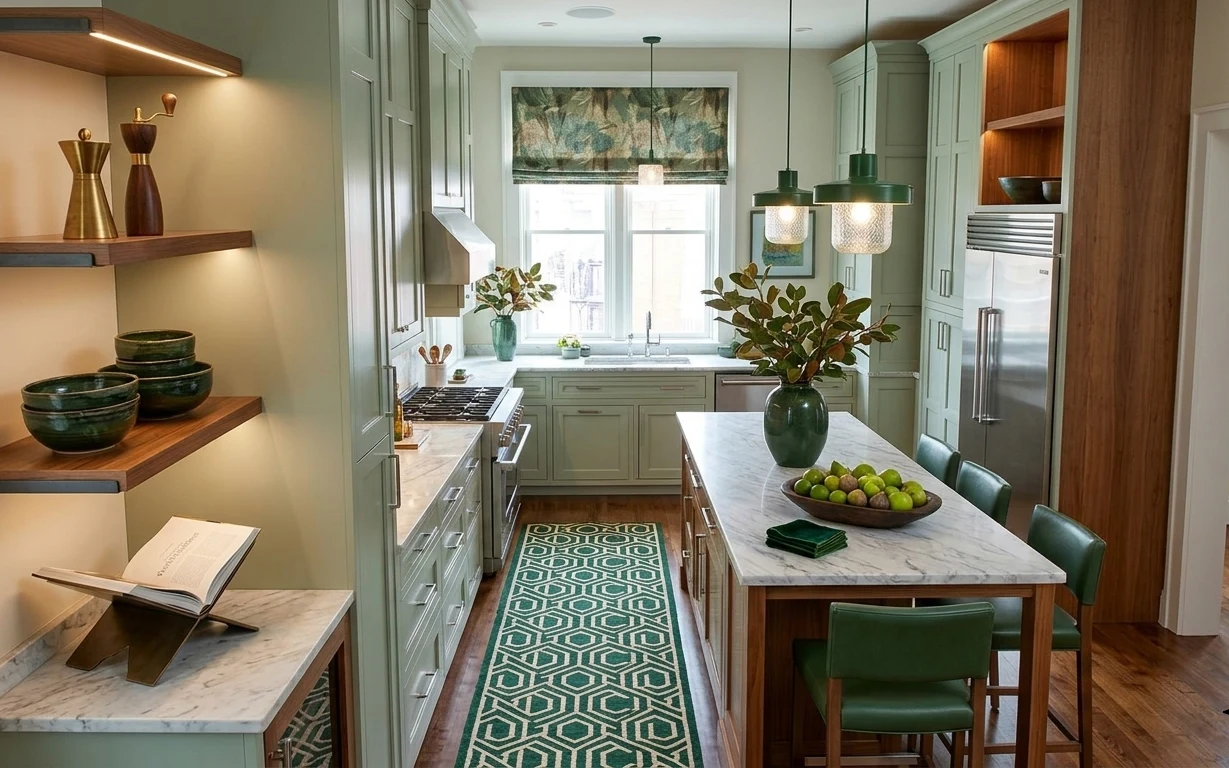
Under $400: move-ready kitchen dining nook refresh with 7 swaps
A move-friendly kitchen dining nook refresh under $400, built around removable swaps: a patterned rug runner, a framed print above the wind…