- Best for
- Cost and renter-friendly styling
- Cost
- Under $350 for 7 layers
- Difficulty
- Easy—mostly shopping and styling
- Time
- About 2–4 hours
Why warm earthy neutrals is the spa bathroom of 2026
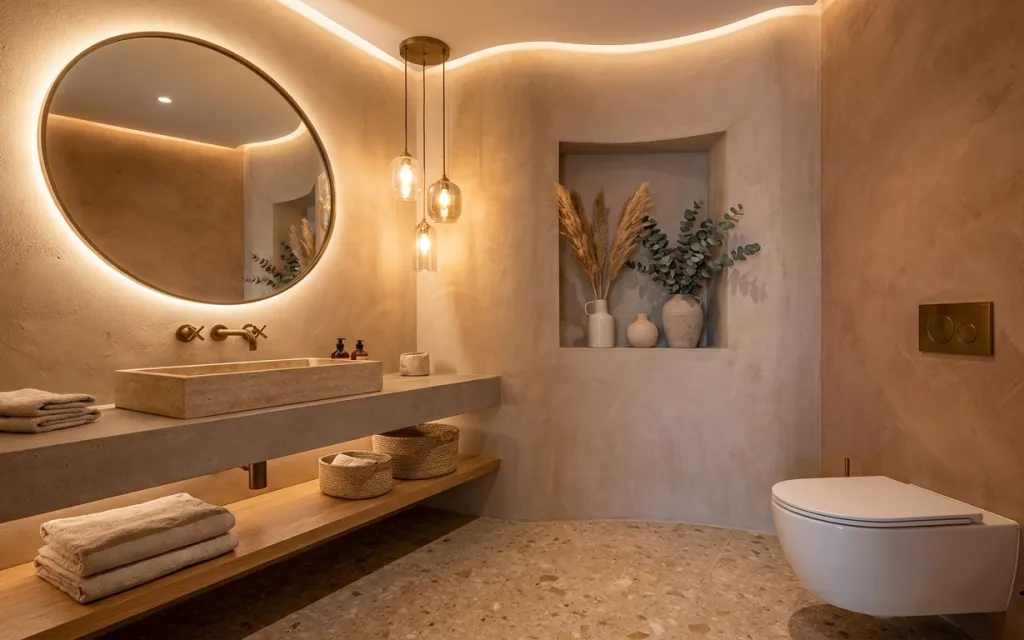
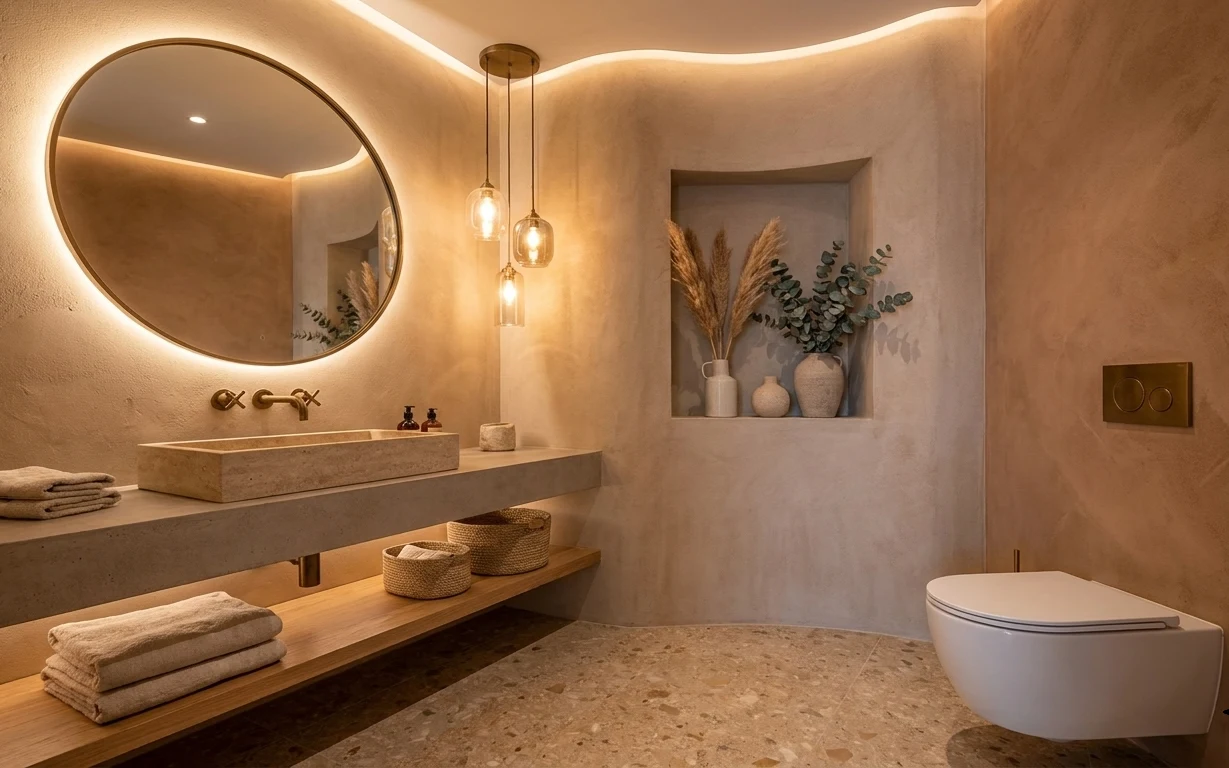
Soft light hits everything in this bathroom, and the textures do most of the talking: concrete counter, warm wood, and those folded beige towels that make the whole corner feel intentional. The circular mirror and the framed botanical artwork give you that “designed” focal rhythm, while the terrazzo-style floor keeps the base interesting. For renters, the good news is that the look doesn’t depend on changing fixtures—it’s all about styling objects you can pack up.
I used to chase the “perfect” bathroom by buying matchy sets, and I always ended up with things that looked staged instead of lived-in. What changed my mind was realizing that bathrooms need repeatable shapes—folds, stacks, and baskets—more than they need matching brands. Here, the folded towels and the woven shelf basket repeat the same warm, natural material story, and it reads calm instead of cluttered.
Layer 1 — bath mat on terrazzo floor ($80) Non-slip, warm underfoot
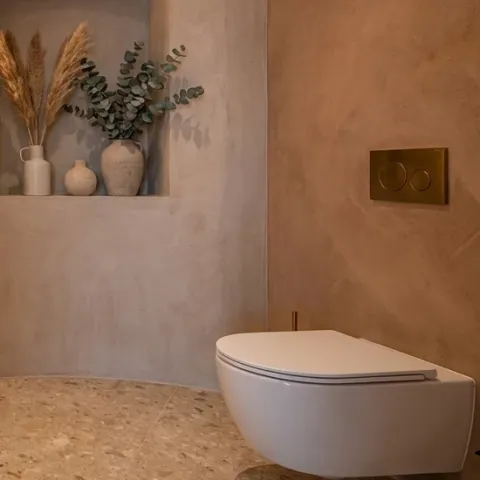
This bath mat grounds the terrazzo-style floor and gives you that finished “spa lane” the instant you step in. I like choosing a mat that’s thick enough to soften the hard surface visually, but neutral enough that it doesn’t fight the concrete vanity counter. The trade-off is straightforward: a mat is another thing to launder or shake out, so it’s worth picking one that won’t hold onto bathroom humidity. If you’re tempted to skip it, don’t—this is the easiest layer to make the whole room feel calmer.
Pick the mat for grip first
Look for a non-slip backing so the bath mat stays put when the floor is damp.
Layer 2 — folded beige towels on wooden shelf ($30) Stack height beats extra clutter
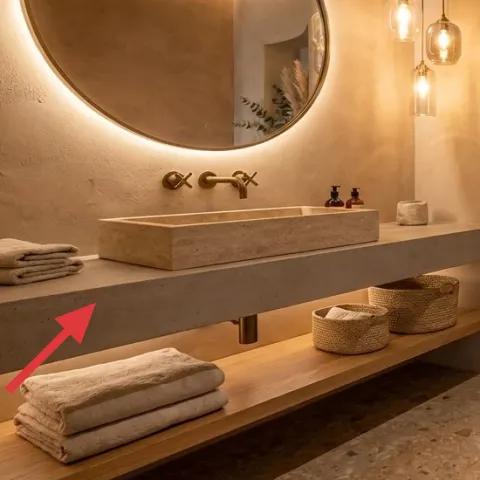
These folded beige towels look styled because the folds create tidy lines, not because they’re branded or fancy. I’d copy the scale: two to three towels maximum, placed where you naturally glance—on the lower wooden shelf near the vanity. The warm beige color keeps the palette cohesive with the concrete counter and wood, and the downside is that you do need to re-fold after laundry so it stays “intentional.” When I’ve skipped this step, towels instantly read like clean-up fabric instead of decor.
Go monochrome, then vary the fold
Keeping the same towel color while changing fold shapes adds rhythm without adding visual noise.
Layer 3 — woven basket on wooden shelf ($30) Gives you one home for odds and ends
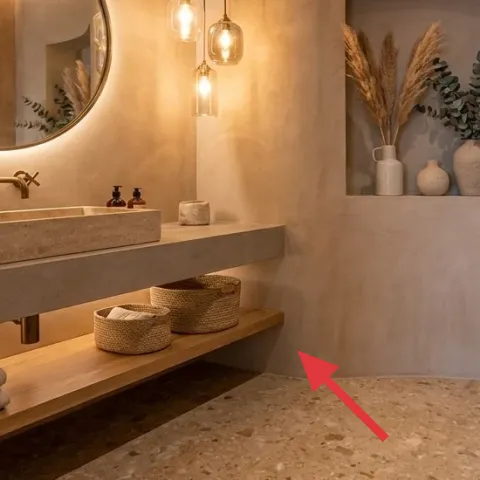
This woven basket is doing two jobs: it stores the small stuff you’d otherwise scatter, and it adds that woven texture that matches the room’s earthy neutrals. On a bathroom shelf, baskets look better than labeled plastic bins because the material reads warm rather than utilitarian. The trade-off is capacity—you won’t shove everything in like a deep hamper—so it works best when the basket holds “daily” items. If you want the look, pick a basket that sits low and wide so it stays visually anchored on the wooden shelf.
Hide the daily clutter
Store extra hand towels, cotton rounds, or spare soap refills inside so the counter stays calm.
Layer 4 — candle on vanity counter ($35) One warm focal point, no fixtures required
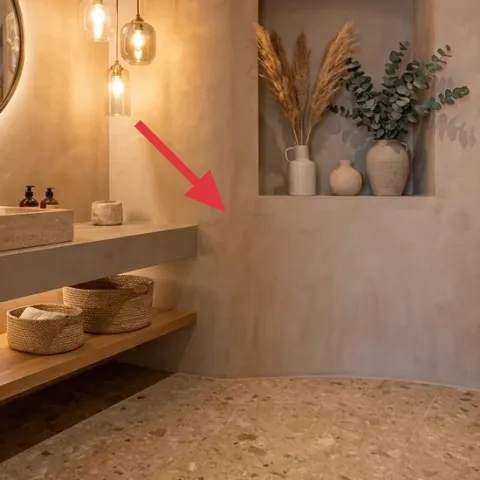
Make it instead of buying it
Make your own poured candle to match the warm, spa-style glow—so you get the same centerpiece effect for less.
Materials
- Wax (soy or paraffin) — ~1 lb — craft store — $12
- Wick — 1–2 — craft store — $4
- Candle jar — 1 jar — home goods — $6
- Wick tabs/adhesive — 1 pack — craft store — $5
- Fragrance oil or essential oil (optional) — 1 small bottle — craft store — $2
Steps
- Set up a clean workspace and prep your wick (attach to the tab and center it in the jar).
- Melt wax using a double-boiler method until fully liquid, stirring gently.
- Let wax cool slightly, then add fragrance if using, and stir slowly.
- Pour into the jar to your desired height, keeping the wick centered.
- Let the candle set until the surface is firm and fully opaque.
- Trim the wick and cure the candle before first burn.
Total DIY cost: $29 — saves about $6 over buying.
This candle sits on the concrete bathroom vanity counter and acts like the “highlight” in a styling photo—warm, small, and easy to swap. In this layout, it works because it’s placed low and centered, so it doesn’t compete with the framed botanical artwork in the niche. The trade-off: candles need a quick safety routine (keep the flame away from paper towels, drafts, and anything overhanging). If you’ve tried scented candles before, note that a heavy fragrance can clash with the room’s herbal vibe—go light or unscented for the cleanest look.
Don’t place it where water can splash
Keep the jar far enough from the sink edge that you’re not dealing with stray droplets.
Layer 5 — tall ceramic vase with dried eucalyptus ($35) Build the vertical rhythm
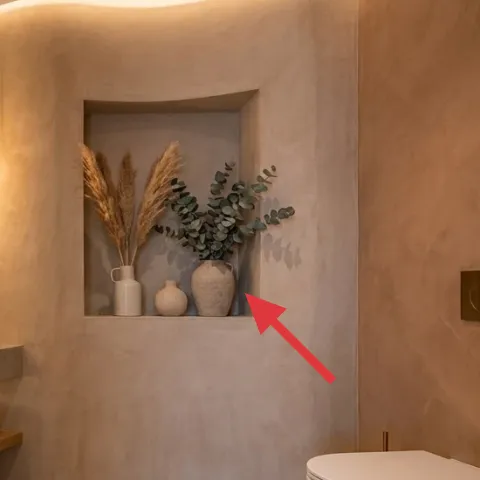
The tall ceramic vase is the vertical anchor that makes the framed botanical artwork feel curated instead of empty. The dried eucalyptus stems add movement—those curved lines echo the arched geometry of the mirror—and the dark green leaves bring contrast against the warm beige wall. I’m choosing a tall vase here because bathroom niches otherwise flatten visually; without height, everything reads like the same horizontal line. The trade-off is maintenance: dried stems shed a little, so plan to dust gently and refresh the arrangement when it fades.
Match the leaf color to the room’s palette
Dark green pops against warm beige without looking “holiday.”
Layer 6 — small round ceramic vessel ($15) Add one “quiet” accent on the niche shelf
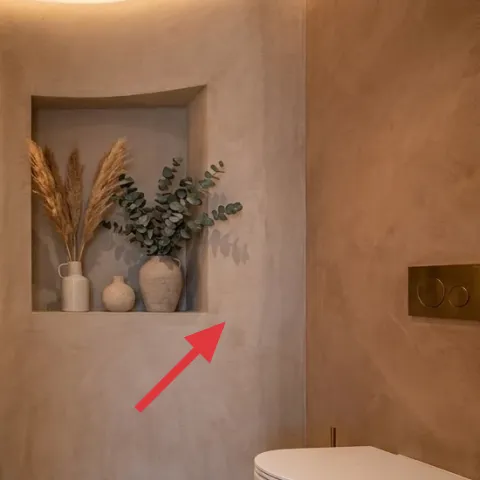
This small round ceramic vessel adds a secondary shape that keeps the niche styling from looking one-note. The roundness balances the vase’s height and gives your eye something to land on besides the dried eucalyptus. I like this as a renter layer because it’s inexpensive, easy to replace, and you can tuck it into different spots if the bathroom layout changes. The trade-off is scale: too many small pieces starts to look like you’re staging a craft table. One small vessel is the sweet spot for that collected-but-not-cluttered vibe.
Use odd numbers, then stop
Two or three objects max on the niche shelf keeps the arrangement intentional.
Layer 7 — framed botanical artwork in niche ($80) The wall focal that feels like a spa print
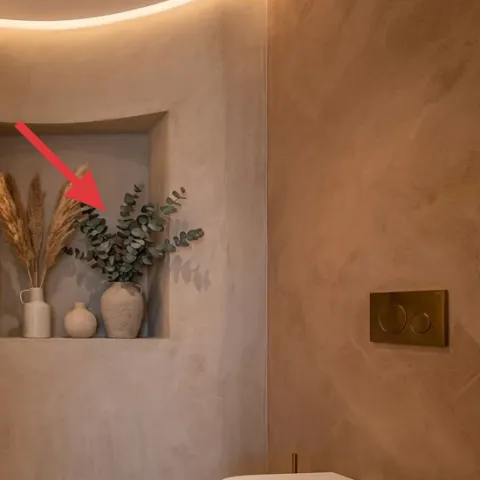
The framed botanical artwork is what turns this bathroom from “nice objects” into a cohesive room. In a niche, it matters because it creates a dedicated focal panel—your eyes don’t wander across the vanity and mirror endlessly. I’m using the framed print here instead of adding more decor because art supplies a finished composition instantly. The trade-off is that framed pieces can feel large for small bathrooms, but the niche scale helps; it’s already a built-in stage. If you rent, the upside is that frames can be packed and moved without touching landlord fixtures.
Keep the frame style consistent with the mirror
A simple frame shape reads calmer next to a round wall mirror.
The cost, layer by layer
| Layer | Item | Cost |
|---|---|---|
| 1 | Bath mat | $80 |
| 2 | Folded beige towel set | $30 |
| 3 | Woven shelf basket | $30 |
| 4 | Candle (DIY retail-equivalent) | $35 |
| 5 | Tall ceramic vase + dried stems | $35 |
| 6 | Small round ceramic vessel | $15 |
| 7 | Framed botanical artwork | $80 |
| Total | $305 | |
If you want to spend less, swap the framed botanical artwork for a smaller framed print and choose one larger vessel instead of two ceramics. Keep the bath mat and towel styling—those two layers do the heavy lifting visually.
What worked, what didn't (across the whole room)
The biggest win here is the repeatable material story: warm beige textiles, wood warmth, and earthy ceramics. The niche styling also works because it has a vertical anchor plus one small secondary object, so it reads curated rather than crowded.
What worked
- The bath mat softens the terrazzo floor and makes the space feel spa-like in one step.
- Folded beige towels add order without needing any hardware changes.
- The woven basket keeps bathroom odds-and-ends from drifting onto the counter.
- The tall ceramic vase gives height inside the niche, preventing a flat look.
- The framed botanical artwork creates a clear focal panel, so styling feels intentional.
- The candle on the concrete counter adds warm presence without replacing fixtures.
What didn't
- Dried stems shed slightly, so dusting has to be part of the routine.
- Over-stuffing the shelf basket makes it look like storage instead of decor.
- Too many small ceramic pieces in the niche turns the panel busy fast.
- A scented candle that’s too strong can fight the herbal botanical palette.
What we'd skip if we did it again
Skip buying matching “set” items that all share the same shape and texture. In this bathroom, the calm comes from varied shapes—folded towels, a tall vase, and one quiet small vessel—so mixing materials beats buying duplicates.
Skip going heavy on scent. If the candle is strongly perfumed, it can compete with the eucalyptus and the earthy palette; a lighter candle (or even unscented) reads cleaner and more spa-like.
Skip adding more objects once the niche has its three jobs: framed art as the focal panel, tall vase for height, and one small ceramic accent for balance. After that, extra decor starts to blur the composed look.
Frequently asked
How long does it take to get this spa bathroom look?
Plan on about 2–4 hours total. Shopping is the slow part, then styling is quick: place the bath mat, refold the towels, set the woven basket on the shelf, and build the niche arrangement around the framed botanical art and the tall ceramic vase. If you DIY the candle, include the extra curing time before your first burn.
Is this renter-friendly if I can’t change fixtures or tile?
Yes. This refresh avoids swapping any landlord-installed fixtures and focuses on renter-safe layers: textiles, freestanding storage, candles, and decor that doesn’t need drilling. The framed artwork can be hung using landlord-approved methods (like Command-style hanging systems) as long as your lease allows them.
What if my bathroom is smaller—should I copy the exact same layout?
Copy the structure, not the scale. Keep one vertical element (the tall vase) and one focal piece (framed botanical artwork). Then reduce the number of small objects—aim for two towels and one basket only. A smaller bath mat works too; the goal is still to soften the floor and create a clear “landing zone.”
What should I look for when shopping for the towels and bath mat?
Look for warm neutral tones (beige, oatmeal, cream) so they read cohesive against the concrete vanity and terrazzo-style floor. For the bath mat, prioritize non-slip backing. For towels, choose thicker towels if possible; thin towels fold flatter and can look less intentional.
Where to find the tall vase and dried eucalyptus stems?
Home goods stores and craft stores are reliable for ceramic vases, and dried stems are widely available in seasonal decor sections. If you’re matching color, pick stems with dark green leaves and beige-tan dried parts. Buy one arrangement you can reuse, then swap the small ceramic vessel for variety.
Biggest mistake people make with bathroom styling?
Over-collecting small items. When the counter and niche get too busy, bathrooms start to look like storage rather than a room. The fix is simple: keep the niche to three elements (framed art, tall vase, one small vessel) and limit towels to a small, repeatable stack.
More in Bathroom
Under $350: renter-friendly spa bathroom refresh with 7 layers
A renter-friendly spa bathroom refresh that uses 7 swaps—bath mat, folded towels, a woven shelf basket, one candle, and niche styling—witho…
Under $300: 7 move-friendly bathroom swaps for shared housing
A modern, spa-like bathroom look you can rebuild for under $300 using 7 move-friendly swaps that pack into a few boxes. The checklist focus…
Under $800: 7 spa-style bathroom upgrades that fit a weekend
A spa-style bathroom refresh under $800: swap in an oval mirror, tune up the vanity area, and add warm brass and greenery. This weekend pro…