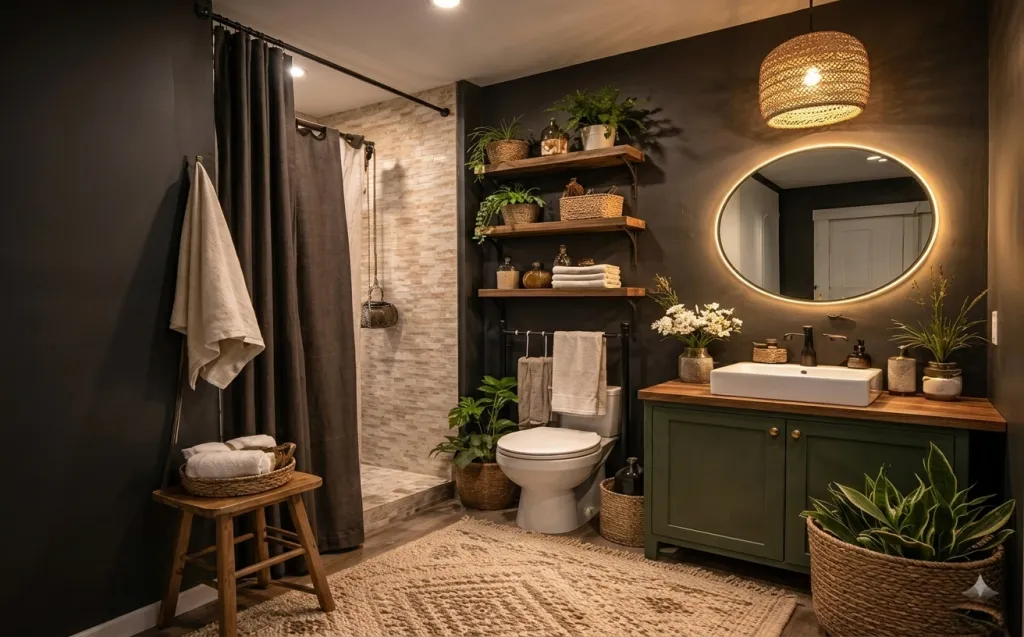
- Best for
- Spa-style bathroom mood with shelves, rug, and warm lighting
- Cost
- Under $600
- Time
- About 6 hours total (weekend)
- Difficulty
- Moderate (mounting + styling)
Why warm-lit spa bathrooms are the spa bathroom of 2026
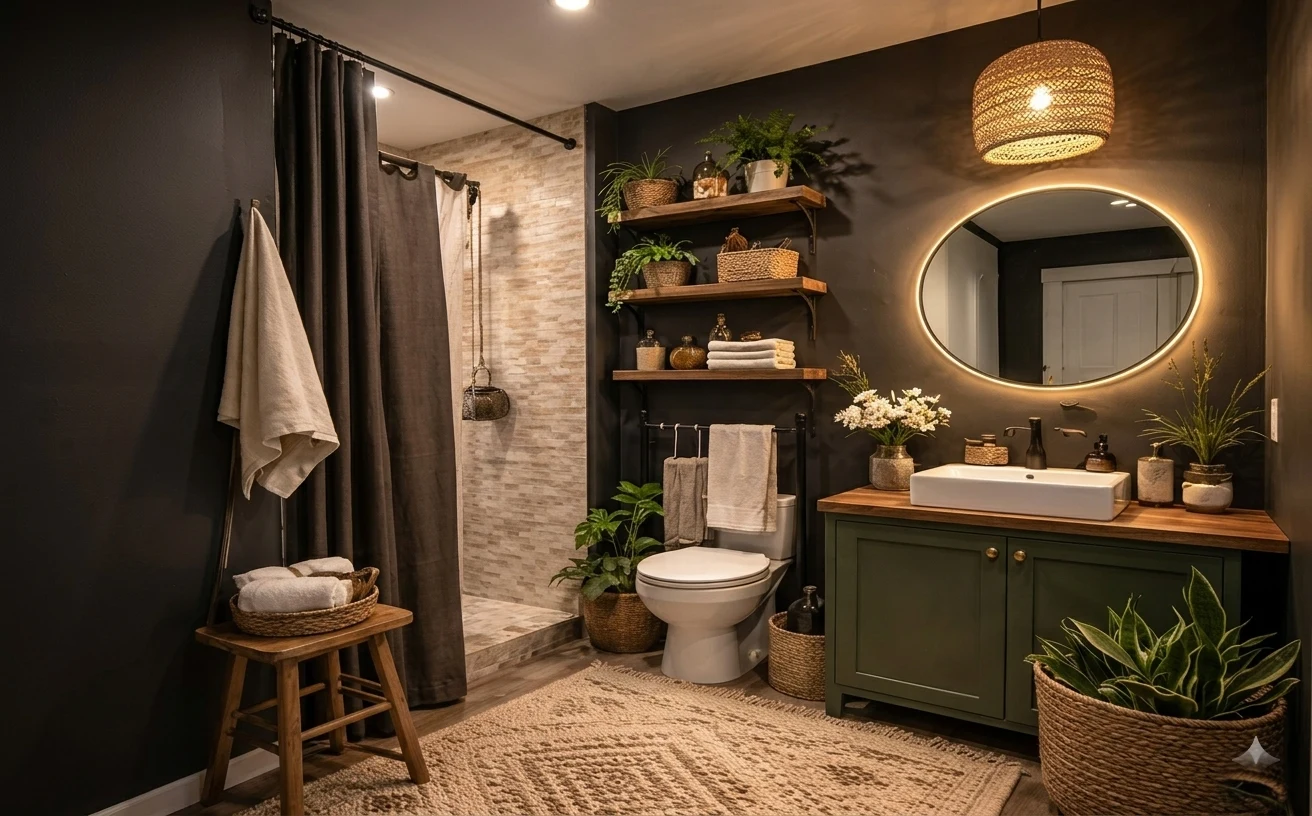
Dark, mood-forward bathrooms are having a moment for a reason: they let warm lighting and natural textures do the heavy lifting. In the style world, I keep seeing this “near-black walls + glowing mirror” pairing in editorials—often with a nod to Japandi calm and biophilic softness. If you look closely at the hero bathroom, you’ve got matte-dark wall color, stacked-stone tile, woven baskets, and a rattan pendant all sharing the same warm, tactile language. My quick timing on projects like this is about 6 hours total across a weekend—because you’re mainly mounting shelves, swapping soft goods, and styling. For US homeowners refreshing their own place, this look is achievable without chasing perfect reversibility: pick the changes with the highest visual impact and live with them proudly.
The first time I tried to mimic this vibe, I made the shelves too “even.” Everything sat in a straight grid, and the room read a little like a catalog photo instead of a lived-in spa. What finally clicked was breaking the symmetry with height—one item higher on the shelves, one towel folded lower, and a plant placed so it “breathes” between objects. I also learned to trust the glowing halo mirror: it reflects the shelves and vanity, so you don’t need a ton of additional wall art to feel finished. Do that, and the room feels curated instead of cluttered—especially at night when the warm pendant adds a second light layer.
Layer 1 — Halo round mirror ($0) Light that flatters every angle
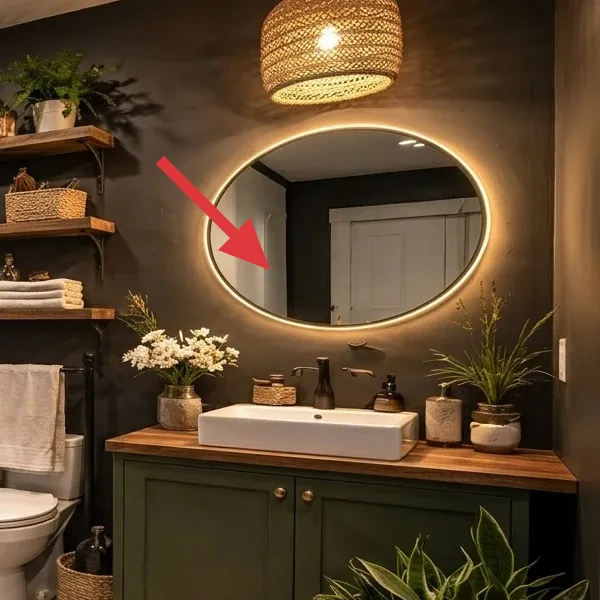
This round mirror has a glowing halo effect that frames the vanity zone like a soft spotlight. It sits on the dark wall above a green vanity cabinet and reflects the sink area, the shelves, and part of the shower-curtain wall. The light ring makes the center of the room feel brighter even when the overhead feels dim.
Keeping the mirror (instead of chasing a new one) is smart because it’s doing two jobs at once: it visually widens the bathroom and it adds warmth without introducing another hard-to-match fixture. If you do upgrade anything around it, aim for styling changes that appear in the mirror reflection—because that’s where the “finished” look comes from. I’d rather spend on rug pattern and shelf objects than pay for a third light source you don’t actually need.
Let the mirror guide your shelf layout
When you style the floating shelves, imagine what the mirror is reflecting and keep one negative space “gap” so the reflection doesn’t feel crowded.
Layer 2 — Green vanity & sink ($0) The anchor color
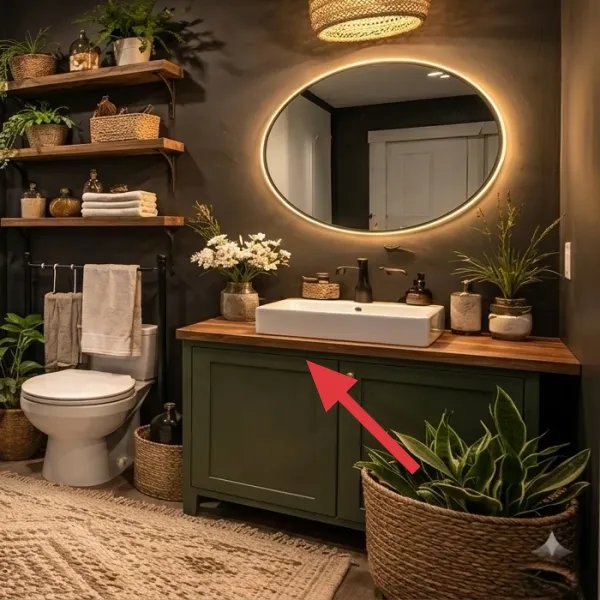
The vanity is a deep green cabinet with simple raised-panel doors and a clean, bright countertop. A white vessel-style sink sits centered, with small toiletries grouped nearby. The overall shape is uncluttered, so the green reads as a grounded base rather than visual noise.
This works in a dark-wall bathroom because green is warm enough to coexist with charcoal tones, but still distinct from the black-ish background. If you went with a lighter cabinet, the room would look brighter, but it would lose the spa contrast that makes the mirror glow feel intentional. You can’t “DIY” this anchor on a weekend (without plumbing-level work), so the best move is to keep it and build the rest of the layers around it.
Keep the counter styling light
Group items into one or two clusters so the mirror reflection looks curated, not busy.
Layer 3 — Floating shelves & decor ($170) Vertical storage that looks designed
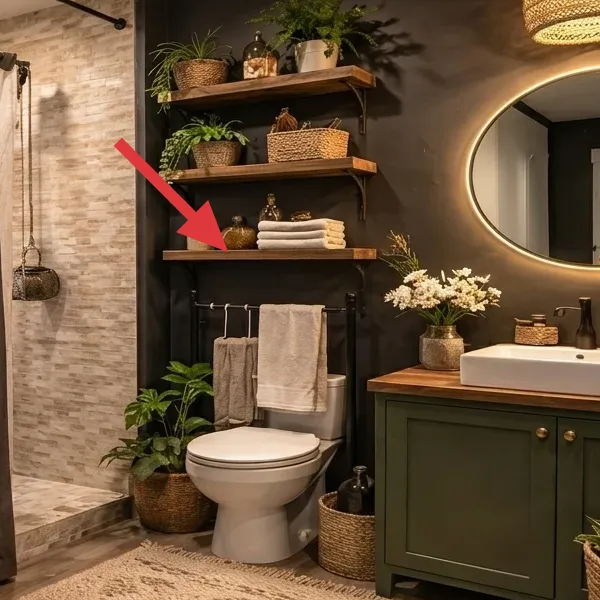
Two floating shelves run across the dark wall, creating a warm stage for towels and small decor. On the shelves you can see folded white towels, woven-texture baskets, and several small bottles/jars plus a couple of plants. The shelves sit in a way that visually connects the shower side to the vanity side.
Shelves are the highest-return change in this kind of bathroom because they solve “where do the towels go?” while also adding rhythm to the dark wall. The trade-off is that they demand a little editing: you can’t treat them like a junk shelf. When you set out decor, use a mix of heights (towels folded tall, jars grouped low) and vary textures (woven, glass/ceramic, and greenery) so the wall doesn’t go flat.
Build height contrast with towels and jars
Fold towels so they peek out from behind smaller items; then leave one shelf section emptier for visual breathing room.
Layer 4 — Shower curtain & towel styling ($140) Soft privacy with texture
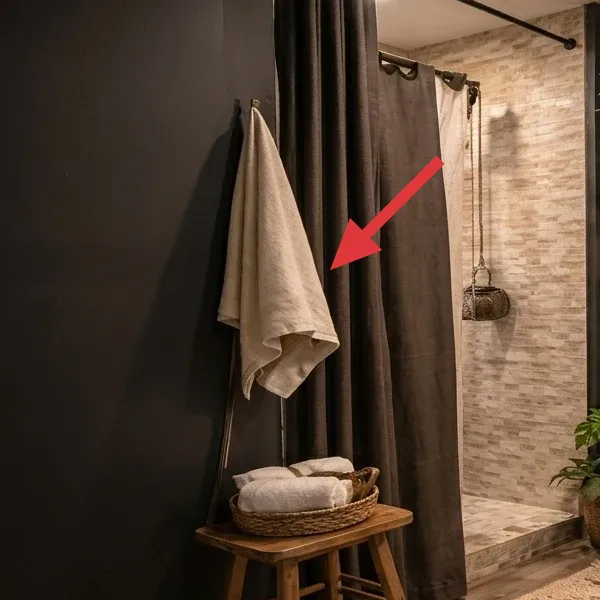
The shower curtain is a dark, muted gray with a smooth, slightly drapey look, hung from a black rod. On the left side of the room, a small wooden stool holds neatly stacked towels, and there’s a basket woven for extra linens. The textile setup adds contrast against the dark walls and makes the shower area feel intentional.
I’d choose textured linens over matching “set” towels because the room already has enough visual structure from tile and shelves. The curtain color matters too: a medium-dark gray keeps the bathroom moody without turning it into a cave the way very black fabrics can. The trade-off is that lighter curtains show water spots faster, so if you go darker, commit to a quick shake-out after showers and a gentle wash per the label.
Don’t skip curtain-length check
If the curtain puddles on the floor, it’ll drag and look messy; if it’s too short, it’ll splash outside. Aim for coverage that clears the floor by a small, consistent margin.
Layer 5 — Rattan pendant light ($120) A warm second light layer
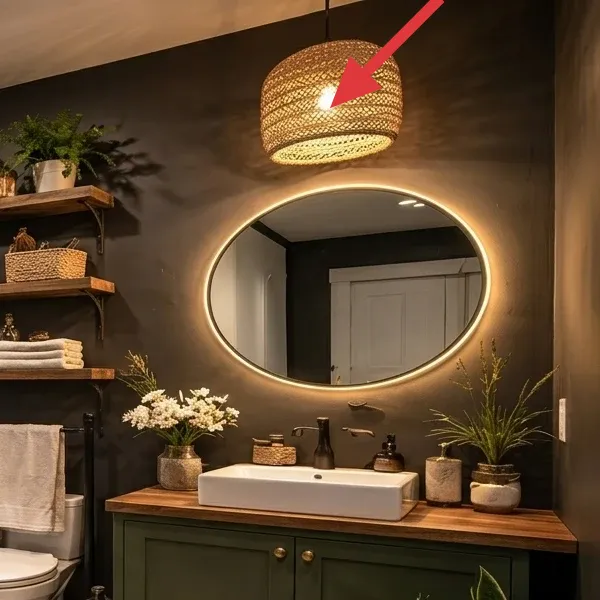
A hanging rattan pendant draws the eye upward, with a warm bulb glow visible inside the woven shade. It hangs above the vanity zone, adding softness that balances the crisp lines of the mirror and cabinetry. The texture of the shade also echoes the woven baskets and gives the whole room a natural, grounded feel.
Why this instead of a plain ceiling fixture? In a dark-walled bathroom, you want one “texture” light source so the room doesn’t feel flat. The pendant’s warm glow also makes the mirror reflection read more dimensional. If you go for a super-bright white bulb, the rattan turns gray and the cozy effect disappears—so keep the bulb warm and the shade design consistent with the woven theme already in the room.
Choose a warm bulb temperature
Look for a warm white bulb (not daylight) so the rattan reads honey-toned, not washed-out.
Layer 6 — Patterned area rug ($130) The cozy underfoot layer
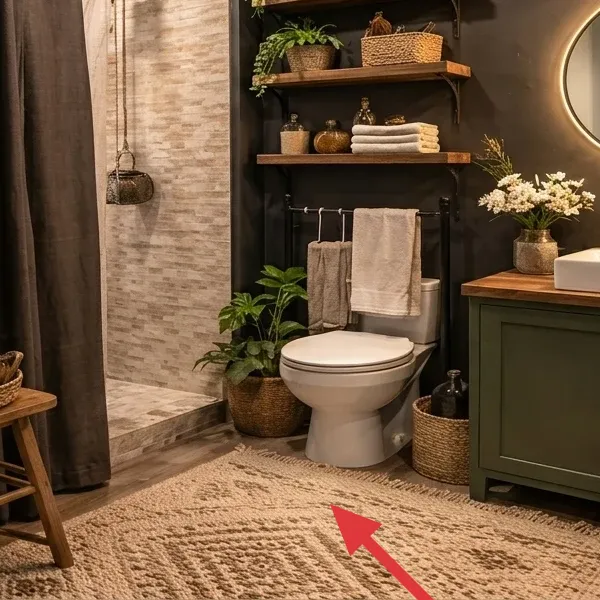
The patterned rug covers the bathroom floor in a warm beige-and-brown palette that visually softens the tile. Its pattern is subtle enough to feel calm but present enough to keep the room from looking like all surfaces are the same tone. Because it sits under the vanity and in front of the shower curtain, it ties both “sides” of the bathroom together.
If you only added one thing for comfort, I’d pick the rug—because it changes the sound and the mood of the room immediately. The trade-off is maintenance: bathroom floors get wet, so choose a rug that can be vacuumed easily and dry fast after cleaning. Pattern helps hide the occasional splash, and the warm neutral color keeps the rug from fighting the deep green cabinet.
Pick warm neutrals for dark walls
Even if you love high-contrast rugs, warm beiges and toasted browns usually harmonize best with charcoal and green.
Layer 7 — Floral & greenery accents ($20) DIY freshness that looks expensive
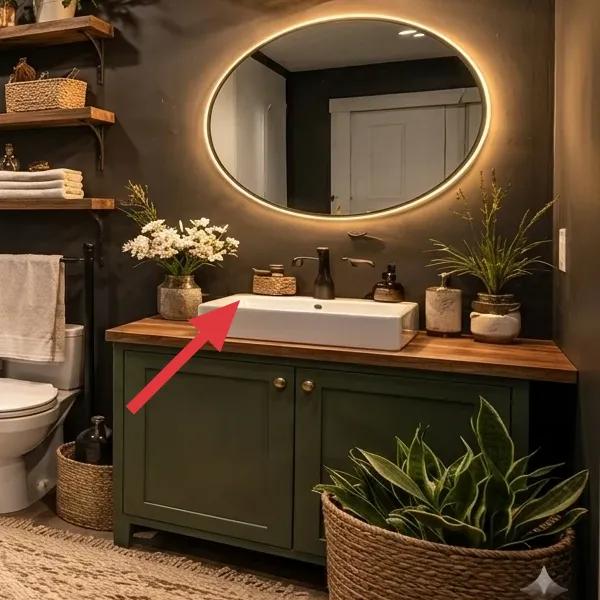
A small ceramic vase on the vanity holds white blossoms, and there’s also lush greenery in a woven basket near the foreground. Together, these accents add life to the dark wall and make the bathroom feel less “styled for a photo” and more lived-in. The mix of pale flowers and deeper green leaves creates contrast right where your eye lands—at sink height.
This is the one layer I always recommend doing yourself, because the biggest impact comes from freshness and placement, not from buying matching decor sets. Instead of spending on a pre-made arrangement, you can assemble a simple composition that looks curated in the mirror reflection. The trade-off is timing: you’ll want to refresh it every week or two, depending on the stems you choose and your bathroom’s humidity.
Make it instead of buying it
DIY a simple white-flower + greenery arrangement in the existing vanity vase so it reads bright against the dark wall without costing more than $20.
Materials
- White mixed-flower bunch — 1 bunch — Trader Joe's — $10
- Greenery stem bunch — 1 bunch — Trader Joe's — $8
- Twist ties — 1 pack — Target — $2
Steps
- Cut the stems to vase height with sharp snips so the flowers sit just above the rim without crowding.
- Remove any leaves that would fall below the water line so the water stays clean longer.
- Build the greenery first by placing 2–3 stems outward for shape, then tuck the flowers in the center for the bright focal point.
- Use twist ties to keep stems together while you test the arrangement, then adjust until the bloom cluster faces forward.
- Fill the vase with cool water, then recheck the balance from the doorway and in the mirror reflection.
- Trim a little off the ends after 30 minutes if the stems settle too low.
Total DIY cost: $20 — saves about $25 over buying a pre-made arrangement.
The cost, layer by layer
| Layer | Item | Cost |
|---|---|---|
| 1 | Keep the existing halo round mirror | $0 |
| 2 | Keep the existing green vanity and sink | $0 |
| 3a | Floating shelf set (2 shelves, includes brackets) | $90 |
| 3b | Anchor/mounting hardware kit for shelves | $10 |
| 3c | Shelf styling decor (woven baskets + small jars/bottles) | $70 |
| 4a | Shower curtain (dark gray, water-resistant) | $60 |
| 4b | Bathroom towel set (mix of bath towels + hand towels) | $80 |
| 5 | Rattan pendant light fixture | $120 |
| 6 | 5x7 patterned area rug (warm beige/brown) | $130 |
| 7a | White mixed-flower bunch | $10 |
| 7b | Greenery stem bunch | $8 |
| 7c | Twist ties | $2 |
| Total | $580 | |
If you want to spend less, keep the same look but buy a pre-styled shelf set from a thrift store instead of new decor, and swap the rattan pendant for a simpler plug-in shade that still reads warm. You can also choose a lower-cost rug in the same warm neutral range—pattern helps, but color harmony does most of the work here.
What worked, what didn't (across the whole room)
This bathroom’s win is the way the layers echo each other: warm light, woven textures, and dark wall contrast. The few missteps were mostly about editing—too much at once reads busy, no matter how nice the pieces are.
What worked
- The halo mirror makes the vanity area feel brighter without changing any plumbing, and it also reflects the shelves beautifully.
- The patterned rug softens tile acoustics and keeps the room from feeling slippery or echo-y, especially near the shower.
- Woven textures show up in multiple places (pendant shade, baskets), so the whole room feels like one story.
- Floating shelves create clear towel “zones,” which makes daily mess look temporary instead of permanent.
- The shower curtain in a dark gray reads intentional, not heavy, because it’s paired with lighter towels.
- Fresh flowers and greenery bring contrast at sink height—small detail, big effect in the mirror reflection.
- The pendant adds a warm second light layer, so the bathroom doesn’t rely on only one overhead source.
What didn't
- Over-styling the shelves made the dark wall look crowded; once we removed two items, the room instantly looked calmer.
- A cooler bulb temperature at the pendant stage washed out the rattan tone and made the whole palette feel flatter.
- Too-light towel colors showed every tiny water spot; switching to a warmer white blend looked cleaner for longer.
- If the curtain isn’t hung with enough height, it bunches and makes the shower area look untidy.
- Choosing a rug with too much contrast pulled attention away from the mirror; a warm neutral pattern reads more spa-like.
- If greenery sits too close to the mirror edge, it can block the reflection and make the “glow” feel less even.
What we'd skip if we did it again
Skip buying a “matching set” of bathroom accessories. In a dark-wall setup, you don’t need everything to match in metal or color—what you need is texture variety. A woven basket beside a simple ceramic vase looks more expensive than three identical bottles, and it also keeps the mirror reflection from looking like a single-brand display.
Skip placing decor only at eye level on the floating shelves. If everything sits on one horizontal line, the shelves read flat against the dark wall. Instead, fold towels so they stack vertically, keep one jar slightly forward, and let the plant occupy the space between objects so your eye has a path.
Skip a rug with a cool gray base. Even when the pattern is pretty, cool tones fight deep green and make the whole bathroom feel colder than you want. Stay in warm beige, toasted tan, or sand tones—then use contrast with the shower curtain and countertop so the room still looks modern and crisp.
Do these swaps and you’ll get the same lived-in, warm-lit “spa” feeling without any demolition. The best part: once you’ve built the shelving and textiles, updating small accents like flowers becomes a repeatable weekend ritual.
Frequently asked
How long does this bathroom refresh take on a weekend?
Plan for about 6 hours total across two days. Day one is usually for getting the floating shelf hardware mounted and setting up the shower textiles. Day two is mostly styling: rug placement, pendant setup (if you’re swapping it), and arranging the shelf decor and fresh flowers. If you keep the vanity and halo mirror as-is, you avoid the long, fussy parts that typically blow weekend timelines.
Is this renter-safe or do I need permission?
This plan is written for homeowners refreshing their own place, and it includes mounting shelves and hanging textiles properly. If you’re renting, the safest version is to keep shelves to what you can do with non-drill methods and skip any light fixture swap that requires electrical work. But the visual priority here is the layered look (rug + lighting + shelves + textiles), so you can still mimic the impact with permission-friendly options.
What if my bathroom is smaller than this one?
Go smaller but keep the proportions: choose a rug that still covers the main traffic area in front of the vanity and shower, and stick with one bold “glow” element (the halo mirror) rather than adding multiple mirrors. For shelves, avoid maxing out both shelf lines—leave one “pause zone” with fewer objects so the dark wall doesn’t feel tighter. Finally, pick a shower curtain in a medium-dark gray so it visually softens without swallowing the space.
What if my bathroom is bigger—should I add more decor?
Use scale, not clutter. Bigger bathrooms can handle taller shelf groupings and slightly fuller greenery, but keep the same rules: vary height, mix textures, and reserve negative space. If the shelves feel too small against the wall, you can add one more vertical accent like a taller plant or a second towel stack—without filling every inch. The goal is that mirror reflection still looks curated rather than crowded.
Where would you shop differently for these pieces in 2026?
For the highest-value look, I’d prioritize stores with good lighting warm-bulb selection for the pendant, and retailers that carry bathroom rugs that dry quickly. For shelf decor, I’d mix new items with thrifted jars or baskets from ReStore-style shops so the styling looks collected instead of purchased. The flower-and-greenery part is the easiest to “shop fast” in 2026—fresh bouquets and greenery stems are widely available and change the mood with minimal cost.
What’s the single biggest mistake people make in a dark bathroom like this?
The biggest mistake is treating dark walls as if they need more darkness—meaning cool bulbs, overly gray textiles, and shelves packed wall-to-wall. Dark bathrooms actually need warmth and texture variety to feel spa-like. Use a warm second light layer, keep the rug in warm neutrals, and edit the shelves so there’s breathing room. If you do those three, the rest falls into place.
How do I keep the shelves and countertop from looking messy over time?
Create “zones” that make mess look intentional. Put the towels in the shelf folds and keep bottles clustered on the vanity so visitors see a set-up, not loose items. When you style, leave at least one section of each shelf less populated than the others. For the countertop, group items into one small cluster and let the sink area stay visually open—especially important because the mirror reflects everything.
More in Bathroom
Weekend laundry-room refresh: 7 styling upgrades for under $400
This weekend laundry-room refresh uses seven simple upgrades—stacked white towels, a tidy shelf hamper, a small plant, and one DIY pine org…
Under $400: 7 moving-friendly bathroom layers for shared renters
This moving-friendly bathroom refresh gives you the spa-like, layered look without swapping landlord fixtures—just seven renter-safe layers…
Under $600 weekend spa bathroom refresh: dark walls, rug, warm shelves
This spa bathroom refresh delivers a hotel-like glow on a real homeowner weekend budget of Under $600. By layering a patterned area rug, wa…