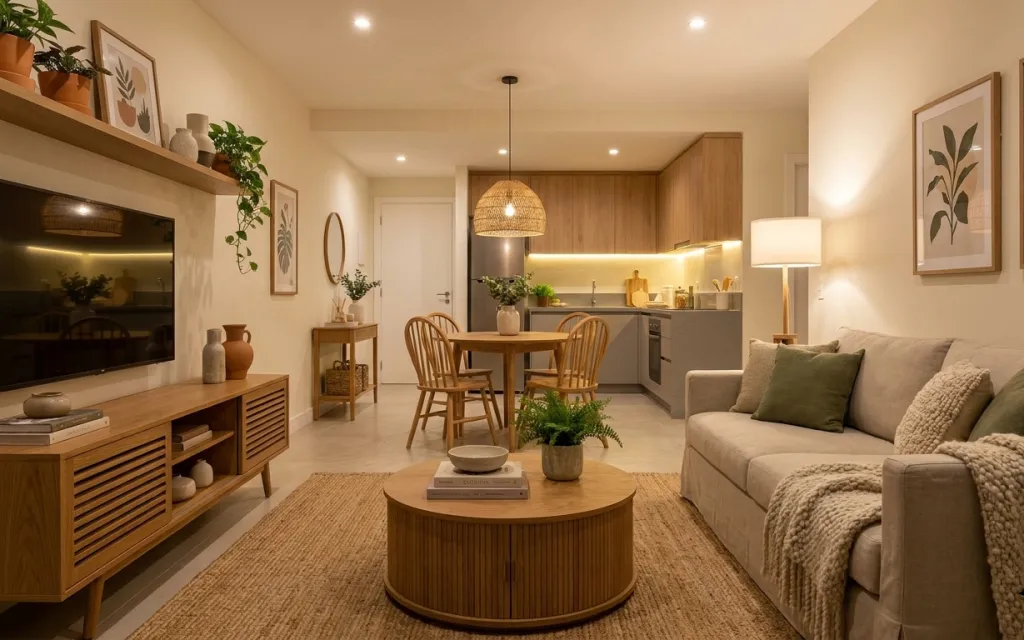
- Best for
- a homeowner's small open-plan living zone
- Cost
- $640
- Difficulty
- Confident DIY — spray-paint and drywall-anchor skills required
- Time
- three weekends end-to-end
Why this cream-and-olive condo is the open-plan living room of 2026
The mounted-TV-and-mid-century-shelf look had its moment in 2020 when every Apartment Therapy house tour ran some version of it — slatted media console, terracotta-potted pothos on a floating shelf, a single olive throw pillow. Most of those rooms now read as the Crate & Barrel catalogue from a particular six-month window, which is the curse of decorating from one mood board. The version Lina kept coming back to is the 'New Standard' issue of Dwell from spring 2024 — a Portland kit-of-parts house tour where the same warm-honey wood, jute floor, and cream-with-olive palette was deployed without leaning on a single trend item. The reproduceable details are concrete: a round reeded coffee table instead of a square, one tall lit lamp in the corner instead of three table lamps spread around, and exactly two framed botanicals over the sofa instead of the busy multi-frame cluster look. Power-tool moves are on the table here — the TV mount uses real anchors, and the floor-lamp DIY in Layer 6 needs a drill bit you'd be embarrassed to admit you don't already own.
I bought a $260 Article floor lamp two years ago because it photographed well on someone else's Instagram. It arrived in a single box and felt structurally fine for about three months, then the seam where the brass tube meets the plastic base started rattling every time the AC kicked on. The thrifted lamp in Layer 6 (a 1970s brass column from a Salem estate sale, $25) is heavier, quieter, and the only sound it makes is when the cord taps the wood floor as I move it. The lesson I keep re-learning in the bungalow: the lamp you'll keep for fifteen years rarely shipped flat in a box from a brand that ran Pinterest ads at you in the past month. Buy the bones secondhand. Build the rest yourself.
Layer 1 — Stack of design books on the coffee table ($15) sets the styled-not-cluttered tone
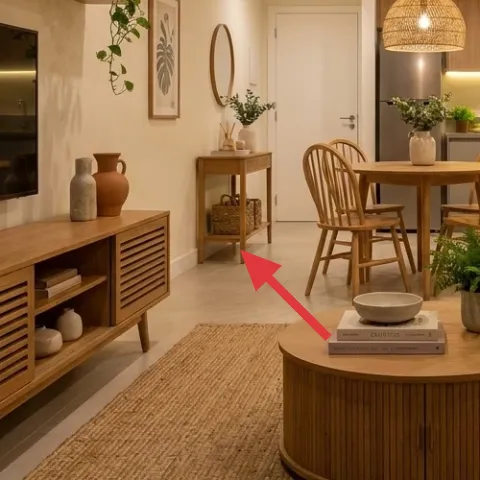
Three large-format design books stacked on the reeded coffee table — a Phaidon hardcover at the bottom, a thinner Apartamento back issue in the middle, and a single $4 yard-sale find on top with a saturated coral spine. The Phaidon was $35 new but I picked it up at the Powell's annex for $12 with a slightly bumped corner that hides under the next book. The stack height matters: ten inches puts the top book exactly at the level of the small fern pot beside it, which is what makes the coffee table read as composed rather than cluttered. Skip the gold foil-stamped designer-monograph stacks from West Elm; they're $40 each, bound in printed cardboard, and the foil tarnishes uneven inside of a year. Real design books in the wild are everywhere if you check the back room at Goodwill on a Wednesday afternoon when the new donations get put out.
Stack three, never two or four
Two books on a coffee table reads as an unfinished suggestion; four reads as a TBR-pile guilt-trip. Three is the count where the eye stops counting and starts seeing a small sculpture — keep the tallest on the bottom, the most-saturated spine on top.
Layer 2 — Tabletop Boston fern in terracotta planter ($25) catches the lamp light across the coffee table
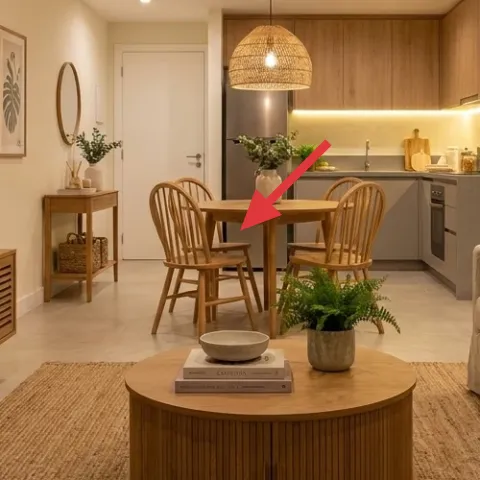
A small Boston fern in a matte terracotta planter, sitting opposite the book stack on the reeded coffee table — close enough that the fronds drape across one corner of the small ceramic bowl beside it. Boston is the only fern that survives Portland's dry-winter heating for more than a season; maidenhair and lemon-button die within four weeks at our humidity. The planter is a 4-inch matte terracotta from Smith & Hawken at $8 (clearance bin) with a $3 plastic insert from the nursery so the clay doesn't crack from the moisture cycle of weekly watering. The fronds catch the corner floor-lamp light at the same height as the top edge of the books, which is what makes the two layers feel composed rather than placed-next-to-each-other. Repot every 18 months into a half-inch larger planter; this same plant has been in this same pot for two years and is starting to crowd.
Pick the fern variety for your climate, not the look
Boston for dry winter heat, maidenhair only in humid coastal apartments, blue-star for shade rooms, lemon-button for kitchens with steam from cooking. Buying the wrong fern for your air is the single most common reason a coffee-table plant dies in week three.
Layer 3 — Pair of olive linen throw pillow covers ($60) ties the bedding green to the dining greenery
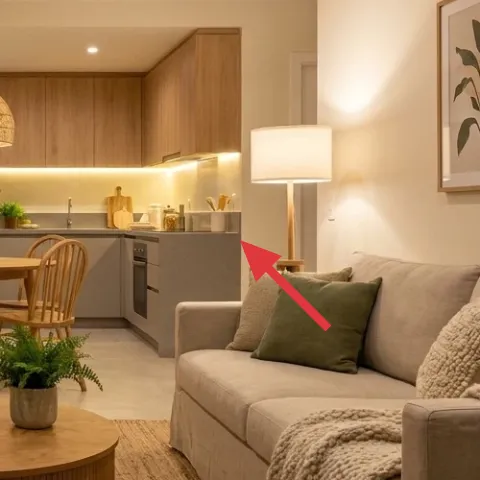
A pair of olive linen throw pillow covers in a heavyweight 12-ounce cotton-linen blend, sitting at the back of the cream sofa where they catch the floor-lamp light. Both are West Elm 20-inch covers at $30 each — full retail, no sale, because the color-match between batches is more reliable than from a smaller brand and a single mismatched cover ruins the whole pair. The 12-ounce weight is the part most people skip on: lighter linens crumple by week three and start to look slept-on; the heavier weave holds its shape between guest visits and irons flat on the lowest heat in under a minute. The single olive shade tying back to the fern, the dining-nook greenery, and the framed botanicals on the right wall is what makes the room read as a composition rather than a color-spotted listicle. Skip the cheaper $14 olive cover on Amazon; the dye is too yellow and the cover lands in the trash within a year.
Buy both pillow covers in the same shipment
Dye lots vary even at West Elm. Two covers ordered three months apart can differ by a quarter-shade — visible only under direct lamp light, but visible. One shipment, both covers; if one arrives off, return both and reorder together.
Layer 4 — Chunky cream cotton-blend knit throw ($55) drapes over the right sofa arm only
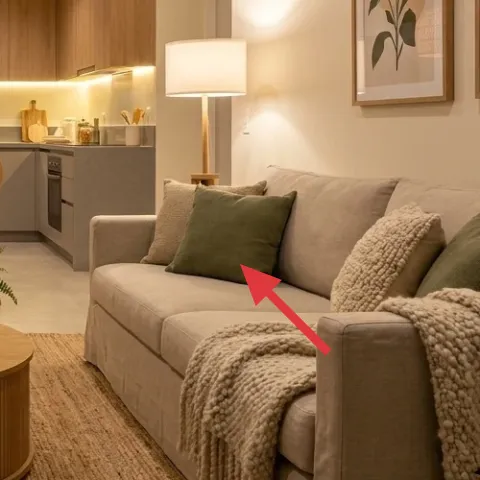
A chunky cream cotton-blend knit throw draped across the right arm of the sofa, falling about 18 inches over the seat cushion and slightly past the front edge. The yarn is a #5 bulky cotton-blend that machine-washes on cold without pilling — the IKEA INGABRITTA at $50 is the closest dupe to the $145 viral chunky-knit throws that filled Instagram in 2024 and didn't survive their first wash cycle. The drape across one arm only (not both) is intentional: a throw on both arms reads as 'staged for a real-estate photo' and a throw centered across the back reads as 'sofa came with the throw built in.' One arm, casual fold, slight asymmetry is what makes it look like someone actually sits there. Machine-wash on cold every other month and air-dry flat on a guest-room bed; tumble drying turns the cotton-blend yarn into a pill-mill within four wash cycles.
Asymmetry is the move on a three-seat sofa
Symmetrical styling on a sofa always reads as a furniture-store photograph. Two pillows on one corner plus a throw on the opposite arm is the formula that makes a room look lived-in rather than staged — even when nothing else in the room is asymmetric.
Layer 5 — Pair of framed botanical art prints ($95) sits at seated eye level above the sofa
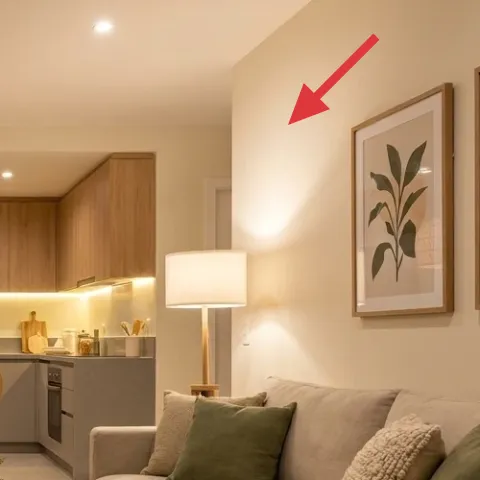
Two 16-by-20-inch framed botanical illustrations on the right wall above the sofa — one stem of fiddle leaf fig, one stem of monstera, both in soft green ink on cream paper. The prints came as a pair from a local Portland artist's Etsy shop at $40 each; the frames are simple oak from the Aaron Brothers liquidation last summer at $20 each for the pair, plus $5 in mat board cut to a half-inch reveal at the local frame shop. Mat board behind each print adds another beat that's worth it — borderless framing on art at this scale reads as 'temporary' even when the rest of the room doesn't. Hung at exactly eye level when seated on the sofa, which is six inches lower than where most people hang art and is the whole reason the prints feel proportional rather than floating above the cushion line. Two prints in matching frames beats five mismatched ones on the same wall every time.
Hang to seated eye level, not standing eye level
Standing eye level is 62–66 inches; seated eye level on a standard sofa is 48–52 inches. Art over a sofa belongs at seated eye level. The 'gallery height' rule from museum tours assumes a standing viewer — it produces art that floats too high in a living room.
Layer 6 — Refinished thrifted brass floor lamp with new linen shade ($130) anchors the corner at 2700K
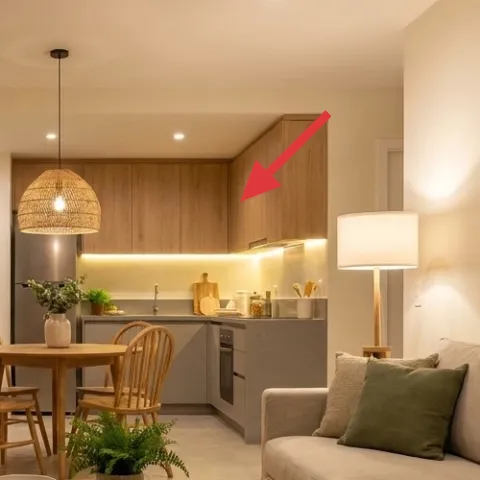
A 60-inch brass column floor lamp in the corner behind the sofa, refinished from a 1970s thrift store find — Salem estate sale, $25 for the lamp itself, sold without a shade. The original brass was tarnished and pitted; two coats of matte cream Rust-Oleum 2X with built-in primer at $18 covered it cleanly without obscuring the column's reeded detail. The new 14-inch linen drum shade is a $35 Lampshade Pro replacement; the 60-watt warm-LED Edison-style bulb at $8 puts out 2700K warm light that picks up the cream-and-olive palette and softens the sharp edges of the TV across the room. Total DIY cost $86; a comparable new floor lamp at West Elm runs $260 and ships in three boxes with visible seam lines on the column where the sections meet. The whole project took one weekend afternoon plus 24 hours of paint cure time before reassembly the next day.
Make it instead of buying it
A thrifted 1970s brass column lamp, painted matte cream with a fresh linen drum shade, is the homeowner-DIY answer to the $260 West Elm equivalent — and the column geometry of a vintage lamp beats most current production for the price.
Materials
- Vintage brass floor lamp base, 60-inch column — Goodwill or estate sale — $25
- Rust-Oleum 2X matte cream spray paint with built-in primer — two cans — hardware store — $18
- 14-inch white linen drum shade — Lampshade Pro or Crate & Barrel — $35
- 2700K warm-LED Edison bulb (60W equivalent, dimmable) — Home Depot — $8
Steps
- Disassemble the lamp completely — remove the harp, the socket assembly, and any felt or rubber feet — and wipe the brass column down with rubbing alcohol to strip surface oils that would reject paint.
- In a well-ventilated garage or porch, hang the column from a piece of twine looped through the top harp post and spray the first cream coat in light passes at 12 inches' distance, rotating every two seconds to avoid drips, then let cure 8 hours.
- Spray the second cream coat the same way and let cure overnight (24 hours minimum before any reassembly), looking for any visible coverage gaps near the base where the column thickens.
- Reassemble the socket and harp, install the new 14-inch linen shade and the 2700K Edison bulb, and sit on the sofa to dim to the level where the shade glows but the cream paint on the column still reads as cream rather than as a hot-spot reflection.
Total DIY cost: $86 — saves about $44 over buying.
Layer 7 — Flat-weave 8-by-10 jute area rug ($260) anchors the seating zone to the floor

A flat-weave 8-by-10 jute rug centered under the coffee table and extending out under the front feet of the sofa, with about 28 inches showing past the sofa front and 18 inches on each long side. The flat-weave is the choice over chunky braided here — chunky catches every dropped book and bowls into spots that never quite flatten back out under a coffee table's weight. We paid $260 on a Pottery Barn end-of-season sale; the same rug full price was $349 and the closest West Elm equivalent runs $320 in this size on a regular weekday. Jute sheds for the first four to six weeks — vacuum every other day for the first two weeks, weekly for two more, and the shedding stops by week six. Pair with a $40 felt-and-rubber Mohawk rug pad to stop the corners from curling under the coffee-table legs and to add the quarter-inch of acoustic dampening that makes a small open-plan space stop echoing every time the dishwasher kicks on.
Allow six weeks of jute shedding before judging the rug
Brand-new jute will shed orange dust onto a cream sofa, a white duvet, anything light-colored within arm's reach of the rug. This is normal and stops by week six. Returning a jute in week two because of shedding wastes the return window — the rug was going to work.
The cost, layer by layer
| Layer | Item | Cost |
|---|---|---|
| 1 | Stack of design books on the coffee table | $15 |
| 2 | Boston fern in matte terracotta planter | $25 |
| 3 | Pair of olive linen throw pillow covers (20-inch) | $60 |
| 4 | Chunky cream cotton-blend knit throw | $55 |
| 5 | Pair of framed botanical art prints (16 by 20) | $95 |
| 6 | Refinished brass floor lamp with linen shade (DIY ~$86 in materials) | $130 |
| 7 | Flat-weave jute area rug, 8 by 10 | $260 |
| Total | $640 | |
The cheaper variant: drop the framed botanicals to a single 24-by-36 piece instead of a pair (Society6 prints frame-included at $60), keep the $260 jute, and the room still reads as 80 percent of this look at $625 total. The other cut to consider: a 6-by-9 jute at $180 instead of the 8-by-10 — works in a living zone under 140 square feet without making the floor feel busy. The floor-lamp DIY is the layer that does the most visual work per dollar; never cut that one or the corner goes dim and the open plan loses its anchor.
What worked, what didn't (across the whole room)
The room reads as a real living space after about four weeks of small adjustments — the seven-layer plan got us 80 percent there over three weekends, and the rest was just living with the lighting at night and shifting the lamp angle one degree at a time.
What worked
- The cream-and-olive palette in the pillows and the botanicals tied the open plan together so the dining nook and kitchen no longer read as separate rooms.
- The single tall corner floor lamp at 2700K did more for the evening ambiance than the four recessed ceiling lights at full brightness ever managed.
- The flat-weave jute rug under the coffee table absorbed enough sound that the open kitchen stopped echoing every time someone loaded the dishwasher.
- Refinishing the thrifted brass floor lamp at $86 instead of buying new at $260 felt like the highest dollar-impact decision of the whole project.
- Mounting the TV with proper drywall anchors (the second time around, after the screw-only first attempt) freed up the entire media console for plants and books.
- The single matched pair of olive pillow covers from West Elm read as designed rather than collected, which is what one cohesive shade does that mixed greens cannot.
What didn't
- The first floor-lamp shade we ordered was 12 inches when 14 was the right size, and the column poked up above the shade looking unfinished.
- The mat board behind the framed prints was ordered too small the first time at a quarter-inch reveal and looked stingy; redoing at a half-inch fixed it.
- The dining-area pendant we considered putting on a smart dimmer would have required an electrician on the circuit and added $180 to the project.
- The Phaidon design book bumped corner that was supposed to hide under the next book on the stack didn't actually hide once we vacuumed and shifted the stack.
- The first jute rug we tried at $180 from Amazon shed for ten weeks straight and dyed the cream sofa skirt a permanent dusty yellow before we returned it.
What we'd skip if we did it again
Skip the dining-area pendant in favor of the corner floor lamp as the primary evening light source. The pendant over the dining table in this photo is borrowed from the previous tenant and is wired into the same circuit as the kitchen recessed lights, which means it can't dim independently and gets used at 100 percent or not at all. The corner floor lamp on a smart plug — set to 40 percent at 7 p.m. and 20 percent at 9 — does what the pendant pretends to do. If you're starting from a blank dining wall, hardwire the floor-lamp outlet instead and skip the pendant entirely; the room reads taller and the dining table photographs better without a fixture floating over it.
Skip the third throw pillow. The viral 'odd-numbered pillow rule' (three on a sofa, five on a sectional) is a Pinterest-era invention. Two olive pillows in matching shades plus the chunky knit throw is enough — adding a third in a third color creates a five-element gradient on the sofa back that the eye can't settle on. We tried a textured cream lumbar pillow at $35 from World Market between the two olives and the photo came out reading 'busy spa hotel' rather than 'lived-in editorial.' Selling the lumbar back through Facebook Marketplace for $20 made the photo composition snap into focus the next morning.
Skip the flat wall-mount TV in favor of a tilt-swivel arm. The flat-mount TV directly above the media console is the look most homeowners default to from the showroom photos; the practical reality is glare from the floor lamp on the screen during evening movies and a fixed viewing angle that's wrong for half the room. A $90 swivel arm from Echogear (rated for up to 55-inch panels) mounted to the back of the wall behind the console lets the TV pull out and rotate; everything tucks back into a flush position when not in use. The wall stays clean, the screen angles to wherever the sofa is, and the cable bundle hides behind the console rather than running visibly up the wall.
Frequently asked
How long does this whole open-plan refresh actually take if I do it over a weekend?
Plan three weekends, not one — the lamp refinishing alone needs 24 hours of paint cure time, and the TV mount install with proper drywall anchors is half a Saturday on its own. Weekend one is the lamp project: tear down, two cream coats, full cure between each. Weekend two is shopping and mounting — the framed prints from the local artist (allow two weeks for the print plus frame to arrive), the rug from Pottery Barn (in stock for the 8x10, longer for other sizes), and the TV swivel arm install on Saturday. Weekend three is when you live with the lighting at night and decide whether the second olive pillow needs to move from the right end to the left or stay where it is.
I own my place but I'm not handy — can I really refinish a brass lamp at home?
Yes. The whole project is two skills: cleaning brass with rubbing alcohol, and spray-painting at 12 inches' distance in light passes. Both are skills you have if you've ever cleaned a counter or used hairspray. The hardest part is the cure time — 24 hours between coats and another 24 before reassembly — which is patience, not technique. Buy Rust-Oleum 2X with primer built in (the can says 'two-in-one') and you skip the primer coat entirely; that drops the whole project from two weekends to one. The worst that happens if the paint job goes wrong: you sand off the cream and try again the next weekend, having spent another $18 in paint. The brass underneath is unkillable and the whole rebuild stays under $100 either way.
My living room is part of an open plan and the kitchen is six feet away — does the seven-layer plan still work?
Yes, with one adjustment: keep all seven layers in the living-room zone and do nothing in the kitchen except let the under-cabinet lighting match the floor-lamp color temperature (2700K, not 3000K — the difference is visible from the sofa). The mistake people make in open-plan condos is trying to extend the living-room palette into the kitchen with matching pillows on a banquette or matching art over the range; the kitchen reads as its own room visually no matter how you decorate it. Let it be utilitarian and warm-lit. The jute rug under the living-room zone is the visual fence that tells the eye 'this is the soft area.' The kitchen LVT or tile finishing the floor is the visual fence for 'this is the hard area' — that's all the separation you need.
Where do you actually shop for a thrifted brass floor lamp under $30 in 2026?
Estate sales in older neighborhoods are the most reliable source — the 1970s brass column lamp had its biggest US production run between 1972 and 1978, which means anyone whose grandparent bought a house in that decade owns one. EstateSales.net lists sales by zip code in advance with photos, and the lamps in the photos almost never sell at the asking price (which is usually $40 to $60); show up at the half-price Sunday and they're $20. Goodwill and Salvation Army stock them at $12 to $25 with no shades; check the lighting section of any large Goodwill at least once a month. Skip Facebook Marketplace for this one — sellers tend to know what they have and price accordingly, often higher than estate sales.
What's the biggest mistake homeowners make in a small open-plan living room?
Hanging the TV too high. The standard wall-mount height most installers default to is six feet from floor to center of screen — that's the bar-and-restaurant standard, designed for people standing up watching a game. For a homeowner sitting on a 17-inch-deep sofa cushion, the center of the TV should be at 42 inches from the floor (the height of your sightline when seated). A too-high TV makes everyone slouch backward to watch, which kills the sofa's posture support and is the actual reason your back hurts after movie nights. Re-drill the mount holes two feet lower and accept the patch-and-paint job on the old holes; the difference in the room is dramatic and immediate.
Will the Boston fern actually survive on a coffee table in indirect light?
Yes, if the room gets at least three hours of bright indirect light a day and the air isn't desert-dry. Boston ferns hate dry air more than they hate low light — Portland's rainy winters and humidified summers keep them happy; an Arizona condo with the heat at 72 will fry one in four weeks regardless of light levels. A $25 small humidifier on a timer next to the coffee table fixes the air issue for any climate. Water when the top inch of soil is just barely dry — Boston is a 'water often, small amounts' plant, not a 'water deeply and let dry' plant like a fiddle leaf fig. Repot every 12 to 18 months into a half-inch-larger planter; root-bound is what kills them more than anything else.
More in Living Room
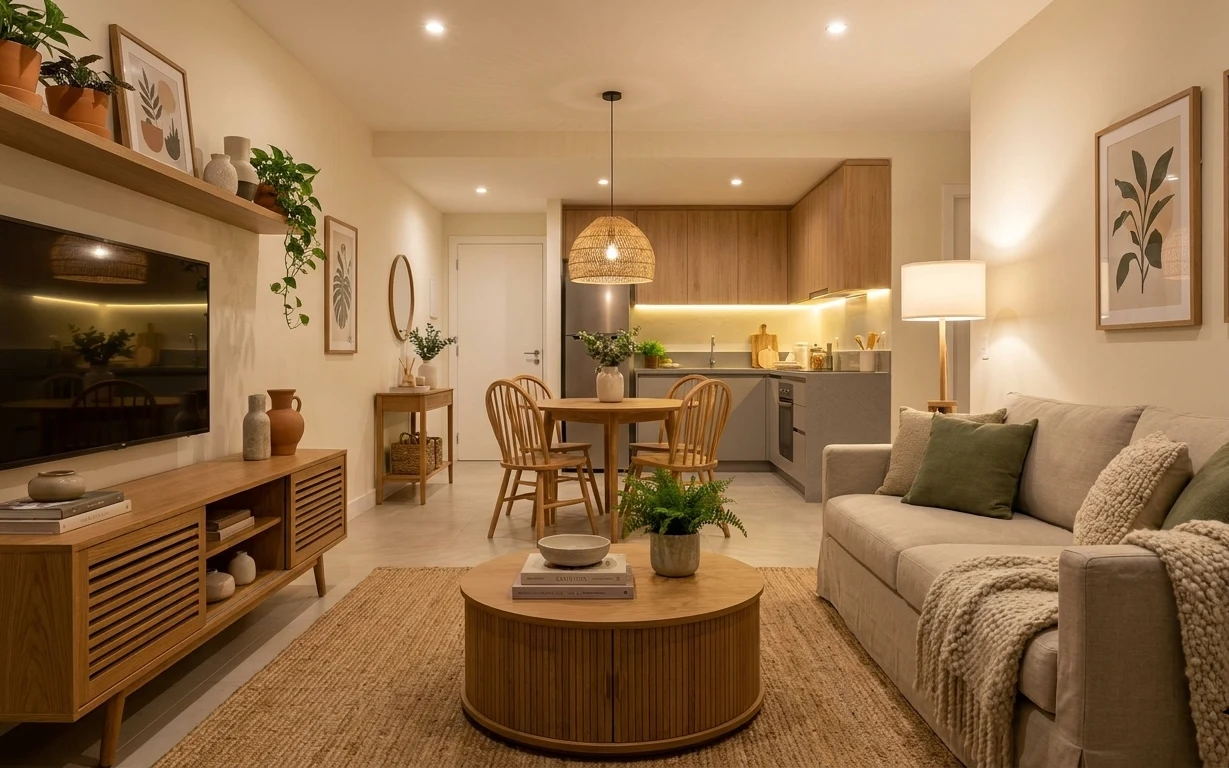
Under $700: a homeowner's warm-modern living room refresh with seven plant-forward layers
A complete seven-layer homeowner refresh for a small open-plan living room — cream sofa with olive pillows, a refinished thrifted brass flo…
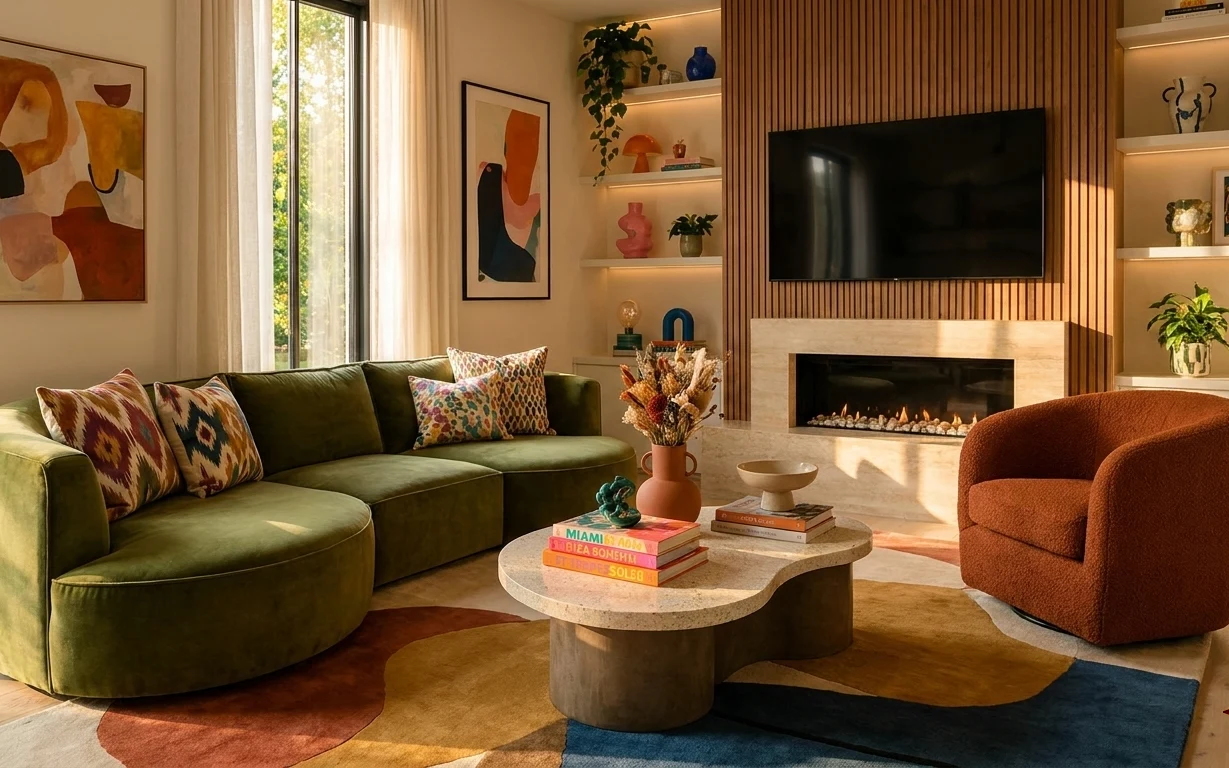
Under $600: eclectic living room swaps that look settled
A warm, olive-and-rust living room look—made renter-friendly with 7 movable swaps. Plan for about $600 total and focus on rug scale, layere…
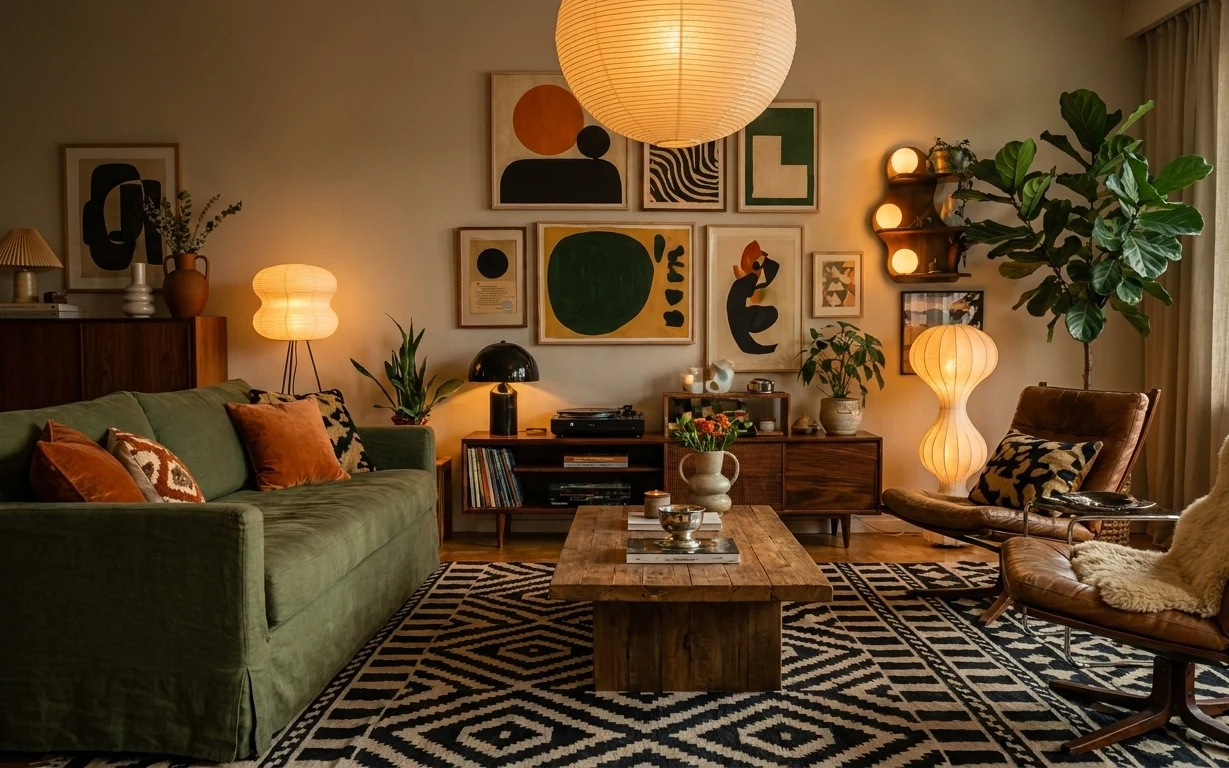
Under $600: olive-and-tan living room refresh with 7 renter swaps
A renter-friendly living room refresh inspired by olive-and-tan styling: a bold patterned rug, warm lamps, a tray-and-candle coffee table m…