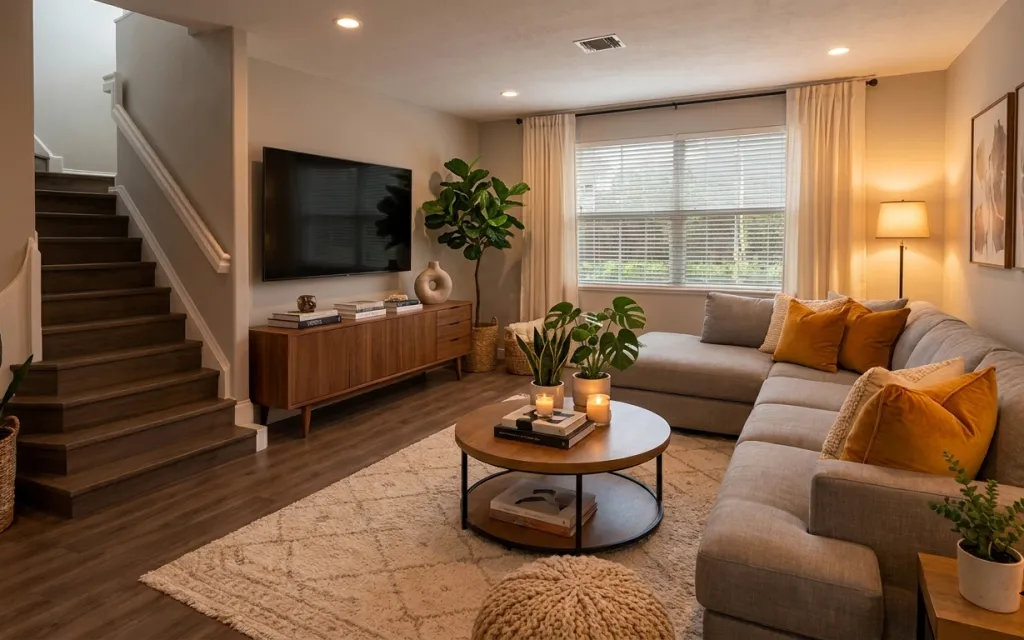
- Best for
- weekend refresh that feels cohesive
- Cost
- $770 total
- Difficulty
- Easy
- Time
- 1 weekend
Why this warm beige-and-amber palette is the living room of 2026
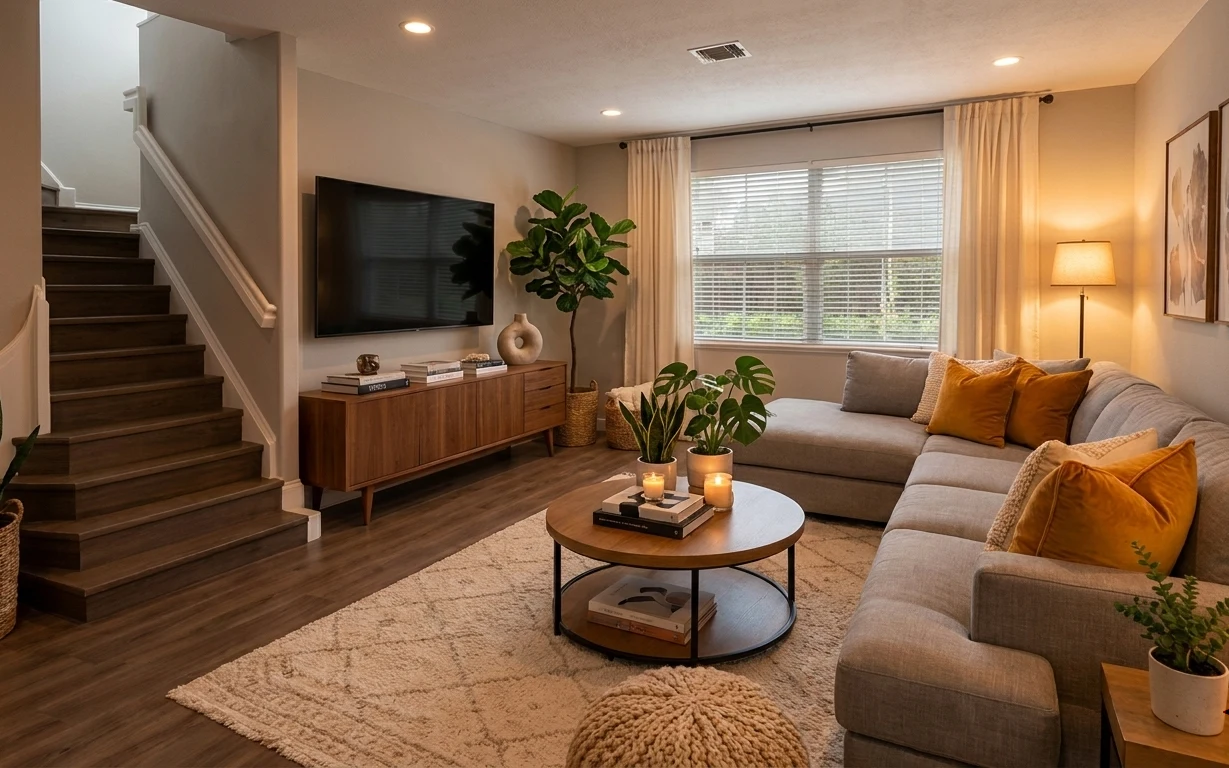
The quickest way to make a living room feel “done” is to give your eyes a consistent rhythm: soft floor underfoot, hanging fabric at the window, and warm light at sofa height. In this setup, the cream area rug anchors the dark wood floor, while beige curtain panels add vertical calm. The gray sectional sofa stays neutral, and the mustard and tan throw pillows do the work of adding color without turning the room loud. You can see the warmth also comes from textures—linen-like curtains, a wood coffee table, and the glow from a beige-shade table lamp.
I used to treat pillows and art like the last step—like the room would somehow “hold itself together” until the end. Then I moved into a place where the lighting was harsh and the rug was the wrong size, and nothing else mattered. This is the order that finally clicked for me: rug and curtains first, then warmth (lamp), then color hits (pillows), and finally one framed detail you can look at from the sofa.
Layer 1 — cream area rug ($150) anchors the whole floor in one move
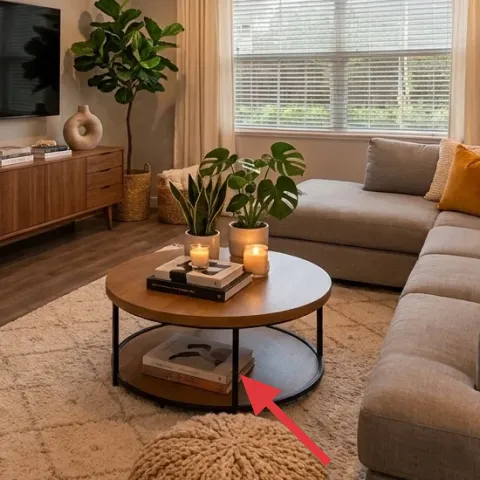
A cream area rug under the sofa and coffee table is what turns a dark wood floor from “bare and busy” into a calm base. The important part is scale: the rug here sits wide enough that the coffee table and sofa feel tied to the same zone. If you go smaller, you end up with a rug that looks decorative instead of structural. I’d rather buy one right-sized rug than add more small decor, because it changes how everything lands—pillows, curtains, and even the way the room reflects light.
Match rug-to-sofa proportions, not rug-to-room proportions
Pull the rug so at least the front legs of the sofa feel “supported,” then let the rest of the room breathe beyond it.
Layer 2 — beige curtain panels ($90) add vertical softness without changing the paint
Beige curtain panels make this living room feel warmer because they add a continuous fabric band across the window, which softens the whole wall. The tone is also doing double duty: it picks up the beige-y warmth of the lamp light, so the room doesn’t feel washed-out when the sun goes down. A common alternative is switching to a heavier printed curtain, but prints tend to fight the other neutrals. Keep it simple—choose a light-filtering beige and hang with enough height above the window to lengthen the space.
Sheer-to-light-filtering is the sweet spot
If the curtains block all light, the room reads darker; if they’re too see-through, they lose that layered, polished look.
Layer 3 — round wood coffee table with black legs ($160) creates a friendly “landing circle”
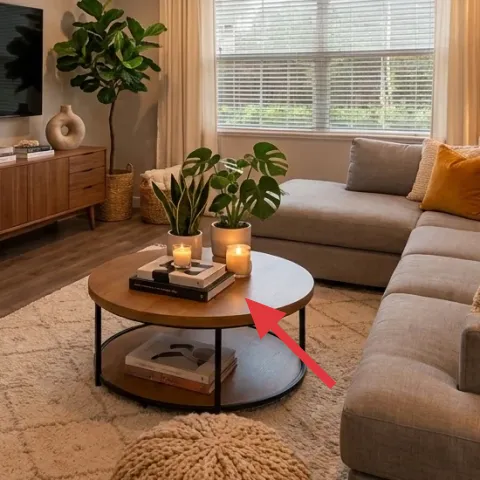
A round wood coffee table with black legs keeps traffic easy and visually breaks up the sharp lines of a sectional. In this photo, the shape also pairs well with the circular candle group on top—curves repeat without needing more clutter. You could replace it with a rectangular coffee table, but that often makes the middle of the room feel busier, especially when the media console and TV already bring in strong horizontal lines. The black legs are a smart trade-off: they ground the lighter wood without making the table look heavy.
Use the tabletop as a mini-styling “set”
Stick to a small stack (books) plus 2–3 candles so the table looks styled even when you’re not actively decorating.
Layer 4 — throw pillows in mustard and tan ($60) add color you can swap seasonally
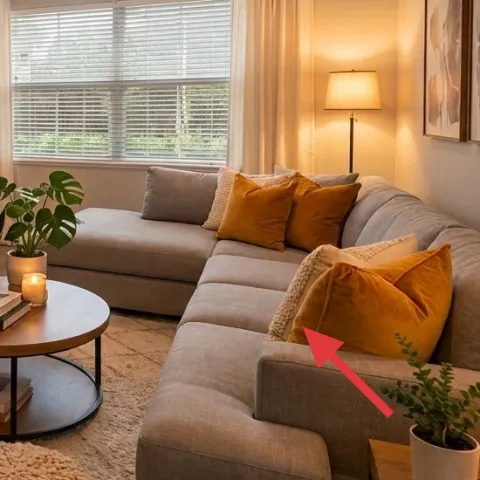
Mustard and tan throw pillows are the easiest way to bring warmth into a gray-and-beige base. The color choice works because it stays within the same family as the lamp’s honey tone and the curtain beige, so the room reads cohesive rather than “random accent pieces.” The alternative is one big patterned pillow, but then you’re stuck designing the rest of the room around it. Here, the pillows behave like punctuation—small enough to change quickly, yet noticeable enough to make the sofa feel finished.
Don’t let all pillows match in intensity
If every cushion is the same saturation, the sofa looks flat. Mix one warmer accent (mustard) with more muted tones (tan/neutral).
Layer 5 — wood media console with open shelf ($180) makes the TV wall feel intentional
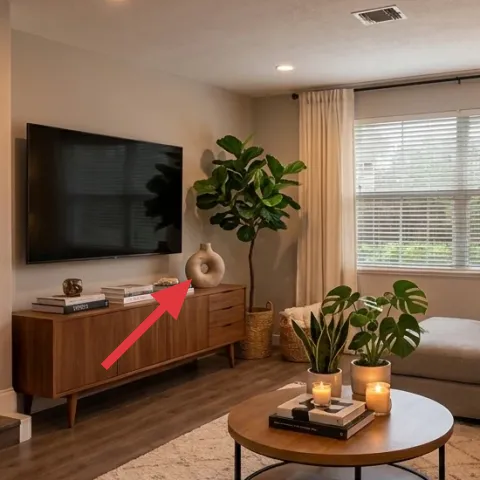
The wood media console with open shelf gives the TV wall warmth and depth, which is especially helpful when the room has white trim and a lot of soft neutrals. It also creates practical styling space: the open shelf is where books and small objects can live without crowding the tabletop. If you skip this and rely only on wall décor, the TV area can feel like a sticker-on detail. A good trade-off is accepting that the console will need occasional rearranging—open shelves look best when they’re edited, not packed.
Leave a little negative space on the shelf
One vase or one small stack of books per side reads cleaner than filling every inch.
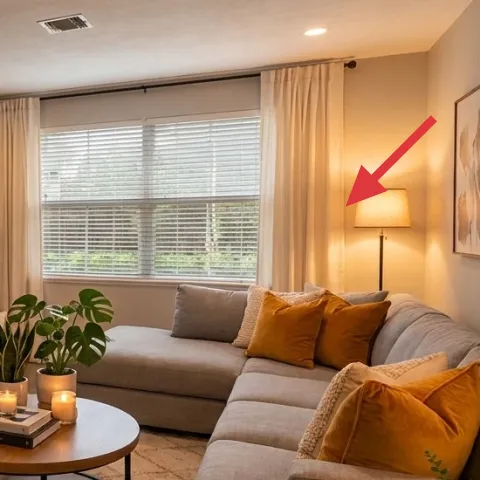
Layer 6 — table lamp with beige shade ($85) warms up the room after dark
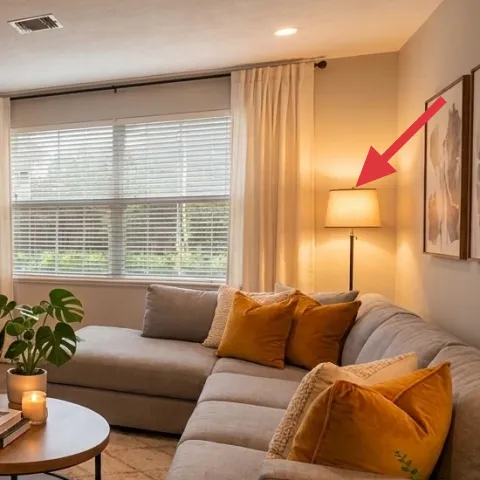
A table lamp with a beige shade is doing more than lighting—it’s setting the mood. The lamp’s warm glow brings the mustard pillows and curtain beige into the same temperature, so the room feels connected instead of split between “cool daylight” and “yellow lamp.” A ceiling-only light would flatten the sofa and make corners feel harsher. I’d choose a smaller lamp over a brighter one, then use it consistently with fewer overhead bulbs. The goal is soft pools of light at the height you sit.
Place the lamp where it hits the sofa back
If the light only reaches the floor, the sofa reads dim even when the bulb is on.
Layer 7 — framed wall art prints ($45) lets you DIY one “anchor” detail
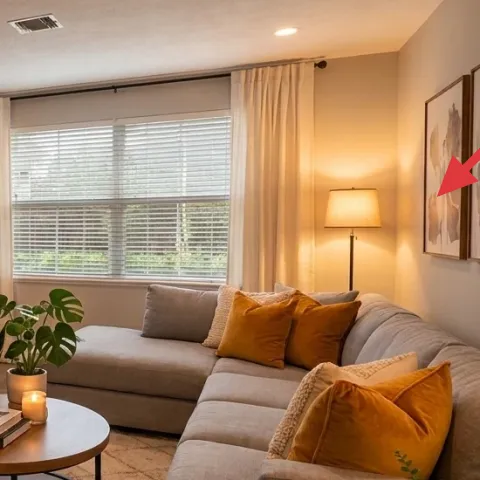
The framed wall art prints on the right wall keep this living room from feeling like all neutrals with no focal point. In photos like this, one framed piece beats a scattered set, because it gives the eye somewhere to rest when you’re looking from the sofa. The trade-off is that the frame matters—cheap frames can look fine in daylight and off at night. That’s why this is a great DIY target: paint only the frame, keep the print, and you can tune the finish (matte, wood-tone, or a darker accent) to match your rug and lamp.
Make it instead of buying it
Paint the frame on one framed wall art print so it matches the warm tones in the rug and lamp without replacing the art.
Materials
- Bonding primer — 1 can — hardware store — $20
- Painter’s tape — 1 roll — hardware store — $6
- Fine-grit sandpaper (180–220) — 1 pack — hardware store — $5
- Small foam roller/brush set — 1 set — craft store — $4
- Clean cloths — 1 pack — grocery store — $0
Steps
- Remove the frame from the wall and take out the paper backing.
- Lightly scuff the frame with 180–220 sandpaper to help primer grip.
- Wipe dust off with a dry cloth.
- Mask the print edges and any glass trim with painter’s tape.
- Apply bonding primer in thin, even coats.
- Let primer dry fully, then do a quick light sanding for smoothness.
- Paint on your chosen color in thin coats using a foam roller or brush.
- Allow the final coat to dry overnight before reassembling and rehanging.
- Reinstall the frame carefully, avoiding fingerprints on the glass.
Total DIY cost: $35 — saves about $10 over buying.
The cost, layer by layer
| Layer | Item | Cost |
|---|---|---|
| 1 | Cream area rug (5×7) | $150 |
| 2 | Beige curtain panel pair (84") | $90 |
| 3 | Round wood coffee table with black legs | $160 |
| 4 | Throw pillow set (mustard and tan) | $60 |
| 5 | Wood media console with open shelf | $180 |
| 6 | Table lamp with beige shade | $85 |
| 7 | Framed wall art print (DIY frame paint) | $45 |
| Total | $770 | |
If your rug budget is tight, choose a smaller 5×7 style in a similar cream tone and add a rug pad for grip. Keep the curtain panels in beige and use the table lamp as your warmth source, so the room still reads layered, not sparse.
What worked, what didn't (across the whole room)
This refresh works because the big visual changes happen where your eyes actually land: the rug zone, the window fabric, and the warm lamp. The smaller details—pillows and framed art—then finish the sofa-and-TV area without fighting the neutral palette.
What worked
- The cream area rug gives the dark wood floor a soft boundary under the coffee table.
- Beige curtain panels add height and texture even when the TV wall is busy.
- The round coffee table shape keeps the center open and makes the room feel less crowded.
- Mustard and tan throw pillows bring warmth without needing a patterned overhaul.
- The wood media console makes the TV wall feel like furniture, not an appliance.
- The beige-shade table lamp keeps the room’s color temperature cohesive after dark.
What didn't
- Going with a smaller rug would have made the sofa zone look disconnected from the coffee table.
- Skipping curtain height (hanging at the window trim) would have shortened the visual ceiling.
- Over-styling the coffee table with too many objects would have competed with the TV console.
- Using only gray pillows would have left the sofa feeling flat against the warm walls.
- Picking a cool-toned lamp shade would have fought the beige curtains and mustard accents.
What we'd skip if we did it again
Skip replacing everything at once. Start with the cream area rug and beige curtain panels, because those two set the floor-and-window foundation that the rest of the styling depends on.
Skip a rectangular coffee table if your layout encourages walking paths. In a room like this, the round top keeps the center feeling open and makes styling easier to balance.
Skip buying a new framed piece if the print still works. Painting just the frame is the faster, cheaper fix—and it’s the detail that most clearly updates the look in this exact warm palette.
Frequently asked
How long does this living room refresh take?
If you’re sourcing items ahead of time, most of the look is a 1-weekend project: rug placement, hanging curtain panels, and swapping pillow styling can be done in a day or two. The frame DIY is the only slower part; even with dry times, you can still keep the rest moving while the paint sets. Plan for a couple of hours for careful measuring and rehanging the art so it sits at a comfortable height from the sofa.
Can this work if I rent?
Yes, with a few swaps. Choose a tension rod or a standard curtain rod that doesn’t require wall damage, and keep the framed art option to free-standing frames or removable hooks. The rug, pillows, and table lamp are fully renter-friendly. If you can’t paint the frame, you can buy a ready-made frame in a warm finish or paint a separate thrifted frame off-site and swap it in.
What if my living room is smaller than this one?
Go slightly smaller on the coffee table scale and keep the rug proportion rule: the rug should still be large enough that the sofa’s front legs feel anchored on it. For curtains, hang high to preserve the vertical look, and use lighter beige fabric so daylight doesn’t get swallowed. Pillows can be fewer—two to four maximum—so the sofa reads styled instead of crowded.
What if my living room has more natural light?
More light can handle slightly richer accents. Keep the cream rug and beige curtains, then consider adding a deeper mustard pillow or a darker lamp base finish if your walls run cooler. The main idea stays the same: use the lamp and warm accents to maintain color temperature consistency after dark, even if the daytime brightness is already strong.
Where should I shop if I want this exact warm beige look?
Look for the rug and curtains first, because those set the color temperature. For the coffee table and media console, prioritize warm wood tones with simple lines, then let pillows and art add the mustard warmth. Hardware stores and craft stores are great for the frame DIY supplies. If you’re buying used, focus on condition of the table top, lamp shade, and rug fibers.
What’s the biggest mistake people make with this kind of room?
The biggest mistake is treating the rug like a finishing accessory instead of a structural anchor. If it’s too small, it won’t visually connect the sofa and coffee table, and the whole room starts to look staged rather than lived-in. The second mistake is hanging curtains too low; low curtains shorten the ceiling and flatten the window wall.
More in Living Room
Under $800: warm beige living room refresh with 7 layers
A warm beige-and-gray living room refresh you can finish in a weekend. This $800 plan uses 7 visible upgrades—rug, curtains, coffee table s…
Under $700: earthy living room sofa corner refresh with 7 layers
A warm, boho living room sofa corner starts with cream-and-terracotta textiles, then gets anchored by a rug, curtains, and one statement wa…
Under $800: weekend refresh for a teal sofa living room
A teal-sofa living room with brass pendants, sheer curtains, and a beige rug can feel polished fast. This weekend plan uses 7 visible swaps…